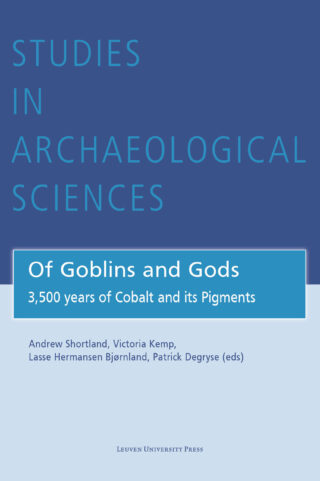

Of Goblins and Gods
3,500 years of Cobalt and its Pigments
Andrew J. Shortland (Editor), Victoria Kemp (Editor), Lasse Hermansen Bjørnland (Editor), Patrick Degryse (Editor),

Series: Studies in Archaeological Sciences 9
Category: Archaeology
Language: English
ISBN: 9789462704985
Publication date: February 25, 2026
€80.00 (including 6% VAT)
Buy NowNumber of pages: 300
Size: 234 x 156 x 16 mm
Number of illustrations: 100

Stock item: 170423
Standard delivery time for print books:
For Belgium: 5 to 8 working days
For EU: 2 to 3 weeks
For other countries: 4 to 5 weeks
Series: Studies in Archaeological Sciences 9
Category: Archaeology
Language: English
ISBN: 9789461667090
Publication date: February 25, 2026
Download Free EpubNumber of pages: 300
Number of illustrations: 100
Series: Studies in Archaeological Sciences 9
Category: Archaeology
Language: English
ISBN: 9789461667083
Publication date: February 25, 2026
Download Free PDFNumber of pages: 300
Number of illustrations: 100
The historical and technological significance of cobalt and its compounds
Cobalt: named after goblins, allotted to gods.
Cobalt and its compounds have had a long and important part to play in history. Metallic cobalt is a modern innovation, vital in the green energy transition. However, cobalt compounds have been used for 3,500 years to create deep-blue pigments, featuring in many important works of art and religious artefacts, associated with heaven, eternity and the divine. Cobalt ores are rare, and their exploitation is a dangerous pursuit. Their co-occurrence with arsenic has led to severe health consequences for workers, which were blamed on supernatural spirits and goblins, “kobolds”, from which the name cobalt is derived. Of Goblins and Gods discusses the state-of-the-art of the extraction and use of cobalt ores through history, alongside the technology involved in making and applying cobalt pigments in many man-made materials across all regions and periods, from the Death Mask of Tutankhamun and pre-Islamic tiles to Indian manuscripts and the windows of Canterbury Cathedral.
Preface
Part 1 — Cobalt through the ages
Chapter 1
Cobalt: Of goblins and gods
Andrew J. Shortland
Chapter 2
Cobalt through the ages, illustrated through a selection of objects demonstrating its use
Andrew J. Shortland
Part 2 — Sources and signatures
Chapter 3
Norwegian cobalt production and uses
Lasse Hermansen Bjørnland
Chapter 4
Provenancing smalt: The potential of geological analysis
Patrick Degryse and Andrew J. Shortland
Chapter 5
Variations in the chemical signatures of cobalt colourants used in glass from the 17th to the early 20th centuries
Bernard Gratuze
Chapter 6
The cobalt mine at Kashan, Iran: A brief overview of its history, from the pre- Mongol period to the early 20th century
Moujan Matin
Chapter 7
Cobalt mining at Alderley Edge, Cheshire, UK
Nigel Dibben
Part 3 — Applications
Chapter 8
Cobalt in Late Bronze Age glassmaking: Insights from archaeometric analyses and case studies
Victoria Kemp and Andrew J. Shortland
Chapter 9
Early Islamic cobalt-blue glass: Colourant and matrix
Nadine Schibille
Chapter 10
Smalt and other blues in painting from South Asia and Iran
Katherine Eremin, Penley Knipe, Georgina Rayner, Jinah Kim, Richard Newman, Erin Mysak and Michelle Derrick
Chapter 11
The use of cobalt on Chinese ceramics from the 7th to 20th centuries CE
Yun Zhang and A. Mark Pollard
Chapter 12
Light and dark blue: A non-destructive analysis of blue enamel and underglaze compositions in Fürstenberg porcelains
Dennis Braekmans, Jens Storre, Christian Lechelt, Rosa Seepma and Andrew J. Shortland
Andrew J. Shortland
Andrew J. Shortland is Professor of Archaeological Science at Cranfield University, working on the identification and interpretation of material culture from the ancient and historical worlds.
Victoria Kemp
Victoria Kemp is a postdoctoral research assistant at the Ashmolean Museum, applying surface imaging techniques and compositional analysis to study painting materials and techniques.
Lasse Hermansen Bjørnland
Lasse Hermansen Bjørnland is historian and museum pedagogist, working at the Norwegian Blue Colour Works.
Patrick Degryse
Patrick Degryse is Professor of Archaeometry at KU Leuven, studying the history and use of mineral resources in ancient technology.
This work will become a scholarly standard reference, as it explores the subject with the latest insights from various research disciplines, encompassing both the natural sciences and the humanities. - Wim De Clercq, University of Ghent
Frequently Asked Questions
What is "Of Goblins and Gods" about?
The historical and technological significance of cobalt and its compounds
Cobalt: named after goblins, allotted to gods.
Cobalt and its compounds have had a long and important part to play in history. Metallic cobalt is a modern innovation, vital in the green energy transition. However, cobalt compounds have been used for 3,500 years to create deep-blue pigments, featuring in many important works of art and religious artefacts, associated with heaven, eternity and the divine. Cobalt ores are rare, and their exploitation is a dangerous pursuit. Their co-occurrence with arsenic has led to severe health consequences for workers, which were blamed on supernatural spirits and goblins, “kobolds”, from which the name cobalt is derived. Of Goblins and Gods discusses the state-of-the-art of the extraction and use of cobalt ores through history, alongside the technology involved in making and applying cobalt pigments in many man-made materials across all regions and periods, from the Death Mask of Tutankhamun and pre-Islamic tiles to Indian manuscripts and the windows of Canterbury Cathedral.
Who wrote "Of Goblins and Gods"?
"Of Goblins and Gods" was written by Dennis Braekmans, Michelle Derrick, Nigel Dibben, Katherine Eremin, Bernard Gratuze, Jinah Kim, Penley Knipe, Christian Lechelt, Moujan Matin, Erin Mysak, Richard Newman, Mark Pollard, Georgina Rayner, Nadine Schibille, Jens Storre and Yun Zhang.
Mark Pollard is Edward Hall Professor of Archaeological Science at the Research Laboratory for Archaeology, School of Archaeology, University of Oxford, and PI on the ERC Advanced Grant ‘FLAME’.
Nadine Schibille is a senior researcher in art history and archaeometry in the Institut de recherche sur les archéomatériaux (IRAMAT-CEB) at the French National Centre for Scientific Research (CNRS).
Who edited "Of Goblins and Gods"?
"Of Goblins and Gods" was edited by Andrew J. Shortland, Victoria Kemp, Lasse Hermansen Bjørnland and Patrick Degryse.
Andrew J. Shortland is Professor of Archaeological Science at Cranfield University, working on the identification and interpretation of material culture from the ancient and historical worlds.
Victoria Kemp is a postdoctoral research assistant at the Ashmolean Museum, applying surface imaging techniques and compositional analysis to study painting materials and techniques.
Lasse Hermansen Bjørnland is historian and museum pedagogist, working at the Norwegian Blue Colour Works.
Patrick Degryse is Professor of Archaeometry at KU Leuven, studying the history and use of mineral resources in ancient technology.
Is "Of Goblins and Gods" part of a series?
Yes, "Of Goblins and Gods" is part of the "Studies in Archaeological Sciences" series. It's book 9 in the series.
Studies in Archaeological Sciences presents state-of-the-art methodological, technical or material science contributions to Archaeological Sciences. The series aims to reconstruct the integrated story of human and material culture through time and testifies to the necessity of inter- and multidisciplinary research in cultural heritage studies. Studies in Archaeological Sciences aims to publish at least one volume a year and accepts monographs as well as coherent edited volumes in English. Contributions should be set up to be a specialist reference work for a broad audience of academic readers. Manuscript should be 80.000 to 120.000 words in length and may include graphs and tables in black and white. All contributions are submitted to international peer review.

Readership
Researchers and graduate students in fields such as Archaeology, Archaeological Sciences, History, Conservation and Cultural Heritage Studies and Museum Sciences.
Editor-in-Chief
Prof. Patrick Degryse, Centre for Archaeological Sciences, KU Leuven, Belgium
Editorial Board
Prof. Dennis Braeckmans, Department of Archaeological Sciences, Universiteit Leiden, The Netherlands
Prof. Ian Freestone, Institute of Archaeology, University College London, United Kingdom
Dr. Andrew Meek, Department of Scientific Research, The British Museum
Dr. Andrew Shortland, Centre for Archaeological and Forensic Analysis, Cranfield University, United Kingdom
Prof. Manuel Sintubin, Department of Earth & Environmental Sciences, KU Leuven, Belgium
Invitation to future Advisory Board members
Scholars interested to join the Advisory Board of this new series are cordially invited to contact Prof. Patrick Degryse (Editor-in-Chief) or one of the editorial board members.
Proposals
Proposals and inquiries can be sent to to editor-in- chief Patrick Degryse or one of the editorial board members. Please send a preliminary abstract (1-2 pp.) and a short bio. Upon approval of this abstract (average turnaround time of 4 weeks), the full manuscript will be submitted to international peer review. Two peer reviewers will be asked for expert advice, three in case of conflicting reports.
Please make use of the submission form to present your manuscript or proposal to our board.
Authors interested in Open Access can consult the available funding options.
Links & Resources
Is "Of Goblins and Gods" available Open Access?
Yes, "Of Goblins and Gods" is published Open Access. It is available under a BY-NC-ND license.
What is the Table of Contents for "Of Goblins and Gods"?
Preface
Part 1 — Cobalt through the ages
Chapter 1
Cobalt: Of goblins and gods
Andrew J. Shortland
Chapter 2
Cobalt through the ages, illustrated through a selection of objects demonstrating its use
Andrew J. Shortland
Part 2 — Sources and signatures
Chapter 3
Norwegian cobalt production and uses
Lasse Hermansen Bjørnland
Chapter 4
Provenancing smalt: The potential of geological analysis
Patrick Degryse and Andrew J. Shortland
Chapter 5
Variations in the chemical signatures of cobalt colourants used in glass from the 17th to the early 20th centuries
Bernard Gratuze
Chapter 6
The cobalt mine at Kashan, Iran: A brief overview of its history, from the pre- Mongol period to the early 20th century
Moujan Matin
Chapter 7
Cobalt mining at Alderley Edge, Cheshire, UK
Nigel Dibben
Part 3 — Applications
Chapter 8
Cobalt in Late Bronze Age glassmaking: Insights from archaeometric analyses and case studies
Victoria Kemp and Andrew J. Shortland
Chapter 9
Early Islamic cobalt-blue glass: Colourant and matrix
Nadine Schibille
Chapter 10
Smalt and other blues in painting from South Asia and Iran
Katherine Eremin, Penley Knipe, Georgina Rayner, Jinah Kim, Richard Newman, Erin Mysak and Michelle Derrick
Chapter 11
The use of cobalt on Chinese ceramics from the 7th to 20th centuries CE
Yun Zhang and A. Mark Pollard
Chapter 12
Light and dark blue: A non-destructive analysis of blue enamel and underglaze compositions in Fürstenberg porcelains
Dennis Braekmans, Jens Storre, Christian Lechelt, Rosa Seepma and Andrew J. Shortland
Related titles
 German–Rapanui Entanglements
Cristián Moreno Pakarati (Editor), Diego Muñoz (Editor), Philipp Schorch (Editor),
August 2026
 Modern Etruscans
Chiara Zampieri (Editor), Martina Piperno (Editor), Bart Van den Bossche (Editor),
October 2023
 The Elemental Analysis of Glass Beads
Laure Dussubieux (Editor), Heather Walder (Editor),
October 2022
 Mapping Landscapes in Transformation
Thomas Coomans (Editor), Bieke Cattoor (Editor), Krista De Jonge (Editor),
June 2019
 The Lower to Middle Palaeolithic Transition in Northwestern Europe
Ann Van Baelen (Author),
October 2017
 Minoan Earthquakes
Simon Jusseret (Editor), Manuel Sintubin (Editor), Jan Driessen (Preface by),
April 2017
 Handheld XRF for Art and Archaeology (paperback)
Aaron N. Shugar (Editor), Jennifer L. Mass (Editor),
November 2013
 Handheld XRF for Art and Archaeology
Aaron N. Shugar (Editor), Jennifer L. Mass (Editor),
March 2013
 Chert Quarrying, Lithic Technology, and a Modern Human Burial at the Palaeolithic Site of Taramsa 1, Upper Egypt
Philip Van Peer (Author), Pierre M. Vermeersch (Author), Etienne Paulissen (Author),
April 2010
 Isotopes in Vitreous Materials
Patrick Degryse (Editor), Julian Henderson (Editor), Greg Hodgins (Editor),
March 2013
 Etude anthropologique du squelette du Paléolithique supérieur de Nazlet Khater 2 (Egypte)
Isabelle Crevecoeur (Author),
December 2008
 A Holocene Prehistoric Sequence in the Egyptian Red Sea Area: The Tree Shelter
Pierre M. Vermeersch (Editor),
July 2008