

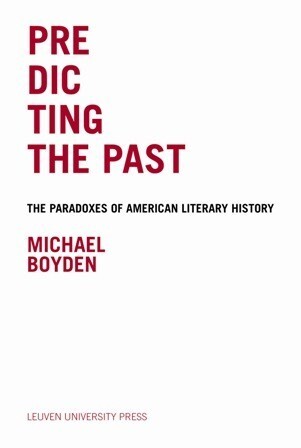

Predicting the Past
The Paradoxes of American Literary History
Michael Boyden (Author),

Drawing from the social theories of Niklas Luhmann and Mary Douglas, Predicting the Past advocates a reflexive understanding of the paradoxical institutional dynamic of American literary history as a professional discipline and field of study. Contrary to most disciplinary accounts, Michael Boyden resists the utopian impulse to offer supposedly definitive solutions for the legitimation crises besetting American literature studies by “going beyond” its inherited racist, classist, and sexist underpinnings. Approaching the existence of the American literary tradition as a typically modern problem generating diverse but functionally equivalent solutions, Boyden argues how its peculiarity does not, as is often supposed, reside in its restrictive exclusivity but rather in its massive inclusivity which drives it to constantly revert to a self-negating “beyond” perspective. Predicting the Past covers a broad range of both well-known and lesser known literary histories and reference works, from Rufus Griswold’s 1847 Prose Writers of America to Sacvan Bercovitch’s monumental Cambridge History of American Literature. Throughout, Boyden focuses on particular themes and topics illustrating the selfinduced complexity of American literary history such as the early “Anglocentric” roots theories of American literature; the debate on contemporary authors in the age of naturalism; the plurilingual ethnocentrism of the pioneer Americanists of the mid-twentieth century; and the genealogical misrepresentation of founding figures such as Jonathan Edwards, Emily Dickinson, and Robert Lowell.
Introduction
• A Forensic Approach to American Literary History
• Revisiting the “End” of American Literature
• Outline of the Chapters
The “Pre-History” of American Literat ure: Early Prospects (1850-1910)
• The Future of an Illusion
• Nationalizing the Past
• The Rhetoric of Race
• Teaching and Preaching
• Why Textbooks (Never) Lie
• The Taboo on Provincialism
Live and Let Live: Debati ng Contemporary Literat ure (1890-1930)
• Explaining Antiquarianism
• The Temptations of the Flesh
• Culture and Scholarship
• Explaining Anti-Antiquarianism
• Historians of the Present
• Facts and Factors
The Uses of Language: Literary Polyvocality and Ethnic Continuity (1880-1950)
• Legends about Language in the U.S.
• Dequarantining “American” Languages
• The Continuation of “Anglocentrism continued”
• The Languages of P(l)ur(al)ism
• The Limits of Cosmopolitanism
• America as a “Unipolar” Culture?
Precursors and Exemplars: Genealogies in American Literary History
• The Priority of Jonathan Edwards
• Multiple Awakenings
• The Dickinson Myth
• How Dickinson Became an Intolerable Woman Author
• The (Not So) Personal Voice: The Confessional Poets
• The Matthew Effect
Conclusion: Nothing Realy Ends
Even so, a book that throws light on the long history of ideological self-righteousness that has driven American literature and culture studies is hard not to like.
Peter Carafiol, Portland State University, Modern Language Quarterly, December 2011
In this insightful and accessible analysis, Boyden reveals the complex ways U.S. literary historians have constructed narratives of national identity and culture that conceal crucial elements of the story. This is an engaging, groundbreaking study of an influential historical form.
Emory Elliott, General Editor, Columbia Literary History of the United States
A member of the new generation of international Americanists deeply familiar with America's institutions, myths, and imaginaries, Boyden ably illustrates the productive possibilities of practicing American Studies as a non-American Americanist.
Djelal Kadir, Founding President, International American Studies Association
A brilliant account of how American literature has systematically internalized the conception of utopian alternatives, so that the projected future of the subject is tied inexorably to its past. Predicting the Past is a major theoretical contribution to the internationalization of the field.
Paul Giles, Professor of American Literature, Oxford University
The strengths of Boyden's work include first of all a comprehensive knowledge not only of American literature, but also of its primary theorists and historiographers, from the Duyckinck brothers to Saevan Bercovitch, David Shumway, Werner Sollors, and Elizabeth Renker. Boyden adds to this an expert negotiation of vexed matters of literary value, in this case not to privilege the status of value or establish literary hierarchies, but to futther a discussion about how the question ofvalue functions within larger intellectual debates. Part of this negotiation involves an impressive series of micro-historical investigations associated with hotly debated critical issues such as the right way to frame Emily Dickinson or confessional poetry.
Ronald Bush, Oxford University
In this remarkable book, Boyden argues that American literary history constitutes a literary technology for the construction of a past that answers the needs of the present. Boyden's critical genealogy of the discipline of American literary history promises to become a benchmark text.
Donald E. Pease, Director of the Futures of American Studies Institute, Dartmouth College
Frequently Asked Questions
What is "Predicting the Past" about?
Drawing from the social theories of Niklas Luhmann and Mary Douglas, Predicting the Past advocates a reflexive understanding of the paradoxical institutional dynamic of American literary history as a professional discipline and field of study. Contrary to most disciplinary accounts, Michael Boyden resists the utopian impulse to offer supposedly definitive solutions for the legitimation crises besetting American literature studies by “going beyond” its inherited racist, classist, and sexist underpinnings. Approaching the existence of the American literary tradition as a typically modern problem generating diverse but functionally equivalent solutions, Boyden argues how its peculiarity does not, as is often supposed, reside in its restrictive exclusivity but rather in its massive inclusivity which drives it to constantly revert to a self-negating “beyond” perspective. Predicting the Past covers a broad range of both well-known and lesser known literary histories and reference works, from Rufus Griswold’s 1847 Prose Writers of America to Sacvan Bercovitch’s monumental Cambridge History of American Literature. Throughout, Boyden focuses on particular themes and topics illustrating the selfinduced complexity of American literary history such as the early “Anglocentric” roots theories of American literature; the debate on contemporary authors in the age of naturalism; the plurilingual ethnocentrism of the pioneer Americanists of the mid-twentieth century; and the genealogical misrepresentation of founding figures such as Jonathan Edwards, Emily Dickinson, and Robert Lowell.
Who wrote "Predicting the Past"?
"Predicting the Past" was written by Michael Boyden.
Michael Boyden is Assistant Professor of American Literature and Culture at the Department of Translation Studies of University College Ghent, Belgium.
Is "Predicting the Past" available Open Access?
Yes, "Predicting the Past" is published Open Access. It is available under a BY-NC-ND license.
What is the Table of Contents for "Predicting the Past"?
Introduction
• A Forensic Approach to American Literary History
• Revisiting the “End” of American Literature
• Outline of the Chapters
The “Pre-History” of American Literat ure: Early Prospects (1850-1910)
• The Future of an Illusion
• Nationalizing the Past
• The Rhetoric of Race
• Teaching and Preaching
• Why Textbooks (Never) Lie
• The Taboo on Provincialism
Live and Let Live: Debati ng Contemporary Literat ure (1890-1930)
• Explaining Antiquarianism
• The Temptations of the Flesh
• Culture and Scholarship
• Explaining Anti-Antiquarianism
• Historians of the Present
• Facts and Factors
The Uses of Language: Literary Polyvocality and Ethnic Continuity (1880-1950)
• Legends about Language in the U.S.
• Dequarantining “American” Languages
• The Continuation of “Anglocentrism continued”
• The Languages of P(l)ur(al)ism
• The Limits of Cosmopolitanism
• America as a “Unipolar” Culture?
Precursors and Exemplars: Genealogies in American Literary History
• The Priority of Jonathan Edwards
• Multiple Awakenings
• The Dickinson Myth
• How Dickinson Became an Intolerable Woman Author
• The (Not So) Personal Voice: The Confessional Poets
• The Matthew Effect
Conclusion: Nothing Realy Ends
What is the DOI for "Predicting the Past"?
The Digital Object Identifier (DOI) for "Predicting the Past" is 10.11116/9789461664310.
Related titles
 The Romero Memory
Judith Gruber (Editor), Jonas Van Mulder (Editor), Stephan Parmentier (Editor), Veerle Draulans (Editor), Joren Janssens (Editor), Jacques Haers (Editor), Kim Christiaens (Editor),
December 2026
 Feminists Resisting Gendered Violence
Hemangini Gupta (Editor), Fiona Mackay (Editor), Jan Breckenridge (Editor), Louise Chappell (Editor), Rachna Mehra (Editor), Rukmini Sen (Editor), Mailin Suchting (Editor),
October 2026
 Affect in Translation and Interpreting
Sofía Monzón (Editor), Lucie Spezzatti (Editor), Elisabeth Goemans (Editor),
May 2026
 Research Methods in Literary Reception Studies
Jeroen Dera (Editor), Anne Oerlemans (Editor), Frederik Van Dam (Editor),
May 2026
 Political Exile in the Global Twentieth Century
Wolfram Kaiser (Editor), Piotr H. Kosicki (Editor),
April 2026
 Comics and the Global South
Andrea Aramburú (Editor), Dibyadyuti Roy (Editor), Joe Sutliff Sanders (Editor),
February 2026

 Situatedness and Performativity
Raquel Pacheco Aguilar (Editor), Marie-France Guénette (Editor),
November 2025
 Transfer Thinking in Translation Studies
Maud Gonne (Editor), Klaartje Merrigan (Editor), Reine Meylaerts (Editor), Heleen van Gerwen (Editor),
September 2025

 The Visionary Art of Franco-Belgian Comics, 1930s to 1960s
Hugo Frey (Editor), Maaheen Ahmed (Editor),
September 2025
 Superhero Comics and Scottish Identity
David John Boyd (Author), Julie Briand-Boyd (Author),
July 2025
 Cross-Cultural Heritage
Jonas Van Mulder (Editor), Thomas Coomans (Editor), Dries Vanysacker (Editor),
April 2025


 European Literatures of Military Occupation
Matthias Buschmeier (Editor), Jeanne E. Glesener (Editor),
October 2024