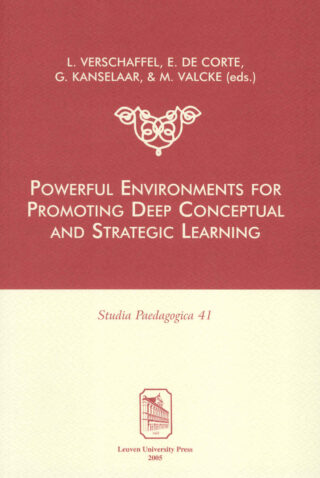
Powerful environments for promoting deep conceptual and strategic learning
Lieven Verschaffel (Author), M. Valcke (Author), E. De Corte (Author), G. Kanselaar (Author),
Over the past years a substantial amount of research has been undertaken relating to the development of powerful learning environments for the acquisition in students of worthwhile educational objectives focussing on conceptual understanding, higher-order cognitive and metacognitive skills, and self-regulated learning. This research has been mainly undertaken from three distinct perspectives in the study of learning and instruction, namely instructional psychology, instructional technology, and instructional design. Against this background a “research community” involving 14 European research teams has been initiated with the aim of interactively contributing to the advancement of theory and methodology relating to the design, implementation, and evaluation of powerful learning environments. This volume constitutes a collective output of this research community, focussing on the identification and analysis of major components and dimensions of powerful learning environments aimed at the promotion of deep conceptual and strategic learning in major domains of school curricula, like mathematics, physics, history, and social sciences. In Part I of the volume three chapters present general perspectives on the central theme of the third workshop. In Part II six studies are reported wherein novel learning environments for elementary and secondary mathematics education have been designed, implemented and evaluated. In Part III of the volume another set of five investigations is presented relating to the design, implementation and evaluation of powerful learning environments in other subject-matter domains and in teacher training.
Introduction
Part I: General perspectives
1. The problem of knowledge in the design of learning environments
S. Vosniadou
2. On learning environments that foster subject-matter competence
A.H. Schoenfeld
3. Engagement in learning: Designing learning environments that are really used
T. de Jong
Part II: Promoting deep conceptual and strategic learning in mathematics
4. Does social interaction influence 3-year-old children’s tendency to focus on numerosity? A quasi-experimental study in day care
M.M. Hannula, A. Mattinen, and E. Lehtinen
5. Using mathematical symbols at the beginning of the arithmetical and algebraic learning
A. Fagnant, J. Vlassis, and M. Crahay
6. Collaboration in small group mathematics problem solving: A case study
G.H.J. Seegers and D.J. Hoek
7. Remedying secondary school students’ illusion of linearity: Developing and evaluating a powerful learning environment
W. Van Dooren, D. De Bock, A. Hessels, D. Janssens and L. Verschaffel
8. Improving procedural transfer in mathematics with interactive animations
P. Gerjets, K. Scheiter, and R. Catrambone
9. Teaching percentages in the primary school: A four country comparative study
F. Depaepe, E. De Corte, P. Op ‘t Eynde, and L. Verschaffel
Part III: Promoting deep conceptual and strategic learning in other major curricular domains
10. Teaching-learning environments and student learning in electronic engeneering
N. Entwistle, J. Nisbet, and A. Bromage
11. Learner control over information presentation in powerful electronic learning environments used in physics education
L. Kester, P.A. Kirschner, and G. Corbalán-Pérez
12. The impact of external graphical representations in different knowledge domains: Is there a domain specific effect?
K. De Westelinck and M. Valcke
13. Using representational tools to support historical reasoning in CSCL
G. Kanselaar, C. van Boxtel, and J. van Drie
List of contributors
Frequently Asked Questions
What is "Powerful environments for promoting deep conceptual and strategic learning" about?
Over the past years a substantial amount of research has been undertaken relating to the development of powerful learning environments for the acquisition in students of worthwhile educational objectives focussing on conceptual understanding, higher-order cognitive and metacognitive skills, and self-regulated learning. This research has been mainly undertaken from three distinct perspectives in the study of learning and instruction, namely instructional psychology, instructional technology, and instructional design. Against this background a "research community" involving 14 European research teams has been initiated with the aim of interactively contributing to the advancement of theory and methodology relating to the design, implementation, and evaluation of powerful learning environments. This volume constitutes a collective output of this research community, focussing on the identification and analysis of major components and dimensions of powerful learning environments aimed at the promotion of deep conceptual and strategic learning in major domains of school curricula, like mathematics, physics, history, and social sciences. In Part I of the volume three chapters present general perspectives on the central theme of the third workshop. In Part II six studies are reported wherein novel learning environments for elementary and secondary mathematics education have been designed, implemented and evaluated. In Part III of the volume another set of five investigations is presented relating to the design, implementation and evaluation of powerful learning environments in other subject-matter domains and in teacher training.
Who wrote "Powerful environments for promoting deep conceptual and strategic learning"?
"Powerful environments for promoting deep conceptual and strategic learning" was written by Lieven Verschaffel, M. Valcke, E. De Corte and G. Kanselaar.
Is "Powerful environments for promoting deep conceptual and strategic learning" part of a series?
Yes, "Powerful environments for promoting deep conceptual and strategic learning" is part of the "Studia Paedagogica" series. It's book 41 in the series.
Editorial Board
Prof. Dr. M. Depaepe (Chairman)
Prof. Dr. G. Kelchtermans
Prof. Dr. B. Maes
Prof. Dr. J. Vandenabeele (Secretary)
Prof. Dr. W. Van Den Noortgate
What is the Table of Contents for "Powerful environments for promoting deep conceptual and strategic learning"?
Introduction
Part I: General perspectives
1. The problem of knowledge in the design of learning environments
S. Vosniadou
2. On learning environments that foster subject-matter competence
A.H. Schoenfeld
3. Engagement in learning: Designing learning environments that are really used
T. de Jong
Part II: Promoting deep conceptual and strategic learning in mathematics
4. Does social interaction influence 3-year-old children's tendency to focus on numerosity? A quasi-experimental study in day care
M.M. Hannula, A. Mattinen, and E. Lehtinen
5. Using mathematical symbols at the beginning of the arithmetical and algebraic learning
A. Fagnant, J. Vlassis, and M. Crahay
6. Collaboration in small group mathematics problem solving: A case study
G.H.J. Seegers and D.J. Hoek
7. Remedying secondary school students' illusion of linearity: Developing and evaluating a powerful learning environment
W. Van Dooren, D. De Bock, A. Hessels, D. Janssens and L. Verschaffel
8. Improving procedural transfer in mathematics with interactive animations
P. Gerjets, K. Scheiter, and R. Catrambone
9. Teaching percentages in the primary school: A four country comparative study
F. Depaepe, E. De Corte, P. Op 't Eynde, and L. Verschaffel
Part III: Promoting deep conceptual and strategic learning in other major curricular domains
10. Teaching-learning environments and student learning in electronic engeneering
N. Entwistle, J. Nisbet, and A. Bromage
11. Learner control over information presentation in powerful electronic learning environments used in physics education
L. Kester, P.A. Kirschner, and G. Corbalán-Pérez
12. The impact of external graphical representations in different knowledge domains: Is there a domain specific effect?
K. De Westelinck and M. Valcke
13. Using representational tools to support historical reasoning in CSCL
G. Kanselaar, C. van Boxtel, and J. van Drie
List of contributors
Related titles
 Teaching About the Violent Past
Line Kuppens (Author), Justin Sheria Nfundiko (Author),
October 2025

 Leren in maatschappelijk betrokken onderwijs – derde, grondig herziene editie
Jan Elen (Editor), Andy Thys (Editor),
September 2025
 Academische vrijheid
Sarah Van Ruyskensvelde (Editor), Kaat Wils (Editor), Rajesh Heynickx (Editor),
June 2025
 Student Notes from Latin Europe (1400–1750)
Xander Feys (Editor), Maxime Maleux (Editor), Andy Peetermans (Editor), Raf Van Rooy (Editor),
May 2025

 Wiskunde voor economen: concepten en technieken uit de lineaire algebra – Tweede editie
Johan Quaegebeur (Author), Wim Schoutens (Author), Naci Tanrıöven (Author), Paulien Vandereyt (Author),
June 2022
 Ons verste verleden
Tim Puttevils (Author), Bart Vanmontfort (Author), Karel Van Nieuwenhuyse (Author), Philip Van Peer (Author),
April 2020
 Financing Quality Education for All
Kristof De Witte (Author), Vitezslav Titl (Author), Oliver Holz (Author), Mike Smet (Author),
September 2019
 Van blokdruk tot blog
Koenraad Brosens (Author), Lieve De Wachter (Author), Margot D'Hertefelt (Author),
September 2018
 Digitale geletterdheid
Tom Willaert (Author), Dirk Speelman (Author), Fred Truyen (Author),
September 2018
 Hoe historici geschiedenis schrijven
Jolien Gijbels (Author), Koen Lagae (Author), Karel Van Nieuwenhuyse (Author),
February 2018
 Herinneringen aan de Holocaust
Koen Lagae (Author), Saartje Vanden Borre (Author), Karel Van Nieuwenhuyse (Author),
October 2016
 Afterschool
Nancy Vansieleghem (Editor), Joris Vlieghe (Editor), Pieter Verstraete (Editor),
October 2015

 The Forgotten Contribution of the Teaching Sisters
Bart Hellinckx (Author), Frank Simon (Author), Marc Depaepe (Author),
March 2013
 An Educational Pilgrimage to the United States. Un pèlerinage psycho-pédagogique aux États-Unis.
Marc Depaepe (Editor), Lieven D'hulst (Editor),
July 2011

 In the best interests of children and youth
Hans Grietens (Author), Walter Hellinckx (Author), Willy Lahaye (Author),
November 2005