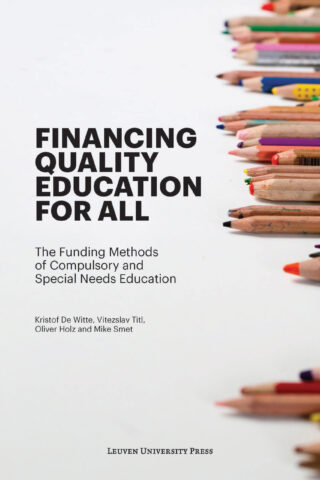

Financing Quality Education for All
The Funding Methods of Compulsory and Special Needs Education
Kristof De Witte (Author), Vitezslav Titl (Author), Oliver Holz (Author), Mike Smet (Author),

Category: Diversity and Equity Studies, Economy, Education, Policy, Governance and Public Administration
Language: English
ISBN: 9789462701915
Publication date: September 11, 2019
€25.00 (including 6% VAT)
Buy NowNumber of pages: 164
Size: 234 x 156 x 10 mm
Illustrations and other content description:
Illustrated in full colour, 11 b&w images, 25 tables
Stock item: 130461
Standard delivery time for print books:
For Belgium: 5 to 8 working days
For EU: 2 to 3 weeks
For other countries: 4 to 5 weeks
Category: Diversity and Equity Studies, Economy, Education, Policy, Governance and Public Administration
Language: English
ISBN: 9789461663016
Publication date: September 11, 2019
Download Free EpubNumber of pages: 164
Illustrations and other content description:
Illustrated in full colour, 11 b&w images, 25 tables
Category: Diversity and Equity Studies, Economy, Education, Policy, Governance and Public Administration
Language: English
ISBN: 9789461663009
Publication date: September 11, 2019
Download Free PDFNumber of pages: 164
Illustrations and other content description:
Illustrated in full colour, 11 b&w images, 25 tables
Funding, efficiency, and equity in education
In OECD countries the average expenditure on primary and secondary education institutions is about 3.5% of GDP. The investment in education has large implications for economic development and the proper functioning of democratic institutions, as well as overall well-being. However, clear consensus and guidance on which system leads to the best educational outcomes is lacking. This volume describes the resource allocation for compulsory and special needs education for a selection of well-performing countries and regions on PISA tests. By studying the funding systems in well-performing countries and regions the authors identify the elements in the respective funding systems that are associated with best outcomes and have the ideal characteristics to pursue particular goals of education systems such as equity and efficiency. The funding methods of primary and secondary education as well as special needs education are covered.
Ebook available in Open Access.
This publication is GPRC-labeled (Guaranteed Peer-Reviewed Content).
List of Figures
List of Tables
Chapter 1. Introduction
Chapter 2. The choice of countries and regions2.1 British Columbia
2.2 Estonia
2.3 Finland
2.4 Flanders
2.5 Massachusetts
Chapter 3. Overview of education systems3.1 British Columbia
Expenditure on education
Approach to special needs students and language minorities
The autonomy and providers of education
3.2 Estonia
Expenditure on education
Approach to special needs students and language minorities
The autonomy and providers of education
3.3 Finland
Expenditure on education
Approach to special needs students and language minorities
The autonomy and providers of education
3.4 Flanders
Expenditure on education
Approach to special needs students and language minorities
Autonomy and providers of education
3.5 Massachusetts
Expenditure on education
Approach to special needs students and language minorities
Autonomy and providers of education
Chapter 4. Funding formulas4.1 British Columbia
Primary schools
An example a primary school budget in the district of Mission Secondary schools
An example of a secondary school budget in the district of Mission Support for special needs students
A case study on special needs funding in the district of Mission A case-study of the funding formula in the district of Mission
Summary of the education funding system in British Columbia and the district of Mission
4.2 Estonia
Primary schools
An example of a primary school budget in Estonia Secondary schools
An example of a secondary school budget in Estonia Special needs schools
An example of a an additional funding calculation for special needs students in Estonia Summary of the Estonian education funding system
4.3 Finland
Primary schools
An example of a primary school in a municipality in Finland Secondary schools
An example of a secondary school in a municipality in Finland Special needs schools
The case of the municipality of Hanko
An example of a school in a municipality in Finland Summary of the Finnish education funding system
4.4 Flanders
Primary schools
An example of a primary school board budget in Flanders Secondary schools
An example of a secondary school board budget in Flanders Special needs education
An example of the budget of a school with special needs students in Flanders Summary of the Flemish education funding system
4.5 Massachusetts
The mechanism behind the formula
The calculation of allocations
An example of a primary school district budget in Massachusetts Required local contribution calculation
Filling the gap with Chapter 70 education aid
An example of a secondary school district budget in Massachusetts Effective funding per student
Funding outside the main formula
Summary of the education funding in Massachusetts
Chapter 5. Conclusions Summary of the funding formulas in the selected regions and countries
Discussion
Appendix
List of primary sources British Columbia
Estonia
Finland
Flanders
Massachusetts
References
Discusses the funding formulas for compulsory and special needs education in countries and regions that have performed well on international tests, focusing specifically on Estonia, Finland, the state of Massachusetts, the province of British Columbia, and the Flemish Community of Belgium. Highlights specific features of the selected countries and regions. Describes the education systems in these regions and their approaches to special needs students. Explains how the funding system in each region works by comprehensively looking at its funding formulas for primary, secondary, and special needs education.
2021. "Annotated Listing of New Books." Journal of Economic Literature, 59 (1): 297-371. DOI: 10.1257/jel.59.1.297
Frequently Asked Questions
What is "Financing Quality Education for All" about?
Funding, efficiency, and equity in education
In OECD countries the average expenditure on primary and secondary education institutions is about 3.5% of GDP. The investment in education has large implications for economic development and the proper functioning of democratic institutions, as well as overall well-being. However, clear consensus and guidance on which system leads to the best educational outcomes is lacking. This volume describes the resource allocation for compulsory and special needs education for a selection of well-performing countries and regions on PISA tests. By studying the funding systems in well-performing countries and regions the authors identify the elements in the respective funding systems that are associated with best outcomes and have the ideal characteristics to pursue particular goals of education systems such as equity and efficiency. The funding methods of primary and secondary education as well as special needs education are covered.
Ebook available in Open Access.
This publication is GPRC-labeled (Guaranteed Peer-Reviewed Content).
Who wrote "Financing Quality Education for All"?
"Financing Quality Education for All" was written by Kristof De Witte, Vitezslav Titl, Oliver Holz and Mike Smet.
Kristof De Witte is professor at the Faculty of Economics and Business at KU Leuven and holds the chair in Effectiveness and Efficiency of Educational Innovations at United Nations University (UNU-MERIT) at Maastricht University.
Vitezslav Titl is doctoral researcher in political economy at KU Leuven. Prior to his doctoral studies, he finished traineeships at the European Parliament and the German Development Institute.
Oliver Holz is assistant professor at KU Leuven, where he works in the teacher training programme. He is affiliated with the research group Leuven Economics of Education Research.
Mike Smet is assistant professor of Research Methods at the Faculty of Economics and Business at KU Leuven. He is affiliated with the research group Leuven Economics of Education Research.
Is "Financing Quality Education for All" available Open Access?
Yes, "Financing Quality Education for All" is published Open Access. It is available under a BY-NC-ND license.
What is the Table of Contents for "Financing Quality Education for All"?
List of Figures
List of Tables
Chapter 1. Introduction
Chapter 2. The choice of countries and regions2.1 British Columbia
2.2 Estonia
2.3 Finland
2.4 Flanders
2.5 Massachusetts
Chapter 3. Overview of education systems3.1 British Columbia
Expenditure on education
Approach to special needs students and language minorities
The autonomy and providers of education
3.2 Estonia
Expenditure on education
Approach to special needs students and language minorities
The autonomy and providers of education
3.3 Finland
Expenditure on education
Approach to special needs students and language minorities
The autonomy and providers of education
3.4 Flanders
Expenditure on education
Approach to special needs students and language minorities
Autonomy and providers of education
3.5 Massachusetts
Expenditure on education
Approach to special needs students and language minorities
Autonomy and providers of education
Chapter 4. Funding formulas4.1 British Columbia
Primary schools
An example a primary school budget in the district of Mission Secondary schools
An example of a secondary school budget in the district of Mission Support for special needs students
A case study on special needs funding in the district of Mission A case-study of the funding formula in the district of Mission
Summary of the education funding system in British Columbia and the district of Mission
4.2 Estonia
Primary schools
An example of a primary school budget in Estonia Secondary schools
An example of a secondary school budget in Estonia Special needs schools
An example of a an additional funding calculation for special needs students in Estonia Summary of the Estonian education funding system
4.3 Finland
Primary schools
An example of a primary school in a municipality in Finland Secondary schools
An example of a secondary school in a municipality in Finland Special needs schools
The case of the municipality of Hanko
An example of a school in a municipality in Finland Summary of the Finnish education funding system
4.4 Flanders
Primary schools
An example of a primary school board budget in Flanders Secondary schools
An example of a secondary school board budget in Flanders Special needs education
An example of the budget of a school with special needs students in Flanders Summary of the Flemish education funding system
4.5 Massachusetts
The mechanism behind the formula
The calculation of allocations
An example of a primary school district budget in Massachusetts Required local contribution calculation
Filling the gap with Chapter 70 education aid
An example of a secondary school district budget in Massachusetts Effective funding per student
Funding outside the main formula
Summary of the education funding in Massachusetts
Chapter 5. Conclusions Summary of the funding formulas in the selected regions and countries
Discussion
Appendix
List of primary sources British Columbia
Estonia
Finland
Flanders
Massachusetts
References
Related titles


 Digital Citizenship
Peter van Baalen (Editor), Selin Gerlek (Editor), Jakko Kemper (Editor), Halil Can Kurban (Editor), Marina Tulin (Editor),
October 2026
 Feminists Resisting Gendered Violence
Hemangini Gupta (Editor), Fiona Mackay (Editor), Jan Breckenridge (Editor), Louise Chappell (Editor), Rachna Mehra (Editor), Rukmini Sen (Editor), Mailin Suchting (Editor),
October 2026
 Brusselse plaatsnamen
Iadine Degryse (Editor), Benjamin Wayens (Editor), Chantal Kesteloot (Editor), Dennis De Vriese (Editor), Matthijs Degraeve (Editor),
April 2026

 Teaching About the Violent Past
Line Kuppens (Author), Justin Sheria Nfundiko (Author),
October 2025
 Leren in maatschappelijk betrokken onderwijs – derde, grondig herziene editie
Jan Elen (Editor), Andy Thys (Editor),
September 2025
 Integration Otherwise Inspiration Kit
Luce Beeckmans (Author), Dounia Salamé (Author), Martina Bovo (Author), Mary Hogan (Author),
June 2025
 Academische vrijheid
Sarah Van Ruyskensvelde (Editor), Kaat Wils (Editor), Rajesh Heynickx (Editor),
June 2025

 Textures of Power
Florence Bernault (Editor), Benoît Henriet (Editor), Emery Kalema (Editor),
May 2025
 Student Notes from Latin Europe (1400–1750)
Xander Feys (Editor), Maxime Maleux (Editor), Andy Peetermans (Editor), Raf Van Rooy (Editor),
May 2025
 Futures for the Public Sector
Geert Bouckaert (Editor), Annie Hondeghem (Editor), Trui Steen (Editor), Steven Van de Walle (Editor),
March 2025
 Brussel in een België met vier gewesten?
Dirk Moors (Editor), Anneloes Vandenbroucke (Editor), Iadine Degryse (Editor), Simon Boone (Editor),
February 2025
 Architectures of Resistance
Angeliki Sioli (Editor), Nishat Awan (Editor), Kristopher Palagi (Editor),
August 2024
 Wiskunde voor economen: concepten en technieken uit de wiskundige analyse – tweede editie
Johan Quaegebeur (Author), Walter Van Assche (Author), Naci Tanrıöven (Author), Paulien Vandereyt (Author),
July 2024