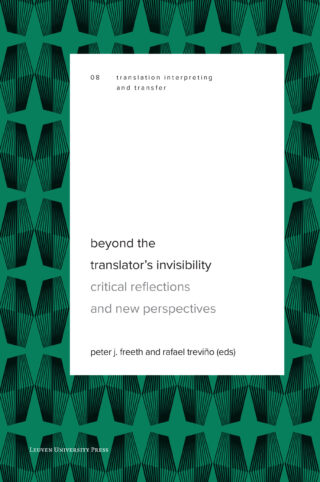

Beyond the Translator’s Invisibility
Critical Reflections and New Perspectives
Peter J. Freeth (Editor), Rafael Treviño (Editor),

Series: Translation, Interpreting and Mediation 8
Category: Linguistics, Literature, Translation Studies
Language: English
ISBN: 9789462703988
Publication date: February 6, 2024
€59.00 (including 6% VAT)
Buy NowNumber of pages: 286
Size: 234 x 156 x 12 mm

Funded by: Open Book Collective
Stock item: 158787
Standard delivery time for print books:
For Belgium: 5 to 8 working days
For EU: 2 to 3 weeks
For other countries: 4 to 5 weeks
Series: Translation, Interpreting and Mediation 8
Category: Linguistics, Literature, Translation Studies
Language: English
ISBN: 9789461667304
Publication date: September 30, 2025
Download Free PDFNumber of pages: 286
Funded by: Open Book Collective
The value of nuanced approaches to the concept of translator invisibility
The question of whether to disclose that a text is a translation and thereby give visibility to the translator has dominated discussions on translation throughout history. Despite becoming one of the most ubiquitous terms in translation studies, however, the concept of translator (in)visibility is often criticized for being vague, overly adaptable, and grounded in literary contexts. This interdisciplinary volume therefore draws on concepts from fields such as sociology, the digital humanities, and interpreting studies to develop and operationalize theoretical understandings of translator visibility beyond these existing criticisms and limitations. Through empirical case studies spanning areas including social media research, reception studies, institutional translation, and literary translation, this volume demonstrates the value of understanding the visibilities of translators and translation in the plural and adds much-needed nuance to one of translation studies’ most pervasive, polarizing, and imprecise concepts.
Contributors: Klaus Kaindl (University of Vienna), Renée Desjardins (Université de Saint-Boniface), Helle V. Dam (Aarhus University), Minna Ruokonen (University of Eastern Finland), Deborah Giustini (Hamad Bin Khalifa University / KU Leuven), Motoko Akashi (Trinity College Dublin), Peter J. Freeth (London Metropolitan University), Seyhan Bozkurt Jobanputra (Yeditepe University), Gys-Walt van Egdom (Utrecht University), Haidee Kotze (Utrecht University), Pardaad Chamsaz (British Library), Rachel Foss (British Library), Will René (National Poetry Library), Esa Penttilä (University of Eastern Finland), Juha Lång (University of Eastern Finland), Juho Suokas (University of Eastern Finland), Erja Vottonen (University of Eastern Finland), and Helka Riionheimo (University of Eastern Finland).
This publication is GPRC-labeled (Guaranteed Peer-Reviewed Content).
“Introduction” by Peter J. Freeth is distributed under the terms of the Creative Commons Attribution CC BY NC ND 4.0 International license. To view a copy of this license, visit http://creativecommons.org/licenses/by-nc-nd/4.0/
Introduction © 2024 by P.J. Freeth.
Listen to an interview with Peter J. Freeth and Rafael Treviño at New Books Network: https://newbooksnetwork.com/beyond-the-translators-invisibility
Part I: The plurality of visibility
Visibilities of translation – Visibilities of translators : Reflections on the theoretical foundations of an opaque concept
Klaus Kaindl, translated by Peter J. Freeth
Reconfiguring the translator’s/translation’s online and digital (in)visibility
Renée Desjardins
Bringing in the translators’ views on their (in)visibility : The forms and significance of visibility in research on translator status
Helle V. Dam & Minna Ruokonen
Towards a sociological redressing of interpreters’ (in)visibility
Deborah Giustini
Part II: Visibilities of translators
The implications of translator celebrity : Investigating the commercial impact of Haruki Murakami’s fame as a translator
Motoko Akashi
“Yes: I translated it!” : Visibility and the performance of translatorship in the digital paratextual space
Peter J. Freeth
(In)visible networks of translation in a time of cultural evolution : The case of the TEDA translation grant program
Seyhan Bozkurt Jobanputra
Part III: Visibilities of translation
What the invisible reader has to say about the invisibility of translation : Studying translation reception in online reading communities
Gys-Walt van Egdom & Haidee Kotze
Making translation visible : The translator-in-residence program at the British Library
Pardaad Chamsaz, Rachel Foss & Will René
The (in)visibility of translation and translatorial agents in academic research
Esa Penttilä, Juha Lång, Juho Suokas, Erja Vottonen & Helka Riionheimo
Contributors
Peter J. Freeth
Peter J. Freeth is senior lecturer in translation at London Metropolitan University.
Rafael Treviño
Rafael Treviño is a sign language interpreter at the U.S. Department of State and is completing his doctoral studies at Gallaudet University.
This highly interesting volume engages critically with the scope and limitations of the notions of visibility and invisibility in various translational practices. The chapters demonstrate the value of a more complex and diversified understanding of translator and translation (in)visibility and offer broader perspectives as well as innovative interdisciplinary ways of investigation. - Christina Schäffner, Aston University
In this excellent collection, Freeth and Treviño offer a long overdue perspective on the in/visibilities (in plural) of translation and translators, challenging prevailing conceptions of visibility. The importance of this volume lies in its critical approach questioning the assumption of invisibility, as well as how desirable it is for translators to be visible. This book certainly has the potential of reshaping the discourse on a topic ubiquitous in Translation Studies. - Rafael Schögler, University of Graz
For nearly thirty years, visibility has occupied an influential position in the theoretical framing of translation and translators’ work. This forward-looking volume breathes fresh life into this much-debated mainstay by reflecting the affordances of contemporary methodologies and praxis, with inspiring conceptual and empirical enquiries cutting across social media, professional practice, status, digital paratexts, reception, and translation in/for research. In pivoting away from Venuti’s narrow, literary-historical focus, Freeth and Treviño bring visibility firmly into the 21st century. - Callum Walker, University of Leeds
'Beyond the Translator’s Invisibility: Critical Reflections and New Perspectives' is a foundational collection that successfully achieves its aim of broadening and diversifying the concept of visibility. By deploying empirical case studies and powerful conceptual tools drawn from sociology, digital humanities, and other fields, the volume reframes visibility as a plural and multidimensional phenomenon. This work decisively moves past the binary limitations of earlier discussions, demonstrating that visibility relates not only to the textual product but also crucially to the social, professional, and commercial status of the translator as an active agent. The collective contributions highlight the continued relevance of addressing translator status, recognition, and remuneration across the diverse modalities of translation and interpreting, making it a critical volume for any scholar seeking to understand the dynamic, contemporary landscape of translation studies. - Ozum Arzik-Erzurumlu, Papers on Language & Literature, Volume 60, Number 1, Winter 2026
Frequently Asked Questions
What is "Beyond the Translator’s Invisibility" about?
The value of nuanced approaches to the concept of translator invisibility
The question of whether to disclose that a text is a translation and thereby give visibility to the translator has dominated discussions on translation throughout history. Despite becoming one of the most ubiquitous terms in translation studies, however, the concept of translator (in)visibility is often criticized for being vague, overly adaptable, and grounded in literary contexts. This interdisciplinary volume therefore draws on concepts from fields such as sociology, the digital humanities, and interpreting studies to develop and operationalize theoretical understandings of translator visibility beyond these existing criticisms and limitations. Through empirical case studies spanning areas including social media research, reception studies, institutional translation, and literary translation, this volume demonstrates the value of understanding the visibilities of translators and translation in the plural and adds much-needed nuance to one of translation studies’ most pervasive, polarizing, and imprecise concepts.
Contributors: Klaus Kaindl (University of Vienna), Renée Desjardins (Université de Saint-Boniface), Helle V. Dam (Aarhus University), Minna Ruokonen (University of Eastern Finland), Deborah Giustini (Hamad Bin Khalifa University / KU Leuven), Motoko Akashi (Trinity College Dublin), Peter J. Freeth (London Metropolitan University), Seyhan Bozkurt Jobanputra (Yeditepe University), Gys-Walt van Egdom (Utrecht University), Haidee Kotze (Utrecht University), Pardaad Chamsaz (British Library), Rachel Foss (British Library), Will René (National Poetry Library), Esa Penttilä (University of Eastern Finland), Juha Lång (University of Eastern Finland), Juho Suokas (University of Eastern Finland), Erja Vottonen (University of Eastern Finland), and Helka Riionheimo (University of Eastern Finland).
This publication is GPRC-labeled (Guaranteed Peer-Reviewed Content).
"Introduction" by Peter J. Freeth is distributed under the terms of the Creative Commons Attribution CC BY NC ND 4.0 International license. To view a copy of this license, visit http://creativecommons.org/licenses/by-nc-nd/4.0/
Introduction © 2024 by P.J. Freeth.
Listen to an interview with Peter J. Freeth and Rafael Treviño at New Books Network: https://newbooksnetwork.com/beyond-the-translators-invisibility
Who edited "Beyond the Translator’s Invisibility"?
"Beyond the Translator’s Invisibility" was edited by Peter J. Freeth and Rafael Treviño.
Peter J. Freeth is senior lecturer in translation at London Metropolitan University.
Rafael Treviño is a sign language interpreter at the U.S. Department of State and is completing his doctoral studies at Gallaudet University.
Is "Beyond the Translator’s Invisibility" part of a series?
Yes, "Beyond the Translator’s Invisibility" is part of the "Translation, Interpreting and Mediation" series. It's book 8 in the series.

Translation, Interpreting and Mediation
Mission statement
Championing a broad and transversal approach to the study of translational phenomena, Translation, Interpreting and Mediation (TIME) is a book series for monographs and edited volumes that explore translation as a pervasive social practice connecting spaces and collectivities through complex forms of resemiotization and mediation. The series transcends traditional notions of translation as the decoding and recoding of semantic invariants and embraces an expansive understanding of translational agency. It aims to provide a venue for theoretical and methodological innovations at the disciplinary frontiers where translation is pervasive and essential but seldom fully understood or acknowledged. The series welcomes different perspectives on translation, interpreting and mediation, interfacing with a variety of areas of study, including sociology, literature, linguistics, cognition, politics, law, history, communication, multimodality, ecology, technology, cultural production and digital humanities (among others). The series draws inspiration from the collective expertise of CETRA (Centre for Translation Studies), its institutional home at KU Leuven.
All volumes in the series are double peer reviewed.
For questions, please contact the series editors.
Series editors
Jack McMartin (KU Leuven)
Sara Ramos Pinto (University of Leeds)
Editorial board
Núria Codina Solà (KU Leuven)
Lieven D’hulst (KU Leuven)
Peter J. Freeth (London Metropolitan University)
Deborah Giustini (Hamad Bin Khalifa University)
Gabriel González Núñez (University of Texas Rio Grande Valley)
Bei Hu (National University of Singapore)
Akiko Sakamoto (Kansai University)
Advisory board
Brian Baer (Kent State University)
Pieter Boulogne (KU Leuven)
Lynne Bowker (University of Laval)
Elke Brems (KU Leuven)
Leo Tak-hung Chan (Lingnan University, Hong Kong)
Antoon Cox (KU Leuven)
Michael Cronin (Trinity College Dublin)
Dilek Dizdar (Johannes Gutenberg-Universität Mainz)
Yves Gambier (University of Turku)
Maud Gonne (University of Liège)
Arnt Lykke Jakobsen (Copenhagen Business School)
Haidee Kotze (Utrecht University)
Kaisa Koskinen (Tampere University)
Kobus Marais (University of the Free State)
Reine Meylaerts (KU Leuven)
Joss Moorkens (Dublin City University)
Jemina Napier (Heriot-Watt University)
Franz Pöchhacker (University of Vienna)
Hanna Risku (University of Vienna)
Diana Roig Sanz (Universitat Oberta de Catalunya)
Heidi Salaets (KU Leuven)
Christina Schäffner (Aston University)
Luc van Doorslaer (University of Tartu / KU Leuven)
Proposals
Proposals and enquiries can be sent to the series editors.
Please make use of the submission form to present the full manuscript to our board.
Authors interested in Open Access can consult the available funding options.
Links & Resources
Is "Beyond the Translator’s Invisibility" available Open Access?
Yes, "Beyond the Translator’s Invisibility" is published Open Access. It is available under a BY-NC-ND license.
Who funded the publication of "Beyond the Translator’s Invisibility"?
Publication of "Beyond the Translator’s Invisibility" was funded by Open Book Collective
.
What is the Table of Contents for "Beyond the Translator’s Invisibility"?
Part I: The plurality of visibility
Visibilities of translation – Visibilities of translators : Reflections on the theoretical foundations of an opaque concept
Klaus Kaindl, translated by Peter J. Freeth
Reconfiguring the translator’s/translation’s online and digital (in)visibility
Renée Desjardins
Bringing in the translators’ views on their (in)visibility : The forms and significance of visibility in research on translator status
Helle V. Dam & Minna Ruokonen
Towards a sociological redressing of interpreters’ (in)visibility
Deborah Giustini
Part II: Visibilities of translators
The implications of translator celebrity : Investigating the commercial impact of Haruki Murakami’s fame as a translator
Motoko Akashi
“Yes: I translated it!” : Visibility and the performance of translatorship in the digital paratextual space
Peter J. Freeth
(In)visible networks of translation in a time of cultural evolution : The case of the TEDA translation grant program
Seyhan Bozkurt Jobanputra
Part III: Visibilities of translation
What the invisible reader has to say about the invisibility of translation : Studying translation reception in online reading communities
Gys-Walt van Egdom & Haidee Kotze
Making translation visible : The translator-in-residence program at the British Library
Pardaad Chamsaz, Rachel Foss & Will René
The (in)visibility of translation and translatorial agents in academic research
Esa Penttilä, Juha Lång, Juho Suokas, Erja Vottonen & Helka Riionheimo
Contributors
Related titles



 Feminists Resisting Gendered Violence
Hemangini Gupta (Editor), Fiona Mackay (Editor), Jan Breckenridge (Editor), Louise Chappell (Editor), Rachna Mehra (Editor), Rukmini Sen (Editor), Mailin Suchting (Editor),
October 2026
 Affect in Translation and Interpreting
Sofía Monzón (Editor), Lucie Spezzatti (Editor), Elisabeth Goemans (Editor),
May 2026
 Research Methods in Literary Reception Studies
Jeroen Dera (Editor), Anne Oerlemans (Editor), Frederik Van Dam (Editor),
May 2026
 Comics and the Global South
Andrea Aramburú (Editor), Dibyadyuti Roy (Editor), Joe Sutliff Sanders (Editor),
February 2026

 Situatedness and Performativity
Raquel Pacheco Aguilar (Editor), Marie-France Guénette (Editor),
November 2025
 Transfer Thinking in Translation Studies
Maud Gonne (Editor), Klaartje Merrigan (Editor), Reine Meylaerts (Editor), Heleen van Gerwen (Editor),
September 2025
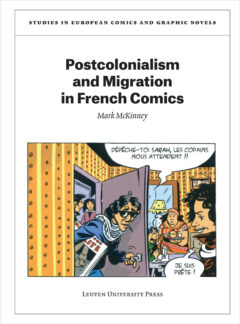

 The Visionary Art of Franco-Belgian Comics, 1930s to 1960s
Hugo Frey (Editor), Maaheen Ahmed (Editor),
September 2025
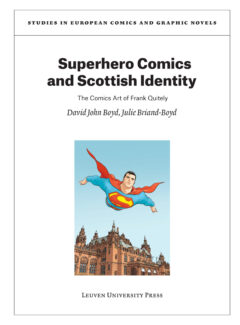 Superhero Comics and Scottish Identity
David John Boyd (Author), Julie Briand-Boyd (Author),
July 2025
 Retranslating the Bible and the Qur’an
Pieter Boulogne (Editor), Marijke H. de Lang (Editor), Joseph Verheyden (Editor),
December 2024
 European Literatures of Military Occupation
Matthias Buschmeier (Editor), Jeanne E. Glesener (Editor),
October 2024
 Alles verandert altijd – Herziene editie
Lieven D'hulst (Editor), Chris Van de Poel (Editor),
December 2023
 Modern Etruscans
Chiara Zampieri (Editor), Martina Piperno (Editor), Bart Van den Bossche (Editor),
October 2023