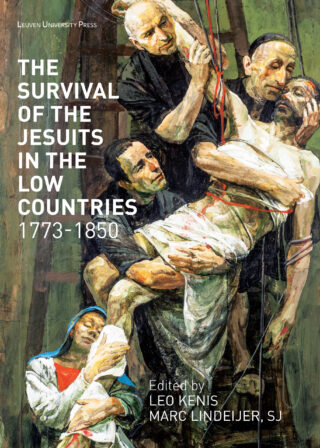
The Survival of the Jesuits in the Low Countries, 1773-1850
Leo Kenis (Editor), Marc Lindeijer (Editor),
Series: KADOC-Studies on Religion, Culture and Society 25
Category: History 1500-1800, Religion
Language: English
ISBN: 9789462702219
Publication date: December 18, 2019
€27.50 (including 6% VAT)
Buy NowNumber of pages: 392
Size: 238 x 170 x 22 mm

Stock item: 132428
Standard delivery time for print books:
For Belgium: 5 to 8 working days
For EU: 2 to 3 weeks
For other countries: 4 to 5 weeks
Series: KADOC-Studies on Religion, Culture and Society 25
Category: History 1500-1800, Religion
Language: English
ISBN: 9789461663191
Publication date: December 18, 2019
€41.00 (including 6% VAT)
Buy NowNumber of pages: 392
How the Jesuits re-emerged after forty years of suppression
In 1773, Pope Clement XIV suppressed the Society of Jesus. For the 823 Jesuits living in the Low Countries, it meant the end of their institutional religious life. In the Austrian Netherlands, the Jesuits were put under strict surveillance, but in the Dutch Republic they were able to continue their missionary work. It is this regional contrast and the opportunities it offered for the Order to survive that make the Low Countries an exceptional and interesting case in Jesuit history.
Just as in White Russia, former Jesuits and new Jesuits in the Low Countries prepared for the restoration of the Order, with the help of other religious, priests, and lay benefactors. In 1814, eight days before the restoration of the Society by Pope Pius VII, the novitiate near Ghent opened with eleven candidates from all over the United Netherlands. Barely twenty years later, the Order in the Low Countries – by then counting one hundred members – formed an independent Belgian Province. A separate Dutch Province followed in 1850. Obviously, the reestablishment, with new churches and new colleges, carried a heavy survival burden: in the face of their old enemies and the black legends they revived, the Jesuits had to retrieve their true identity, which had been suppressed for forty years.
Contributors: Peter van Dael, SJ (Vrije Universiteit Amsterdam & Pontifical Gregorian University Rome), Pierre Antoine Fabre (École des hautes études en sciences sociales Paris), Joep van Gennip (Tilburg School of Catholic Theology), Michel Hermans, SJ (University of Namur), Marek Inglot, SJ (Pontifical Gregorian University Rome), Frank Judo (lawyer Brussels), Leo Kenis (KU Leuven) Marc Lindeijer, SJ (Bollandist Society Brussels), Jo Luyten (KADOC-KU Leuven), Kristien Suenens (KADOC-KU Leuven), Vincent Verbrugge (historian)
This publication is GPRC-labeled (Guaranteed Peer-Reviewed Content).
INTRODUCTION Leo Kenis – Marc Lindeijer, SJ
SURVIVED
The Quick Downfall and Slow Rise of the Jesuit Order in the Low Countries Marc Lindeijer, SJ – Jo Luyten – Kristien Suenens
SURVIVAL
The ‘Suppressions’ of the Society of Jesus in the Gallo-Belgian Province Michel Hermans, SJ
“Contulit hos virtus, expulit invidia” The Suppression of the Jesuits of the Flemish-Belgian Province Joep van Gennip
The Fate of the Jesuits of the Gallo-Belgian Province after 1773 Michel Hermans, SJ
The Jesuits of the Low Countries and the Society of Jesus in Russia Marek Inglot, SJ
SURVIVORS
Restoration in One Country? The Strange History of Balthazar de Villegas’ Mémoire sur le rétablissement des Jésuites Frank Judo
The Post-Concordatory Vicissitudes of Joannes Vrindts (1781-1862) Priest in Search of an Identity, Jesuit at Heart Jo Luyten
Pierre-Antoine Malou-Riga (1753-1827) A Part-time Jesuit? Vincent Verbrugge
“Aptus ad gubernandum” The Formation of Fr Jan Roothaan in the Principles and Practices of Good Governance of the Restored Society of Jesus (1823-1829) Marc Lindeijer, SJ
REVIVAL?
‘Jesuits’ as Promoters of Female Religious Congregations in Belgium (c. 1800-1870) Continuity or Discontinuity? Jo Luyten – Kristien Suenens
“A great swarm of nocturnal raptors shrieking horribly” Negative Images of the Jesuits in the Netherlands between the Restoration of the Order and the Establishment of the Dutch Jesuit Province, 1814-1850 Joep van Gennip
Jesuit Churches in the Netherlands in the First Half of the Nineteenth CenturyPeter van Dael, SJ
CONCLUSION
Jesuits in the Low Countries from the Modern to the Contemporary Era Resources for a New History Pierre-Antoine Fabre
Appendix Catalogue of Jesuits in and from the Low Countries, 1773-1830
Bibliography Contributors Index Colophon
“The Survival of the Jesuits in the Low
Countries, 1773-1850, Edited by Leo Kenis and Marc Lindeijer”, alweer een heel
interessante, Engelstalige uitgave van Leuven University Press. Michel
Dutrieue, Stretto – Magazine voor kunst, geschiedenis en muziek, Maart 2020
Der vorliegende Band stellt an den Beginn eine Gesamtdarstellung der Geschichte des Ordens in den Niederlanden von 1773 bis 1850 und bekommt so den Charakter eines Handbuchs, was dessen Erwerb nicht nur für Fachkreise empfiehlt. Ein solcher Überblick ist gerechtfertigt, weil der letzte von 1940 stammt. Darauf folgen die Veröffentlichungen von elf Tagungsbeiträgen zu den Themen survival, also über die Schicksale von Jesuiten nach der Aufhebung und über Initiativen für einen Neuanfang, survivors, über vier Persönlichkeiten, die sich für den Aufbruch verdient gemacht hatten, und revival, der Beschäftigung mit innovativen Elementen der sonst als Restauration bezeichneten Epoche. Den Abschluss bildet eine historiographische Reflexion von Pierre-Antoine Fabre (École des hautes études en sciences sociales, Paris). In einem Appendix finden sich ein wertvolles Verzeichnis der Ordensangehörigen aus den Niederlanden zwischen 1773 und 1830, eine umfangreiche Bibliographie und ein Personenregister. [...] Durch die Arbeit der Herausgeber übersteigt das Werk die Qualität eines Tagungsbandes und bietet Einblick in den gesellschaftlichen Wandel in Religion und Mentalität an der Wende vom 18. zum 19. Jahrhundert.Paul Oberholzer, SZRKG/RSHRC/RSSRC 114 (2020) 389–462, DOI: 10.24894/2673-3641.00074
Le grand mérite de ce volume est sa précision et sa façon de prendre en compte les itinéraires individuels des centaines de personnes impliquées dans l’aventure malheureuse de la Compagnie honnie successivement par quasi tous les pouvoirs temporels et spirituels. Depuis son rétablissement, la Compagnie a toujours été prolixe dans la présentation de sa propre histoire, la bibliographie est proprement époustouflante (p. 351-378 dans ce volume) et il existe plusieurs catalogues prosopographiques très complets de ses membres. Les auteurs en ont largement profité, d’abord en établissant le catalogue nominatif des jésuites qui dans les années 1773-1830 ont eu un rapport avec les grands Pays-Bas dans le sens mentionné ci-dessus, en y vivant ou en y revenant (p. 341-349, et un index nominatif), ensuite en exploitant à fond les archives des maisons, collèges et, dans les Pays-Bas du Nord, « stations missionnaires », c’est-à-dire les églises domestiques installées dans des bâtiments privés, qui ont succédé aux anciennes paroisses supprimées sous le régime protestant.Willem Frijhoff, Archives de sciences sociales des religions, 196 | octobre-décembre 2021, mis en ligne le 01 décembre 2021, DOI : https://doi.org/10.4000/assr.64904
This volume is an extraordinarily welcome contribution. Beyond meticulous accounts of the Jesuit suppression and restoration, it adds fine-grained detail to Catholicism’s great canvas of travails—from the French Revolutionary and Napoleonic eras into nineteenth-century conflicts between ultramontanism and liberal nationalism. All scholars of modern church history will benefit from this kaleidoscopic account. - Stephen Schloesser S.J., The Catholic Historical Review, Volume 110, Number 1, Winter 2024, https://muse.jhu.edu/pub/16/article/921747
Frequently Asked Questions
What is "The Survival of the Jesuits in the Low Countries, 1773-1850" about?
How the Jesuits re-emerged after forty years of suppression
In 1773, Pope Clement XIV suppressed the Society of Jesus. For the 823 Jesuits living in the Low Countries, it meant the end of their institutional religious life. In the Austrian Netherlands, the Jesuits were put under strict surveillance, but in the Dutch Republic they were able to continue their missionary work. It is this regional contrast and the opportunities it offered for the Order to survive that make the Low Countries an exceptional and interesting case in Jesuit history.
Just as in White Russia, former Jesuits and new Jesuits in the Low Countries prepared for the restoration of the Order, with the help of other religious, priests, and lay benefactors. In 1814, eight days before the restoration of the Society by Pope Pius VII, the novitiate near Ghent opened with eleven candidates from all over the United Netherlands. Barely twenty years later, the Order in the Low Countries – by then counting one hundred members – formed an independent Belgian Province. A separate Dutch Province followed in 1850. Obviously, the reestablishment, with new churches and new colleges, carried a heavy survival burden: in the face of their old enemies and the black legends they revived, the Jesuits had to retrieve their true identity, which had been suppressed for forty years.
Contributors: Peter van Dael, SJ (Vrije Universiteit Amsterdam & Pontifical Gregorian University Rome), Pierre Antoine Fabre (École des hautes études en sciences sociales Paris), Joep van Gennip (Tilburg School of Catholic Theology), Michel Hermans, SJ (University of Namur), Marek Inglot, SJ (Pontifical Gregorian University Rome), Frank Judo (lawyer Brussels), Leo Kenis (KU Leuven) Marc Lindeijer, SJ (Bollandist Society Brussels), Jo Luyten (KADOC-KU Leuven), Kristien Suenens (KADOC-KU Leuven), Vincent Verbrugge (historian)
This publication is GPRC-labeled (Guaranteed Peer-Reviewed Content).
Who edited "The Survival of the Jesuits in the Low Countries, 1773-1850"?
"The Survival of the Jesuits in the Low Countries, 1773-1850" was edited by Leo Kenis and Marc Lindeijer.
Leo Kenis is emeritus professor of church history and the history of theology at the Faculty of Theology and Religious Studies, KU Leuven. His research focuses on the modern and contemporary history of Catholic theology.
Marc Lindeijer,SJ is member of the Bollandist Society in Brussels. Before that, he worked in Rome for the causes of the saints of the Society of Jesus. He publishes on modern sanctity and on church history, with a focus on the Jesuits.
Is "The Survival of the Jesuits in the Low Countries, 1773-1850" part of a series?
Yes, "The Survival of the Jesuits in the Low Countries, 1773-1850" is part of the "KADOC-Studies on Religion, Culture and Society" series. It's book 25 in the series.


The longstanding peer-reviewed book series KADOC Studies in Religion, Culture and Society is devoted to a deeper understanding of the role of religion(s) in society in Europe and the world since 1750. By means of monographs and edited volumes, the series explores thematic frontiers and embraces innovative methodological approaches in historical, sociological and anthropological scholarship on religion, culture and society. The series particularly welcomes manuscripts adopting interreligious and transnational perspectives. Taken together, KADOC Studies in Religion, Culture and Society and its companion series KADOC Artes represent a diptych featuring the immaterial and material legacies of religions in Europe and the world from the 18th century onwards.
KADOC Studies in Religion, Culture and Society is managed by an independent Editorial Board. Books are published in English. Open Access publishing is encouraged. Financial support will be examined on a case-by-case basis and in consultation with the author.
KADOC, the Interfaculty Documentation and Research Centre on Religion, Culture and Society at KU Leuven, is an internationally oriented interdisciplinary research center as well as a heritage institution recognized by the Flemish Government with particularly rich and diverse documentary holdings.
Editorial board
Elena Arigita Maza (Universidad de Granada)
Florian Bock (Ruhr Universität Bochum)
Timothy Brittain‐Catlin (University of Cambridge)
James Chappel (Duke University)
Kim Christiaens (KADOC-KU Leuven)
Kathleen James-Chakraborty (University College Dublin)
James Kennedy (Utrecht University)
Franziska Metzger (PH Luzern)
Patrick Pasture (MoSa‐KU Leuven) - chairman
Isabelle Saint‐Martin (EPHE Paris)
Thijl Sunier (VU Amsterdam)
Árpád von Klimó (Catholic University of America)
Veerle De Laet (Leuven University Press)
Peter Heyrman (KADOC-KU Leuven) - secretary
Proposals
Proposals and enquiries can be sent to Peter Heyrman. The series welcomes monographs and edited volumes. Book proposals may relate to, for example, the political impact of religion, the dynamics between religion and welfare, and missionary history. All proposals and manuscripts are subject to double blind peer review involving at least one external reviewer (proposals) or at least two (manuscripts). The editors strive towards completing the review of proposals within two months and of complete manuscripts within five months after submission.
Please make use of the submission form to present your manuscript or proposal to our board.
Authors interested in Open Access can consult the available funding options.
Links & Resources
What is the Table of Contents for "The Survival of the Jesuits in the Low Countries, 1773-1850"?
INTRODUCTION Leo Kenis – Marc Lindeijer, SJ
SURVIVED
The Quick Downfall and Slow Rise of the Jesuit Order in the Low Countries Marc Lindeijer, SJ – Jo Luyten – Kristien Suenens
SURVIVAL
The ‘Suppressions’ of the Society of Jesus in the Gallo-Belgian Province Michel Hermans, SJ
“Contulit hos virtus, expulit invidia” The Suppression of the Jesuits of the Flemish-Belgian Province Joep van Gennip
The Fate of the Jesuits of the Gallo-Belgian Province after 1773 Michel Hermans, SJ
The Jesuits of the Low Countries and the Society of Jesus in Russia Marek Inglot, SJ
SURVIVORS
Restoration in One Country? The Strange History of Balthazar de Villegas’ Mémoire sur le rétablissement des Jésuites Frank Judo
The Post-Concordatory Vicissitudes of Joannes Vrindts (1781-1862) Priest in Search of an Identity, Jesuit at Heart Jo Luyten
Pierre-Antoine Malou-Riga (1753-1827) A Part-time Jesuit? Vincent Verbrugge
“Aptus ad gubernandum” The Formation of Fr Jan Roothaan in the Principles and Practices of Good Governance of the Restored Society of Jesus (1823-1829) Marc Lindeijer, SJ
REVIVAL?
‘Jesuits’ as Promoters of Female Religious Congregations in Belgium (c. 1800-1870) Continuity or Discontinuity? Jo Luyten - Kristien Suenens
“A great swarm of nocturnal raptors shrieking horribly” Negative Images of the Jesuits in the Netherlands between the Restoration of the Order and the Establishment of the Dutch Jesuit Province, 1814-1850 Joep van Gennip
Jesuit Churches in the Netherlands in the First Half of the Nineteenth CenturyPeter van Dael, SJ
CONCLUSION
Jesuits in the Low Countries from the Modern to the Contemporary Era Resources for a New History Pierre-Antoine Fabre
Appendix Catalogue of Jesuits in and from the Low Countries, 1773-1830
Bibliography Contributors Index Colophon
Related titles
 The Romero Memory
Judith Gruber (Editor), Jonas Van Mulder (Editor), Stephan Parmentier (Editor), Veerle Draulans (Editor), Joren Janssens (Editor), Jacques Haers (Editor), Kim Christiaens (Editor),
December 2026

 Toekomstdromen
Maarten Van Dijck (Editor), Gerrit Verhoeven (Editor), Hans Cools (Editor),
November 2026
 Vroegmoderne dieren in de Nederlanden
Judith Brouwer (Editor), djoeke van Netten (Editor),
November 2025
 Christian Churches and Postwar Society
Kristien Suenens (Editor), Michael Snape (Editor), Martin Baumeister (Editor),
June 2025
 Student Notes from Latin Europe (1400–1750)
Xander Feys (Editor), Maxime Maleux (Editor), Andy Peetermans (Editor), Raf Van Rooy (Editor),
May 2025
 Cross-Cultural Heritage
Jonas Van Mulder (Editor), Thomas Coomans (Editor), Dries Vanysacker (Editor),
April 2025
 Laurent-Benoît Dewez (1731–1812), Architect in the Age of Enlightenment
Dirk Van de Vijver (Author),
February 2025
 The Business of Pleasure
Elwin Hofman (Editor), Magaly Rodríguez García (Editor), Pieter Vanhees (Editor),
September 2024