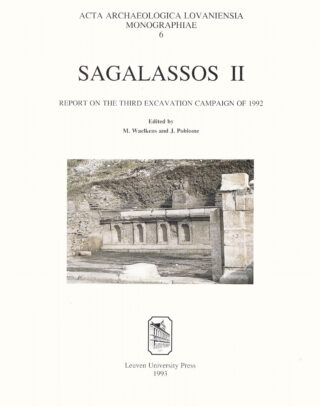
Sagalassos II
Report on the third excavation campaign of 1992
Jeroen Poblome (Author), Marc Waelkens (Author),
Sagalassos, once the metropolis of the Western Taurus range (Pisidia, Turkey), was only thoroughly surveyed in 1884 and 1885 by an Austrian team directed by K. Lanckoronski. In 1986-1989 this work was resumed by a British-belgian team co-directed by Dr. Stephen Mitchell (University College of Swansea) and by Prof. Dr. Marc Waelkens (Catholic University of Leuven). In 1990 Sagalassos became a full scale Belgian project and a leading centre for interdisciplinary archaeological and archaeometrical research.
Due to its altitude, the site is one of the best preserved towns from classical antiquity, with a rich architectural and sculptural tradtion dating from the second century BC to the sixth century AD. From early Imperial times untiel the early Byzantine period a complete range of coarse and red slip wares was produced locally. Excavations are concentrated on qthe upper and lower agoras to document the plitical and commercial life in the town and also in the area where a late Hellenistic fountain house, which stll functions to date, and a Roman library were discovered. Major efforts are undertaken to restore the excavated monuments in their old glory. Several disciplines integrate the town again within its ancient environment and document the central role which Sagalassos played in the area.
The 1992 Season at Sagalassos. A Preliminary Report
M. Waelkens
The Excavation of a late Hellenistic Fountain House and its Surroundings (Site N). An interim report
M. Waelkens
The Nymphaeum at Sagalassos and the Anastylosis
T. Patricio and K. Van Balen
The Inscriptions on the Neon-Library of Roman Sagalassos
H. Devijver
A Preliminary Report on the Excavations at Site W, 1992. Sagalassos Ware and Faunal Remains
R. Degeest, J. Poblome and B. De Cupere
Remains of an Antonine Monument at Sagalassos
L. Vandeput
A Model of Ceramic Evolution. The Pottery Found at Site N
J. Poblome and R. Degeest
Some Late Roman Unguentaria in Sagalassos
R. Degeest
Some Wheelmade Lamps of Sagalassos. A Preliminary Note
E. Scheltens
Mineralogy and Firing Properties of Clays at and near the Archaeological Site of Sagalassos
R. Otteburgs, W. Viaene, C. Jorissen
Analysis of Slip of Sagalassos Ware
W. Viaene, A. Bocquet, R. Degeest and J. Poblome
The Physical Environment at Sagalassos (Western Taurus, Turkey). A Reconnaissance Survey
E. Paulissen, J. Poesen, G. Govers and J. De Ploey
Catalogue of the Coins Found in 1992
S. Scheers
Etude anthropologique des crânes d’époque romaine de Sagalassos
C. Charlier
Some Aspects of the Bone-Working Industry in Roman Sagalassos
B. De Cupere, W. Van Neer and A. Lentacker
Jeroen Poblome
Jeroen Poblome is full professor at KU Leuven and member of the Sagalassos Archeological Research Project since 1991. He was director from 2013 to 2023.
Marc Waelkens
Marc Waelkens is Professor of Eastern Mediterranean Archaeology and director of the Sagalassos Archaeological Research Project and the Centre for Archaeological Sciences at KU Leuven.
Frequently Asked Questions
What is "Sagalassos II" about?
Sagalassos, once the metropolis of the Western Taurus range (Pisidia, Turkey), was only thoroughly surveyed in 1884 and 1885 by an Austrian team directed by K. Lanckoronski. In 1986-1989 this work was resumed by a British-belgian team co-directed by Dr. Stephen Mitchell (University College of Swansea) and by Prof. Dr. Marc Waelkens (Catholic University of Leuven). In 1990 Sagalassos became a full scale Belgian project and a leading centre for interdisciplinary archaeological and archaeometrical research.
Due to its altitude, the site is one of the best preserved towns from classical antiquity, with a rich architectural and sculptural tradtion dating from the second century BC to the sixth century AD. From early Imperial times untiel the early Byzantine period a complete range of coarse and red slip wares was produced locally. Excavations are concentrated on qthe upper and lower agoras to document the plitical and commercial life in the town and also in the area where a late Hellenistic fountain house, which stll functions to date, and a Roman library were discovered. Major efforts are undertaken to restore the excavated monuments in their old glory. Several disciplines integrate the town again within its ancient environment and document the central role which Sagalassos played in the area.
Who wrote "Sagalassos II"?
"Sagalassos II" was written by Jeroen Poblome and Marc Waelkens.
Jeroen Poblome is full professor at KU Leuven and member of the Sagalassos Archeological Research Project since 1991. He was director from 2013 to 2023.
Marc Waelkens is Professor of Eastern Mediterranean Archaeology and director of the Sagalassos Archaeological Research Project and the Centre for Archaeological Sciences at KU Leuven.
Is "Sagalassos II" part of a series?
Yes, "Sagalassos II" is part of the "Sagalassos" series. It's book 6 in the series.
What is the Table of Contents for "Sagalassos II"?
The 1992 Season at Sagalassos. A Preliminary Report
M. Waelkens
The Excavation of a late Hellenistic Fountain House and its Surroundings (Site N). An interim report
M. Waelkens
The Nymphaeum at Sagalassos and the Anastylosis
T. Patricio and K. Van Balen
The Inscriptions on the Neon-Library of Roman Sagalassos
H. Devijver
A Preliminary Report on the Excavations at Site W, 1992. Sagalassos Ware and Faunal Remains
R. Degeest, J. Poblome and B. De Cupere
Remains of an Antonine Monument at Sagalassos
L. Vandeput
A Model of Ceramic Evolution. The Pottery Found at Site N
J. Poblome and R. Degeest
Some Late Roman Unguentaria in Sagalassos
R. Degeest
Some Wheelmade Lamps of Sagalassos. A Preliminary Note
E. Scheltens
Mineralogy and Firing Properties of Clays at and near the Archaeological Site of Sagalassos
R. Otteburgs, W. Viaene, C. Jorissen
Analysis of Slip of Sagalassos Ware
W. Viaene, A. Bocquet, R. Degeest and J. Poblome
The Physical Environment at Sagalassos (Western Taurus, Turkey). A Reconnaissance Survey
E. Paulissen, J. Poesen, G. Govers and J. De Ploey
Catalogue of the Coins Found in 1992
S. Scheers
Etude anthropologique des crânes d'époque romaine de Sagalassos
C. Charlier
Some Aspects of the Bone-Working Industry in Roman Sagalassos
B. De Cupere, W. Van Neer and A. Lentacker
Related titles
 German–Rapanui Entanglements
Cristián Moreno Pakarati (Editor), Diego Muñoz (Editor), Philipp Schorch (Editor),
August 2026

 Of Goblins and Gods
Andrew J. Shortland (Editor), Victoria Kemp (Editor), Lasse Hermansen Bjørnland (Editor), Patrick Degryse (Editor),
February 2026
 Modern Etruscans
Chiara Zampieri (Editor), Martina Piperno (Editor), Bart Van den Bossche (Editor),
October 2023
 The Elemental Analysis of Glass Beads
Laure Dussubieux (Editor), Heather Walder (Editor),
October 2022
 Mapping Landscapes in Transformation
Thomas Coomans (Editor), Bieke Cattoor (Editor), Krista De Jonge (Editor),
June 2019
 The Lower to Middle Palaeolithic Transition in Northwestern Europe
Ann Van Baelen (Author),
October 2017
 Minoan Earthquakes
Simon Jusseret (Editor), Manuel Sintubin (Editor), Jan Driessen (Preface by),
April 2017
 Handheld XRF for Art and Archaeology (paperback)
Aaron N. Shugar (Editor), Jennifer L. Mass (Editor),
November 2013
 Handheld XRF for Art and Archaeology
Aaron N. Shugar (Editor), Jennifer L. Mass (Editor),
March 2013
 Chert Quarrying, Lithic Technology, and a Modern Human Burial at the Palaeolithic Site of Taramsa 1, Upper Egypt
Philip Van Peer (Author), Pierre M. Vermeersch (Author), Etienne Paulissen (Author),
April 2010
 Isotopes in Vitreous Materials
Patrick Degryse (Editor), Julian Henderson (Editor), Greg Hodgins (Editor),
March 2013
 Etude anthropologique du squelette du Paléolithique supérieur de Nazlet Khater 2 (Egypte)
Isabelle Crevecoeur (Author),
December 2008
 A Holocene Prehistoric Sequence in the Egyptian Red Sea Area: The Tree Shelter
Pierre M. Vermeersch (Editor),
July 2008