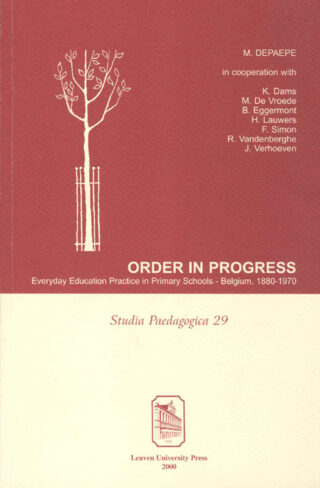
Order in progress
Everyday education practice in primary schools: Belgium 1880-1970
Marc Depaepe (Author), J. Verhoeven (Author),
It is plain from any survey in the history of education that little is known about the actual developments at “chalkface”. The classroom remains something of a black box in educational history, which has yet to give up its secrets.
Since the end of the 18th century, a number of basic mechanisms have been at work in the field of education, mechanisms that may be viewed as rules underpinning Western educational mentality and reality. One essential characteristic of an “educationalised” society is for instance the desire for order and regularity, to which the title of the book refers. It paraphrases the motto of Brazil, which appears in the nation’s flag: “order and progress”. By turning “and” into “in” the authors, however, wish to suggest not only that the order in question was always viewed in terms of progress, but also that it was inescapebly governed by the development of society. Despite the great continuity of “order” and discipline, educational behaviour invariably developed against a background of social progress.
The authors attempt to capture the distinction between internal dynamism and external development – between discontinuity and continuity, if you will – by developing in the first chapter an appropriate method for “classroom history”- a concept they have forged by analogy of “curriculum history”. Focusing on the Belgian case, the history of teaching and educating in primary schools is analysed in the following chapters. To test the hypothetical continuity of educational behaviour, a deliberate choice has been made for three key periods, in which the social situation varied significantly: the 1880s, the 1930s and 1960s.
This study leads to the intriguing conclusion that the everyday educational behaviour in primary schools became steadily more formalised and structured. In this sense it seems justifiable to speak of a “grammar” of educationalisation as a complement to the “grammar of schooling”, depicted by Tyack, Tobin, Cuban and other researchers. The often unwritten, though nevertheless fairly well established rules of the school, that have weighed against educational reform, could not be separated from their basic pedagogical semantics. Better education ought to produce more independent people. The pedagogical paradox with which teachers were constantly confronted was, however, that this emancipatory goal implied increasing independence from a pre-imposed curriculum. The school, as both a prefigurative reflection and reduced version of real life, demanded the compromise between freedom in constraint. This was the context in which children had to be able to develop under the expert guidance of their “master’s” hand – a hand that had to be firm yet as imperceptible as possible.
Developing a theoretical framework for the history of educational reality in the classroom
- ‘The ghost in the machine’: teaching in the 1880s
- Educational reform as ‘explosante-fixe’: teaching in the 1930s
- Teaching in the 1960s: the end of schooling?
- ‘You don’t catch flies with vinegar’: Educating in the1880s
- Educating in the 1930s: criticism without alternatives?
- ‘The joy of working’: educating in the 1960s
Conclusion
Bibliography
Frequently Asked Questions
What is "Order in progress" about?
It is plain from any survey in the history of education that little is known about the actual developments at "chalkface". The classroom remains something of a black box in educational history, which has yet to give up its secrets.
Since the end of the 18th century, a number of basic mechanisms have been at work in the field of education, mechanisms that may be viewed as rules underpinning Western educational mentality and reality. One essential characteristic of an "educationalised" society is for instance the desire for order and regularity, to which the title of the book refers. It paraphrases the motto of Brazil, which appears in the nation's flag: "order and progress". By turning "and" into "in" the authors, however, wish to suggest not only that the order in question was always viewed in terms of progress, but also that it was inescapebly governed by the development of society. Despite the great continuity of "order" and discipline, educational behaviour invariably developed against a background of social progress.
The authors attempt to capture the distinction between internal dynamism and external development - between discontinuity and continuity, if you will - by developing in the first chapter an appropriate method for "classroom history"- a concept they have forged by analogy of "curriculum history". Focusing on the Belgian case, the history of teaching and educating in primary schools is analysed in the following chapters. To test the hypothetical continuity of educational behaviour, a deliberate choice has been made for three key periods, in which the social situation varied significantly: the 1880s, the 1930s and 1960s.
This study leads to the intriguing conclusion that the everyday educational behaviour in primary schools became steadily more formalised and structured. In this sense it seems justifiable to speak of a "grammar" of educationalisation as a complement to the "grammar of schooling", depicted by Tyack, Tobin, Cuban and other researchers. The often unwritten, though nevertheless fairly well established rules of the school, that have weighed against educational reform, could not be separated from their basic pedagogical semantics. Better education ought to produce more independent people. The pedagogical paradox with which teachers were constantly confronted was, however, that this emancipatory goal implied increasing independence from a pre-imposed curriculum. The school, as both a prefigurative reflection and reduced version of real life, demanded the compromise between freedom in constraint. This was the context in which children had to be able to develop under the expert guidance of their "master's" hand - a hand that had to be firm yet as imperceptible as possible.
Who wrote "Order in progress"?
"Order in progress" was written by Marc Depaepe and J. Verhoeven.
Marc Depaepe is Professor of History of Education at KU Leuven.
Is "Order in progress" part of a series?
Yes, "Order in progress" is part of the "Studia Paedagogica" series. It's book 29 in the series.
Editorial Board
Prof. Dr. M. Depaepe (Chairman)
Prof. Dr. G. Kelchtermans
Prof. Dr. B. Maes
Prof. Dr. J. Vandenabeele (Secretary)
Prof. Dr. W. Van Den Noortgate
What is the Table of Contents for "Order in progress"?
Developing a theoretical framework for the history of educational reality in the classroom
- 'The ghost in the machine': teaching in the 1880s
- Educational reform as 'explosante-fixe': teaching in the 1930s
- Teaching in the 1960s: the end of schooling?
- 'You don't catch flies with vinegar': Educating in the1880s
- Educating in the 1930s: criticism without alternatives?
- 'The joy of working': educating in the 1960s
Conclusion
Bibliography
Related titles
 Teaching About the Violent Past
Line Kuppens (Author), Justin Sheria Nfundiko (Author),
October 2025

 Leren in maatschappelijk betrokken onderwijs – derde, grondig herziene editie
Jan Elen (Editor), Andy Thys (Editor),
September 2025
 Academische vrijheid
Sarah Van Ruyskensvelde (Editor), Kaat Wils (Editor), Rajesh Heynickx (Editor),
June 2025
 Student Notes from Latin Europe (1400–1750)
Xander Feys (Editor), Maxime Maleux (Editor), Andy Peetermans (Editor), Raf Van Rooy (Editor),
May 2025
 Wiskunde voor economen: concepten en technieken uit de lineaire algebra – Tweede editie
Johan Quaegebeur (Author), Wim Schoutens (Author), Naci Tanrıöven (Author), Paulien Vandereyt (Author),
June 2022
 Ons verste verleden
Tim Puttevils (Author), Bart Vanmontfort (Author), Karel Van Nieuwenhuyse (Author), Philip Van Peer (Author),
April 2020
 Financing Quality Education for All
Kristof De Witte (Author), Vitezslav Titl (Author), Oliver Holz (Author), Mike Smet (Author),
September 2019
 Van blokdruk tot blog
Koenraad Brosens (Author), Lieve De Wachter (Author), Margot D'Hertefelt (Author),
September 2018
 Digitale geletterdheid
Tom Willaert (Author), Dirk Speelman (Author), Fred Truyen (Author),
September 2018
 Hoe historici geschiedenis schrijven
Jolien Gijbels (Author), Koen Lagae (Author), Karel Van Nieuwenhuyse (Author),
February 2018
 Herinneringen aan de Holocaust
Koen Lagae (Author), Saartje Vanden Borre (Author), Karel Van Nieuwenhuyse (Author),
October 2016
 Afterschool
Nancy Vansieleghem (Editor), Joris Vlieghe (Editor), Pieter Verstraete (Editor),
October 2015
 The Forgotten Contribution of the Teaching Sisters
Bart Hellinckx (Author), Frank Simon (Author), Marc Depaepe (Author),
March 2013
 An Educational Pilgrimage to the United States. Un pèlerinage psycho-pédagogique aux États-Unis.
Marc Depaepe (Editor), Lieven D'hulst (Editor),
July 2011
 In the best interests of children and youth
Hans Grietens (Author), Walter Hellinckx (Author), Willy Lahaye (Author),
November 2005
 Powerful environments for promoting deep conceptual and strategic learning
Lieven Verschaffel (Author), M. Valcke (Author), E. De Corte (Author), G. Kanselaar (Author),
August 2005