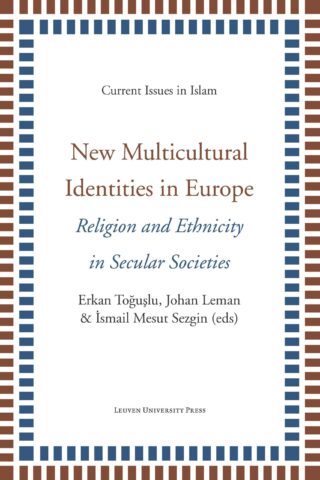

New Multicultural Identities in Europe
Religion and Ethnicity in Secular Societies
Erkan Toguslu (Editor), Johan Leman (Editor), Ismail Mesut Sezgin (Editor),

Series: Current Issues in Islam 1
Category: Diversity and Equity Studies, Migration Studies, Religion, Social Science
Language: English
ISBN: 9789058679819
Publication date: January 30, 2014
€41.50 (including 6% VAT)
Buy NowNumber of pages: 246
Size: 240 x 160 x 10 mm

Stock item: 84653
Standard delivery time for print books:
For Belgium: 5 to 8 working days
For EU: 2 to 3 weeks
For other countries: 4 to 5 weeks
Series: Current Issues in Islam 1
Category: Diversity and Equity Studies, Migration Studies, Religion, Social Science
Language: English
DOI: 10.11116/NMIE_CII
ISBN: 9789461661302
Publication date: January 30, 2014
Download Free PDFNumber of pages: 246
Multiculturalism in present-day Europe
How to understand Europe’s post-migrant Islam on the one hand and indigenous, anti-Islamic movements on the other? What impact will religion have on the European secular world and its regulation? How do social and economic transitions on a transnational scale challenge ethnic and religious identifications? These questions are at the very heart of the debate on multiculturalism in present-day Europe and are addressed by the authors in this book. Through the lens of post-migrant societies, manifestations of identity appear in pluralized, fragmented, and deterritorialized forms. This new European multiculturalism calls into question the nature of boundaries between various ethnic-religious groups, as well as the demarcation lines within ethnic-religious communities. Although the contributions in this volume focus on Islam, ample attention is also paid to Christianity, Judaism, and Hinduism. The authors present empirical data from cases in Turkey, Germany, France, Spain, the United Kingdom, Poland, Norway, Sweden, and Belgium, and sharpen the perspectives on the religious-ethnic manifestations of identity in the transnational context of 21st-century Europe.
Ebook available in Open Access.
This publication is GPRC-labeled (Guaranteed Peer-Reviewed Content).
Contributors
Chris Allen (University of Birmingham), Cüneyt Dinç (Süleyman Şah University, Istanbul), Frédérique Harry (University of Paris-Sorbonne), Goedroen Juchtmans (KU Leuven and IKKS, Antwerp), Vincent Legrand (Université catholique de Louvain), Johan Leman (KU Leuven), Kathryn Lum (European University Institute, Florence), Marcel Meciar (Yeditepe University, Istanbul), Ephraim Nimni (Queen’s University Belfast), Murat Sevencan (Suleyman Sah University, Istanbul), İsmail Mesut Sezgin (Leeds Metropolitan University), Erkan Toğuşlu (KU Leuven), Katarzyna Warmińska (Cracow University)
Introduction
1. The Manifestation of Identities in a Plural Post-Secular Europe
Johan Leman, Erkan Toğuşlu and İsmail Mesut Sezgin
Part I: Post-Migrant Interactions/Identifications
2. New and Old Identity Patterns of Religious Young Muslims in Germany
Cüneyd Dinç
3. Connecting Home and School: on the Second generation Muslim Children’s Agency in Belgian Schools
Goedroen Juchtmans
4. Immigrant Identity, Social Adaptation and Post-Secular Society in Europe
Marcel MeÄiar
5. Manufacturing Self-Respect: Stigma, Pride and Cultural Juggling among Dalit Youth in Spain
Kathryn Lum
6. A Case of Euro-Muslimness in Poland? The Polish Tartars
Katarzyna Warminska
Part II. Non-Migrant, Anti-Islam Interactions/Identifications
7. ‘Anti-Islamisation of Europe’ Activism or the Phenomenon of an Allegedly ‘Non-Racist’ Islamophobia
Vincent Legrand
8. Discourses on Religion and Identity in Norway. Right-Wing Radicalism and Anti-Immigration Parties
Frédérique Harry
9. Competing Forms of Identity and the Concept of Sovereignty in Europe
Murat Sevencan
10. Democratic Theory and the Autonomy of Non-Christian Religious Courts in the UK
Ephraim Nimni
11. Islamophobia and the Rise of Europe’s Multiculturalism
Chris Allen
Conclusion
12. Ethnic-Religious Intersections and New Multiculturalism
Johan Leman, Erkan Toğuşlu and İsmail Mesut Sezgin
About the authors
Frequently Asked Questions
What is "New Multicultural Identities in Europe" about?
Multiculturalism in present-day Europe
How to understand Europe’s post-migrant Islam on the one hand and indigenous, anti-Islamic movements on the other? What impact will religion have on the European secular world and its regulation? How do social and economic transitions on a transnational scale challenge ethnic and religious identifications? These questions are at the very heart of the debate on multiculturalism in present-day Europe and are addressed by the authors in this book. Through the lens of post-migrant societies, manifestations of identity appear in pluralized, fragmented, and deterritorialized forms. This new European multiculturalism calls into question the nature of boundaries between various ethnic-religious groups, as well as the demarcation lines within ethnic-religious communities. Although the contributions in this volume focus on Islam, ample attention is also paid to Christianity, Judaism, and Hinduism. The authors present empirical data from cases in Turkey, Germany, France, Spain, the United Kingdom, Poland, Norway, Sweden, and Belgium, and sharpen the perspectives on the religious-ethnic manifestations of identity in the transnational context of 21st-century Europe.
Ebook available in Open Access.
This publication is GPRC-labeled (Guaranteed Peer-Reviewed Content).
Contributors
Chris Allen (University of Birmingham), Cüneyt Dinç (Süleyman Şah University, Istanbul), Frédérique Harry (University of Paris-Sorbonne), Goedroen Juchtmans (KU Leuven and IKKS, Antwerp), Vincent Legrand (Université catholique de Louvain), Johan Leman (KU Leuven), Kathryn Lum (European University Institute, Florence), Marcel Meciar (Yeditepe University, Istanbul), Ephraim Nimni (Queen's University Belfast), Murat Sevencan (Suleyman Sah University, Istanbul), İsmail Mesut Sezgin (Leeds Metropolitan University), Erkan Toğuşlu (KU Leuven), Katarzyna Warmińska (Cracow University)
Who edited "New Multicultural Identities in Europe"?
"New Multicultural Identities in Europe" was edited by Erkan Toguslu, Johan Leman and Ismail Mesut Sezgin.
Erkan Toğuşlu is Assistant Professor of Anthropology at KU Leuven University, Gülen Chair for Intercultural Studies.
Johan Leman is professor emeritus of Social and Cultural Anthropology at KU Leuven and President of FOYER, a regional minorities centre in Brussels.
İsmail Mesut Sezgin is PhD researcher of the Institute for Spirituality, Religion and Public Life at Leeds Metropolitan University.
Is "New Multicultural Identities in Europe" part of a series?
Yes, "New Multicultural Identities in Europe" is part of the "Current Issues in Islam" series. It's book 1 in the series.


The publications in the series provide insight into the daily life and major developments within intercultural and interreligious settings where Islam features as an important dynamic. They bring original, well-researched, and critical appraisals that aim to contribute to the on-going academic debate in this field as well as providing insights to policymakers and stakeholders working to develop and deliver new ideas for social cohesion and peaceful community relations.
Editorial board
Is "New Multicultural Identities in Europe" available Open Access?
Yes, "New Multicultural Identities in Europe" is published Open Access. It is available under a BY-NC license.
What is the Table of Contents for "New Multicultural Identities in Europe"?
Introduction
1. The Manifestation of Identities in a Plural Post-Secular Europe
Johan Leman, Erkan Toğuşlu and İsmail Mesut Sezgin
Part I: Post-Migrant Interactions/Identifications
2. New and Old Identity Patterns of Religious Young Muslims in Germany
Cüneyd Dinç
3. Connecting Home and School: on the Second generation Muslim Children's Agency in Belgian Schools
Goedroen Juchtmans
4. Immigrant Identity, Social Adaptation and Post-Secular Society in Europe
Marcel MeÄiar
5. Manufacturing Self-Respect: Stigma, Pride and Cultural Juggling among Dalit Youth in Spain
Kathryn Lum
6. A Case of Euro-Muslimness in Poland? The Polish Tartars
Katarzyna Warminska
Part II. Non-Migrant, Anti-Islam Interactions/Identifications
7. 'Anti-Islamisation of Europe' Activism or the Phenomenon of an Allegedly 'Non-Racist' Islamophobia
Vincent Legrand
8. Discourses on Religion and Identity in Norway. Right-Wing Radicalism and Anti-Immigration Parties
Frédérique Harry
9. Competing Forms of Identity and the Concept of Sovereignty in Europe
Murat Sevencan
10. Democratic Theory and the Autonomy of Non-Christian Religious Courts in the UK
Ephraim Nimni
11. Islamophobia and the Rise of Europe's Multiculturalism
Chris Allen
Conclusion
12. Ethnic-Religious Intersections and New Multiculturalism
Johan Leman, Erkan Toğuşlu and İsmail Mesut Sezgin
About the authors
What is the DOI for "New Multicultural Identities in Europe"?
The Digital Object Identifier (DOI) for "New Multicultural Identities in Europe" is 10.11116/NMIE_CII.
Related titles


 The Romero Memory
Judith Gruber (Editor), Jonas Van Mulder (Editor), Stephan Parmentier (Editor), Veerle Draulans (Editor), Joren Janssens (Editor), Jacques Haers (Editor), Kim Christiaens (Editor),
December 2026
 Infrastructuring Arrival
Karel Arnaut (Editor), Luce Beeckmans (Editor), Bruno Meeus (Editor),
November 2026
 Feminists Resisting Gendered Violence
Hemangini Gupta (Editor), Fiona Mackay (Editor), Jan Breckenridge (Editor), Louise Chappell (Editor), Rachna Mehra (Editor), Rukmini Sen (Editor), Mailin Suchting (Editor),
October 2026
 German–Rapanui Entanglements
Cristián Moreno Pakarati (Editor), Diego Muñoz (Editor), Philipp Schorch (Editor),
August 2026

 Nomadic Camera
Burcu Dogramaci (Editor), Winfried Gerling (Editor), Jens Jäger (Editor), Birgit Mersmann (Editor),
March 2026
 Teaching About the Violent Past
Line Kuppens (Author), Justin Sheria Nfundiko (Author),
October 2025
 Interculturaliteit en de geesteswetenschappen – tweede, herziene editie
Idesbald Goddeeris (Editor), Nadia Lie (Editor), Stefania Marzo (Editor),
September 2025
 Integration Otherwise Inspiration Kit
Luce Beeckmans (Author), Dounia Salamé (Author), Martina Bovo (Author), Mary Hogan (Author),
June 2025