

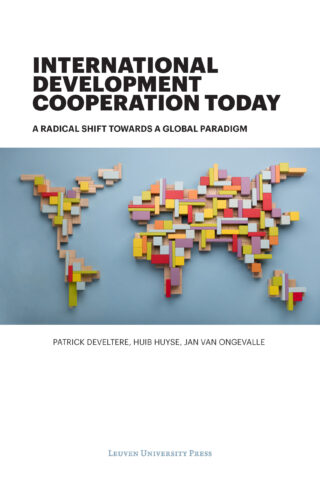
Beyond the traditional North-South perspective
Over the past 60 years high-income countries have invested over 4000 billion euros in development aid. With varying degrees of success, these investments in low-income countries contributed to tackling structural problems such as access to water, health care, and education. Today, however, international development cooperation is no longer restricted to helping by giving. Instead, it is rather about opportunities, mutual interests, risk taking, and an inclusive societal approach. With the arrival of major new actors such as China, India, and Brazil, and the manifestation of private companies and foundations like the Bill and Melinda Gates Foundation, development aid is being eclipsed by new forms of international cooperation, increasingly accompanied by investments, trade, and give-and-take exchanges.
The agenda for sustainable development, adopted by all United Nations Member States in 2015 and to be realised by 2030, is a case in point of new influential frameworks that usher in a global rather than a traditional North-South perspective.
This book reviews 60 years of international development aid and its relevant actors, outlining today’s challenges and opportunities. Richly illustrated with case studies and examples, International Development Cooperation Today maps successes and failures and synthesises visions and discussions from all over the world. By pointing out the radical shift from the traditional North-South perspective to a global paradigm, this book is essential reading for all practitioners, academics, and donors involved in development aid.
List of figures
List of tables
List of boxes
Abbreviations
Preface
Introduction
Development cooperation in an era of globalisationMore and more new actors on the scene: is the sector still a community?
Big donors, generous donors
More conflicting views and approaches: the arena is getting tough
More transactional interests: market appeal
Do new donors have other interests?
Everybody from payers to players: the emergence of a new paradigm
From colonialism to the Sustainable Development GoalsColonial warm-up exercises
Technical cooperation and knowledge transfer
Faith in development aid
Development cooperation: aid in a global setting
The Washington Consensus and structural adjustments
International cooperation, the Millennium Development Goals and the Sustainable Development Goals
Addressing poverty in exchange for debt relief
International development cooperation and Paris: introducing order to the community and the market
The SDGs and the need for a whole-of-government and whole-of-society approach
It takes two to tangoInternationally: among specialists
Recipient countries: donor darlings and donor orphans
The first pillar: official bilateral cooperationMany small players and institutional pluralism
In search of an institutional foundation for development cooperation
Decentralisation: to reach the SDGs or also for other reasons?
The second pillar: multilateral cooperationEurope’s development cooperation patchwork
Multilateral cooperation: the UN galaxy fans out further
The third pillar: non-governmental development organisationsA movement with many faces, roles, visions and strategies
Several generations of NGDOs
A sector with many different visions and strategies
A movement with a plural support base
The sector breaks free from the NGDOs
Is the new social movement becoming an established network movement?
The fourth pillar: towards a whole-of-society approachThe key players of the fourth pillar
The fourth pillar: the children of globalisation challenge the children of the North-South
Starting from a different field
From a level ‘telling’ field to joint action
The near and distant future of a whole-of-society approach
Humanitarian aid: more dispersed or more networked?What place for emergency aid?
Overcoming the humanitarian nemesis
Cash-and-carry on the market
The unbearable lightness of the support for development cooperationThe uneasy relationship with the support base
No (more) aid fatigue?
Popular, yet little understood
Something needs to be done: but by whom?
Time for a new narrative: from development education towards education for global citizenship
Sixty years of international development cooperation: where has the bumpy road led us? 261Progress, but not for everyone
Is aid future-proof?
Are we really that generous?
Who is receiving aid?
The effectiveness and impact of development cooperation
Development cooperation: a stumbling-block?
Conclusion: the past will not come back but is still there
NotesBibliography
‘De hele ontwikkelingssector is geënt op de transfer van middelen naar het Zuiden’, zo schrijft Patrick Develtere, professor Internationale Samenwerking aan de KU Leuven. Na decennia sijpelt nu het besef door dat het anders kan én moet. [...] Ook Patrick Develtere schreef recent een werk over ontwikkelingssamenwerking, zij het meer academisch, samen met Huib Huyse en Jan Vanongevalle. Alle drie de auteurs zijn verbonden aan de KU Leuven. Hun – Engelstalige – boek heeft niet toevallig de ondertitel ‘Een radicale verschuiving naar een globaal paradigma’. Het houdt in dat ontwikkelingssamenwerking meer zal uitgaan van wederzijds belang van helper en geholpene, van risico nemen en van een grote verscheidenheid aan actoren.
John Vandaele, MO*, herfst 2021, https://www.mo.be/interview/het-gewoon-dom-om-niet-solidair-te-zijn
Throughout, International Development Cooperation Today remains eminently accessible in language and layout. Comprehension of basic concepts in international affairs, economics, and sociology are helpful but not required to follow the authors’ arguments. Although it lacks an index, the compendium offers a wealth of insights for students in advanced undergraduate courses. Postgraduate students not yet familiar with the field’s institutional landscape should find it equally enriching and inspiring. Whether or not the authors’ assertion of a radical shift holds, their nuanced and at times witty analysis of how international development cooperation has morphed into a complex web of relations and flows contributes a multifaceted perspective to global debates on development histories, practices, and the field’s uncertain future.
Daniel E. Esser, Ethics & International Affairs , Volume 36 , Issue 3 , Fall 2022 , pp. 396 - 399, DOI: https://doi.org/10.1017/S0892679422000363
Gemeengoed zijn de nieuwe tendensen in ontwikkelingssamenwerking nog niet, maar de geesten evolueren snel. Overal ter wereld staan frisse, nieuwsoortige initiatieven op de sporen. Patrick Develtere (KU Leuven) en Chris Nshimbi (University of Pretoria), beiden experten in international ontwikkelingssamenwerking, pleiten voor een denken over ontwikkeling dat niet langer op een Noord-Zuidleest is geschoeid. Weg donor, weg ontvanger. Sylvie Walreavens, Tertio, 22 maart 2023
Develtere’s conversation with Paeradigms reveals the transformation from a vertical, aid-centric approach dominated by the Global North to a more horizontal and reciprocal framework of global cooperation. This paradigm shift is pivotal and comes to life in the book International Development Cooperation Today: A Radical Shift Towards a Global Paradigm. Here, Develtere, alongside Huib Huyse and Jan Van Ongevalle, chronicles the journey of development aid through the past six decades, scrutinising its complexities, successes, and failures. - Nina Volles, Paraedigms, 10 Jan 2024, https://reci-education.ch/fr/paraedigms-navigating-the-shift-a-dialogue-on-the-global-paradigm-shift-in-international-cooperation-with-professor-patrick-develtere/
Frequently Asked Questions
What is "International Development Cooperation Today" about?
Beyond the traditional North-South perspective
Over the past 60 years high-income countries have invested over 4000 billion euros in development aid. With varying degrees of success, these investments in low-income countries contributed to tackling structural problems such as access to water, health care, and education. Today, however, international development cooperation is no longer restricted to helping by giving. Instead, it is rather about opportunities, mutual interests, risk taking, and an inclusive societal approach. With the arrival of major new actors such as China, India, and Brazil, and the manifestation of private companies and foundations like the Bill and Melinda Gates Foundation, development aid is being eclipsed by new forms of international cooperation, increasingly accompanied by investments, trade, and give-and-take exchanges.
The agenda for sustainable development, adopted by all United Nations Member States in 2015 and to be realised by 2030, is a case in point of new influential frameworks that usher in a global rather than a traditional North-South perspective.
This book reviews 60 years of international development aid and its relevant actors, outlining today’s challenges and opportunities. Richly illustrated with case studies and examples, International Development Cooperation Today maps successes and failures and synthesises visions and discussions from all over the world. By pointing out the radical shift from the traditional North-South perspective to a global paradigm, this book is essential reading for all practitioners, academics, and donors involved in development aid.
Who wrote "International Development Cooperation Today"?
"International Development Cooperation Today" was written by Patrick Develtere, Huib Huyse and Jan Van Ongevalle.
Patrick Develtere has been involved in development cooperation for over 35 years. He teaches international development cooperation at the KU Leuven.
Huib Huyse is the head of the research group “Sustainable Development” of HIVA – Research Institute for Work and Society of the KU Leuven.
Jan Van Ongevalle heads the research unit “Global Development” of HIVA – Research Institute for Work and Society of the KU Leuven.
What is the Table of Contents for "International Development Cooperation Today"?
List of figures
List of tables
List of boxes
Abbreviations
Preface
Introduction
Development cooperation in an era of globalisationMore and more new actors on the scene: is the sector still a community?
Big donors, generous donors
More conflicting views and approaches: the arena is getting tough
More transactional interests: market appeal
Do new donors have other interests?
Everybody from payers to players: the emergence of a new paradigm
From colonialism to the Sustainable Development GoalsColonial warm-up exercises
Technical cooperation and knowledge transfer
Faith in development aid
Development cooperation: aid in a global setting
The Washington Consensus and structural adjustments
International cooperation, the Millennium Development Goals and the Sustainable Development Goals
Addressing poverty in exchange for debt relief
International development cooperation and Paris: introducing order to the community and the market
The SDGs and the need for a whole-of-government and whole-of-society approach
It takes two to tangoInternationally: among specialists
Recipient countries: donor darlings and donor orphans
The first pillar: official bilateral cooperationMany small players and institutional pluralism
In search of an institutional foundation for development cooperation
Decentralisation: to reach the SDGs or also for other reasons?
The second pillar: multilateral cooperationEurope’s development cooperation patchwork
Multilateral cooperation: the UN galaxy fans out further
The third pillar: non-governmental development organisationsA movement with many faces, roles, visions and strategies
Several generations of NGDOs
A sector with many different visions and strategies
A movement with a plural support base
The sector breaks free from the NGDOs
Is the new social movement becoming an established network movement?
The fourth pillar: towards a whole-of-society approachThe key players of the fourth pillar
The fourth pillar: the children of globalisation challenge the children of the North-South
Starting from a different field
From a level ‘telling’ field to joint action
The near and distant future of a whole-of-society approach
Humanitarian aid: more dispersed or more networked?What place for emergency aid?
Overcoming the humanitarian nemesis
Cash-and-carry on the market
The unbearable lightness of the support for development cooperationThe uneasy relationship with the support base
No (more) aid fatigue?
Popular, yet little understood
Something needs to be done: but by whom?
Time for a new narrative: from development education towards education for global citizenship
Sixty years of international development cooperation: where has the bumpy road led us? 261Progress, but not for everyone
Is aid future-proof?
Are we really that generous?
Who is receiving aid?
The effectiveness and impact of development cooperation
Development cooperation: a stumbling-block?
Conclusion: the past will not come back but is still there
NotesBibliography
Related titles

 The Romero Memory
Judith Gruber (Editor), Jonas Van Mulder (Editor), Stephan Parmentier (Editor), Veerle Draulans (Editor), Joren Janssens (Editor), Jacques Haers (Editor), Kim Christiaens (Editor),
November 2026

 Infrastructuring Arrival
Karel Arnaut (Editor), Luce Beeckmans (Editor), Bruno Meeus (Editor),
November 2026
 Digital Citizenship
Peter van Baalen (Editor), Selin Gerlek (Editor), Jakko Kemper (Editor), Halil Can Kurban (Editor), Marina Tulin (Editor),
October 2026
 Feminists Resisting Gendered Violence
Hemangini Gupta (Editor), Fiona Mackay (Editor), Jan Breckenridge (Editor), Louise Chappell (Editor), Rachna Mehra (Editor), Rukmini Sen (Editor), Mailin Suchting (Editor),
October 2026
 German–Rapanui Entanglements
Cristián Moreno Pakarati (Editor), Diego Muñoz (Editor), Philipp Schorch (Editor),
August 2026
 Brusselse plaatsnamen
Iadine Degryse (Editor), Benjamin Wayens (Editor), Chantal Kesteloot (Editor), Dennis De Vriese (Editor), Matthijs Degraeve (Editor),
April 2026
 Teaching About the Violent Past
Line Kuppens (Author), Justin Sheria Nfundiko (Author),
October 2025
 Interculturaliteit en de geesteswetenschappen – tweede, herziene editie
Idesbald Goddeeris (Editor), Nadia Lie (Editor), Stefania Marzo (Editor),
September 2025
 Integration Otherwise Inspiration Kit
Luce Beeckmans (Author), Dounia Salamé (Author), Martina Bovo (Author), Mary Hogan (Author),
June 2025
 Violence and Trauma in Contemporary Performance
Sofie de Smet (Editor), Marieke Breyne (Editor), Pedzisai Maedza (Editor), Christel Stalpaert (Editor),
May 2025
 Textures of Power
Florence Bernault (Editor), Benoît Henriet (Editor), Emery Kalema (Editor),
May 2025