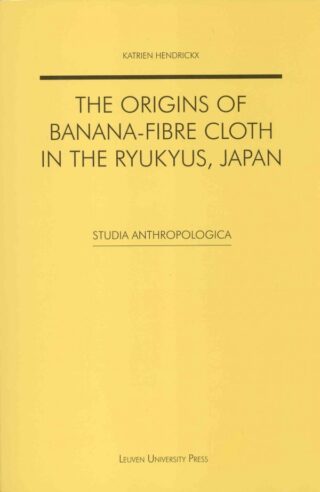
The Origins of Banana-fibre Cloth in the Ryukyus, Japan
Katrien Hendrickx (Author),
The Japanese word bashôfu literally means ‘banana-fibre cloth’. Both the cloth and the clothing made from it are now considered important constituents of Okinawan identity. This special trait of Okinawan material culture was brought to attention by the Japanese Folk Craft Movement in the 1930s. After years of decline following World War II, the weaving and use of bashôfu saw a revival that accelerated after the return of Okinawa to Japan in 1972 and still continues. Although today bashôfu receives considerable attention because of its status since 1974 as one of Japan’s important intangible cultural properties, its origins and history had remained hidden. In this book Katrien Hendrickx searches for the origins of bashôfu in the Ryukyus, including the origins of ito bashô, the plant that provides the raw material, and studies the yarn-making methods and weaving techniques. She also focuses on why and how the Ryukyuan people adopted those techniques and introduced them into their own society. By careful analysis of all available sources, considered from viewpoints that sprang from fields as various as pure history, phytohistory, philology, ethnography, and folklore, Hendrickx convincingly proves that bashôfu was introduced in the Ryukyus from Southern China, and not from Southeast Asia as is commonly argued. Her overview of present-day bashôfu-weaving and its use also provides valuable insights into the situation of folk-craft within Okinawan society during the second half of the 20th century and up to the present-day.
Part I: Historical background
1. The Ryukyu Archipelago
2. Outline of the history of Ryukyu/Okinawa and presentation of sources
Part II: Review of sources
1. Sources regarding weaving and dyeing in the ryukyu Archipelago
2. Sources regarding bashà´fu in the Ryukyu Archipelago
Part III: Musa-fibre weaving in East and Southeast Asia
1. Existing theories on the origins of ito bashà´ and banana-fibre weaving in Ryukyu
2. Sources on Musa-fibre weaving in East and Southeast Asia
Part IV: Bashà´fu in the Ryukyu Archipelago today
1. Early fieldwork
2. Taira Toshiko and the revival of banana-fibre weaving in Kijoka
3. Banana-fibre weaving as ‘important cultural property’ of Japan
4. Material examples of bashà´fu today
5. The production of bashà´fu today
6. Usefulness of the fibre banana plant
Frequently Asked Questions
What is "The Origins of Banana-fibre Cloth in the Ryukyus, Japan" about?
The Japanese word bashôfu literally means 'banana-fibre cloth'. Both the cloth and the clothing made from it are now considered important constituents of Okinawan identity. This special trait of Okinawan material culture was brought to attention by the Japanese Folk Craft Movement in the 1930s. After years of decline following World War II, the weaving and use of bashôfu saw a revival that accelerated after the return of Okinawa to Japan in 1972 and still continues. Although today bashôfu receives considerable attention because of its status since 1974 as one of Japan's important intangible cultural properties, its origins and history had remained hidden. In this book Katrien Hendrickx searches for the origins of bashôfu in the Ryukyus, including the origins of ito bashô, the plant that provides the raw material, and studies the yarn-making methods and weaving techniques. She also focuses on why and how the Ryukyuan people adopted those techniques and introduced them into their own society. By careful analysis of all available sources, considered from viewpoints that sprang from fields as various as pure history, phytohistory, philology, ethnography, and folklore, Hendrickx convincingly proves that bashôfu was introduced in the Ryukyus from Southern China, and not from Southeast Asia as is commonly argued. Her overview of present-day bashôfu-weaving and its use also provides valuable insights into the situation of folk-craft within Okinawan society during the second half of the 20th century and up to the present-day.
Who wrote "The Origins of Banana-fibre Cloth in the Ryukyus, Japan"?
"The Origins of Banana-fibre Cloth in the Ryukyus, Japan" was written by Katrien Hendrickx.
Is "The Origins of Banana-fibre Cloth in the Ryukyus, Japan" part of a series?
Yes, "The Origins of Banana-fibre Cloth in the Ryukyus, Japan" is part of the "Studia Anthropologica" series. It's book 12 in the series.
What is the Table of Contents for "The Origins of Banana-fibre Cloth in the Ryukyus, Japan"?
Part I: Historical background
1. The Ryukyu Archipelago
2. Outline of the history of Ryukyu/Okinawa and presentation of sources
Part II: Review of sources
1. Sources regarding weaving and dyeing in the ryukyu Archipelago
2. Sources regarding bashà´fu in the Ryukyu Archipelago
Part III: Musa-fibre weaving in East and Southeast Asia
1. Existing theories on the origins of ito bashà´ and banana-fibre weaving in Ryukyu
2. Sources on Musa-fibre weaving in East and Southeast Asia
Part IV: Bashà´fu in the Ryukyu Archipelago today
1. Early fieldwork
2. Taira Toshiko and the revival of banana-fibre weaving in Kijoka
3. Banana-fibre weaving as 'important cultural property' of Japan
4. Material examples of bashà´fu today
5. The production of bashà´fu today
6. Usefulness of the fibre banana plant
What is the DOI for "The Origins of Banana-fibre Cloth in the Ryukyus, Japan"?
The Digital Object Identifier (DOI) for "The Origins of Banana-fibre Cloth in the Ryukyus, Japan" is 10.11116/9789461660497.
Related titles


 German–Rapanui Entanglements
Cristián Moreno Pakarati (Editor), Diego Muñoz (Editor), Philipp Schorch (Editor),
August 2026



 Exploring the Transnational Neighbourhood
Stephan Ehrig (Editor), Britta C. Jung (Editor), Gad Schaffer (Editor),
October 2022

 Denken over religie. Deel I Van Xenophanes tot Robertson Smith
Valeer Neckebrouck (Author),
September 2021
 Across Anthropology
Margareta von Oswald (Editor), Jonas Tinius (Editor), Arjun Appadurai (Preface by), Roger Sansi (Afterword by),
June 2020



 The Debate about Colour Naming in 19th Century German Philology.
Barbara Saunders (Author),
June 2007
 The Challenges of Native American Studies
Barbara Saunders (Editor), Lea Zuyderhoudt (Editor),
April 2004

 Changing Genders in Intercultural Perspectives
Marie Claire Foblets (Author), Barbara Saunders (Author),
September 2002