

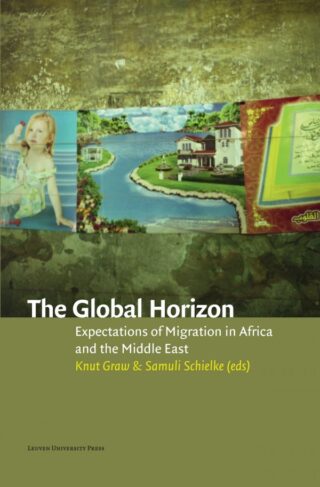

The Global Horizon
Expectations of Migration in Africa and the Middle East
Knut Graw (Editor), Samuli Schielke (Editor),

Category: African Studies, Diversity and Equity Studies, Migration Studies, Social Science
Language: English
ISBN: 9789461663993
Publication date: April 26, 2021
Download Free PDF
Imaginations, expectations, and motivations that propel the pursuit of migration
Although contemporary migration in and from Africa can be understood as a continuation of earlier forms of interregional and international migration, current processes of migration seem to have taken on a new quality. This volume argues that one of the main reasons for this is the fact that local worlds are increasingly measured against a set of possibilities whose referents are global, not local. Due to this globalization of the personal and societal horizons of possibilities in Africa and elsewhere, in many contexts migration gains an almost inevitable attraction while, at the same time, actual migration becomes increasingly restricted.
Based on detailed ethnographic accounts, the contributors to this volume focus on the imaginations, expectations, and motivations that propel the pursuit of migration. Decentring the focus of much of migration studies on the ‘receiving societies’, the volume foregrounds the subjective aspect of migration and explores the impact which the imagination and practice of migration have on the sociocultural conditions of the various local settings concerned.
This publication is GPRC-labeled (Guaranteed Peer-Reviewed Content).
Introduction: Reflections on migratory expectations in Africa and beyond
Knut Graw and Samuli Schielke
Why migrate?
On the cause of migration:Being and nothingness in the African-European border zone
Knut Graw
Bushfalling: The making of migratory expectations in Anglophone Cameroon
Maybritt Jill Alpes
Departures and non-departures
City on the move: How urban dwellers in Central Africa manage the siren’s call of migration
Filip De Boeck
Spaces in movement: Town-village interconnections in West Africa Denise Dias Barros
Migration, identity and immobility in a Malian Soninke village Gunvor Jonsson
“God’s time is the best”: Religious imagination and the wait for emigration in The Gambia
Paolo Gaibazzi
Horizons in the making
The Eiffel Tower and the eye: Actualizing modernity between Paris and Ghana
Ann Cassiman
Literacy, locality, and mobility: Writing practices and ‘cultural extraversion’ in rural Mali
Aissatou Mbodj-Pouye
Engaging the world on the Alexandria waterfront
Samuli Schielke
Afterword
Michael Jackson
Contributors
As a whole, the book is beautifully written and produced. It is a significant contribution to migration studies, in situating international migration within the context of other migration circuits, emphasizing the impossibility of
calculating losses and gains beforehand, and examining how 'The Global Horizon' becomes significant material for personal repositories, struggles, and imaginaries.
Cati Coe Rutgers University, Journal of the Royal Anthropological Institute (JRAI) Issue 20:4
The focus here is on the deep existential dilemmas of migration; how young people at great peril to their lives set out to take part in a globalized world that reaches them only in the form of 'absence' or as Knut Graw argues, as a 'non-arrival of change' (p. 33). [...] At the heart of many African migration journeys, even the high-risk forms that we see today in the Mediterranean and in the Sahara Desert, lies a continues struggle for a life worth living that is in a constant flux between local and global, between tradition and modernity, between what one has been given and what one must achieve in order to make the world one's own. In this excellent book, the dilemmas are given ethnographic context and challenge what we know about African migration.
Hans Lucht, Ethnos, 2015 (pp. 1-;2), http://dx.doi.org/10.1080/00141844.2015.1069366
Frequently Asked Questions
What is "The Global Horizon" about?
Imaginations, expectations, and motivations that propel the pursuit of migration
Although contemporary migration in and from Africa can be understood as a continuation of earlier forms of interregional and international migration, current processes of migration seem to have taken on a new quality. This volume argues that one of the main reasons for this is the fact that local worlds are increasingly measured against a set of possibilities whose referents are global, not local. Due to this globalization of the personal and societal horizons of possibilities in Africa and elsewhere, in many contexts migration gains an almost inevitable attraction while, at the same time, actual migration becomes increasingly restricted.
Based on detailed ethnographic accounts, the contributors to this volume focus on the imaginations, expectations, and motivations that propel the pursuit of migration. Decentring the focus of much of migration studies on the ‘receiving societies', the volume foregrounds the subjective aspect of migration and explores the impact which the imagination and practice of migration have on the sociocultural conditions of the various local settings concerned.
This publication is GPRC-labeled (Guaranteed Peer-Reviewed Content).
Who edited "The Global Horizon"?
"The Global Horizon" was edited by Knut Graw and Samuli Schielke.
Knut Graw is lecturer at the University of Leuven and associated researcher at Zentrum Moderner Orient, Berlin. His current research focuses on ritual praxis and migration in Senegal, Gambia, and Spain.
Samuli Schielke is a research fellow at Zentrum Moderner Orient, Berlin. His research focuses on morality, religiosity, and aspiration in Egypt.
Is "The Global Horizon" available Open Access?
Yes, "The Global Horizon" is published Open Access. It is available under a BY-NC-ND license.
What is the Table of Contents for "The Global Horizon"?
Introduction: Reflections on migratory expectations in Africa and beyond
Knut Graw and Samuli Schielke
Why migrate?
On the cause of migration:Being and nothingness in the African-European border zone
Knut Graw
Bushfalling: The making of migratory expectations in Anglophone Cameroon
Maybritt Jill Alpes
Departures and non-departures
City on the move: How urban dwellers in Central Africa manage the siren's call of migration
Filip De Boeck
Spaces in movement: Town-village interconnections in West Africa Denise Dias Barros
Migration, identity and immobility in a Malian Soninke village Gunvor Jonsson
"God's time is the best": Religious imagination and the wait for emigration in The Gambia
Paolo Gaibazzi
Horizons in the making
The Eiffel Tower and the eye: Actualizing modernity between Paris and Ghana
Ann Cassiman
Literacy, locality, and mobility: Writing practices and 'cultural extraversion' in rural Mali
Aissatou Mbodj-Pouye
Engaging the world on the Alexandria waterfront
Samuli Schielke
Afterword
Michael Jackson
Contributors
What is the DOI for "The Global Horizon"?
The Digital Object Identifier (DOI) for "The Global Horizon" is 10.11116/9789461663993.
Related titles

 The Romero Memory
Judith Gruber (Editor), Jonas Van Mulder (Editor), Stephan Parmentier (Editor), Veerle Draulans (Editor), Joren Janssens (Editor), Jacques Haers (Editor), Kim Christiaens (Editor),
December 2026

 Infrastructuring Arrival
Karel Arnaut (Editor), Luce Beeckmans (Editor), Bruno Meeus (Editor),
November 2026
 Feminists Resisting Gendered Violence
Hemangini Gupta (Editor), Fiona Mackay (Editor), Jan Breckenridge (Editor), Louise Chappell (Editor), Rachna Mehra (Editor), Rukmini Sen (Editor), Mailin Suchting (Editor),
October 2026
 A City in Practice
Aude Tournaye (Editor), Filip De Boeck (Editor), Picha Collective (Editor),
September 2026
 German–Rapanui Entanglements
Cristián Moreno Pakarati (Editor), Diego Muñoz (Editor), Philipp Schorch (Editor),
August 2026

 Jean Katambayi Mukendi
Johannes Muselaers (Editor), Stéphane Symons (Editor), Anne-Claire Schmitz (Editor), Emma Enderby (Editor),
April 2026

 Nomadic Camera
Burcu Dogramaci (Editor), Winfried Gerling (Editor), Jens Jäger (Editor), Birgit Mersmann (Editor),
March 2026
 Comics and the Global South
Andrea Aramburú (Editor), Dibyadyuti Roy (Editor), Joe Sutliff Sanders (Editor),
February 2026
 Teaching About the Violent Past
Line Kuppens (Author), Justin Sheria Nfundiko (Author),
October 2025
 Interculturaliteit en de geesteswetenschappen – tweede, herziene editie
Idesbald Goddeeris (Editor), Nadia Lie (Editor), Stefania Marzo (Editor),
September 2025