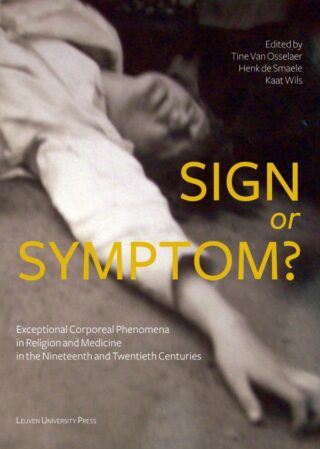
Sign or Symptom?
Exceptional Corporeal Phenomena in Religion and Medicine in the 19th and 20th Centuries
Tine Van Osselaer (Editor), Henk De Smaele (Editor), Kaat Wils (Editor),
Series: KADOC-Studies on Religion, Culture and Society 19
Category: History, History 1800-present, Religion
Language: English
ISBN: 9789461662231
Publication date: March 27, 2017
€34.00 (including 6% VAT)
Buy NowNumber of illustrations: 20
Illustrations and other content description:
20 b&w illustrations

Religion and science on paranormal events
Described as ‘the hand of God’, as ‘pathological’ or even as ‘a clever trick’, exceptional corporeal phenomena such as miraculous cures, stigmata, and incorrupt corpses have triggered heated debates in the past. Depending on their definition as either ‘supernatural’, ‘psycho-somatic’ or ‘fraudulent’, different authorities have sought to explain these enigmatic occurrences by stimulating inquiries and claiming jurisdiction over them. As a consequence, separate ecclesiastic and medical forms of expertise emerged on these issues in the nineteenth and twentieth centuries. This incommensurability has since echoed in historical analyses of paranormal events. In this book the emphasis is not placed solely on the debates within one or the other epistemological system (science or religion), but also on the crossovers and collaborations between them. Religion and science developed through a process of interaction. A changing religious climate and new religious currents provided new cases for study. Religious phenomena inspired new medical approaches such as the healing power of faith. New medical findings could be adopted to oppose new messiahs and medical imagery came to inspire the campaigns of opponents of aberrant of religious currents. Sign or Symptom? explores how the evolutions within religion and science influenced each other, a productive interaction that has been hidden from view until now.
This publication is GPRC-labeled (Guaranteed Peer-Reviewed Content).
Contributors: Ellen Amster (McMaster University), Nicole Edelman (Université de Paris-Ouest-Nanterre), Maria Heidegger (Universität Innsbruck), Mary Heimann (Cardiff University), Paula Kane (University of Pittsburgh), Sofie Lachapelle (University of Guelph), Tiago Pires Marques (Universidade de Coimbra), Tine Van Osselaer (Universiteit Antwerpen)
Introduction
Tine Van Osselaer
The Devil in the Madhouse.
On the Treatment of Religious Pathologies in Early Psychiatry, Tyrol, 1830-1850
Maria Heidegger
Gustave Boissarie, Jean-Martin Charcot and Sigmund Freud.
Three Doctors’ Responses to Some Unusual Bodily Phenomena: Convergences and Divergences (in the Late Nineteenth and Early Twentieth Centuries)
Nicole Edelman
Prophecies of Pilgrimage.
The Rise and Fall of Marie Bergadieu, the Ecstatic of Fontet
Sofie Lachapelle
Medical and Mystical Opinion in British Catholicism.
The Contentious Case of Teresa Higginson
Mary Heimann
Disenchanted America.
Accounting for the Lack of Extraordinary Mystical Phenomena in Catholic America
Paula Kane
The Mad Saint as Healer.
The Islamic Majnun in al-Kattani’s Salwat al-Anfas and in French Colonial Medicine and Sociology
Ellen J. Amster
Experiencing Religion and Medicine.
Marian Apparition and Victim Souls in Portugal, 1910-1950
Tiago Pires Marques
A Question of Competence and Authority.
Lay Views on the Medical Examinations of the Marian Apparition Series in 1930s Belgium
Tine Van Osselaer
Bibliography
Index
Contributors
Colophon
Tine Van Osselaer
Tine Van Osselaer is research professor at Universiteit Antwerpen (Ruusbroec Institute).
Henk De Smaele
Henk de Smaele is professor of history at the University of Antwerp.
Kaat Wils
Kaat Wils is gewoon hoogleraar aan de onderzoeksgroep Cultuurgeschiedenis vanaf 1750 en voorzitter van de Onderzoekseenheid Geschiedenis van de KU Leuven.
Kaat Wils is professor of European cultural history since 1750 at KU Leuven.
Academici blikken in ‘Sign or Symptom?’ terug op twee eeuwen onderzoek naar onder meer stigmata en wonderbaarlijke genezingen. Zowel kerkelijke instanties als wetenschappers hebben in die vermeende tekenen van God vaak symptomen van psychische stoornissen gezien.
Jan Brouwers, Tertio 935, 10 januari 2018
Aquí radica, esencialmente, el gran logro —entendido como contribución colectiva— de este fascinante libro, cuya lectura es muy pertinente para historiadores de la ciencia y de la medicina, investigadores de los fenómenos religiosos, profesionales de la salud y científicos sociales.Angel Martínez Hernáez, Dynamis 2018; 38 (1): 255-279
'This is an invaluable collection of essays on a topic that digs deeply into issues of great human importance, asking what “exceptional corporeal phenomena” might mean and how we might understand and possibly make use of them. It provides the historical perspective we need to dig down on the mind-body problem and the actual possibility of “miracles.” '
Michael Grosso, Reading Religion, 7 August 2018
This interesting collection of essays arose from a workshop held at Leiden in 2013. It is a welcome contribution to the growing number of studies connecting religion to medicine in the modern era. [...] the stories are truly engaging and the editorial work is superb, with convenient, concise footnotes that relate to a common bibliography and an index of proper names (but not ideas). As a whole, Sign or Symptom? stands as an engaging invitation to contemplate the power of microhistory in understanding the interplay of science and faith.Jacalyn Duffin, Isis, volume 109, number 2, june 2018
Skillnaden mellan vetenskapligt och religiöst grundade epistemologier under 1800- och 1900-talen har diskuterats i vetenskapshistoriska framställningar och då inte sällan överbetonats. Boken Sign or Symptom? visar att denna tendens till tudelning av de två epistemologiska systemen är överdriven. Det tycks snarast som att de kompletterade varandra än utgjorde varandras motpoler. De exceptionella kroppsliga fenomen som står i centrum i antologin utgör ett utomordentligt väl lämpat – och spännande – undersökningsområde för att få syn på detta. Antologins huvudtitel är således retorisk. Under den epok som bokens bidrag behandlar rörde det sig inte om en motsättning mellan religion och medicin – om tecken eller symtom – utan om att en religiös neuros kunde uppfattas som både och, det vill säga både som ett tecken på en religiös erfarenhet och som ettsymtom på en medicinskt förklarlig åkomma.Alexander Maurits, Kyrkohistorisk årsskrift 2020
Een panel van internationale academici buigt zich in deze studie over de banden tussen religie en psychiatrie in diverse contexten: hoe werden religieuze pathologieën benaderd in instellingen, mystiek versus geneeskunde in Engeland, mariale verschijningen in Portugal enzovoort. Een merkwaardige studie over een merkwaardig onderwerp dat ook vele banden heeft met België, te beginnen met Pierre De Rudder in Oostakker.
ChristusRex.be, 23/7/2017
Frequently Asked Questions
What is "Sign or Symptom?" about?
Religion and science on paranormal events
Described as ‘the hand of God’, as ‘pathological’ or even as ‘a clever trick’, exceptional corporeal phenomena such as miraculous cures, stigmata, and incorrupt corpses have triggered heated debates in the past. Depending on their definition as either ‘supernatural’, ‘psycho-somatic’ or ‘fraudulent’, different authorities have sought to explain these enigmatic occurrences by stimulating inquiries and claiming jurisdiction over them. As a consequence, separate ecclesiastic and medical forms of expertise emerged on these issues in the nineteenth and twentieth centuries. This incommensurability has since echoed in historical analyses of paranormal events. In this book the emphasis is not placed solely on the debates within one or the other epistemological system (science or religion), but also on the crossovers and collaborations between them. Religion and science developed through a process of interaction. A changing religious climate and new religious currents provided new cases for study. Religious phenomena inspired new medical approaches such as the healing power of faith. New medical findings could be adopted to oppose new messiahs and medical imagery came to inspire the campaigns of opponents of aberrant of religious currents. Sign or Symptom? explores how the evolutions within religion and science influenced each other, a productive interaction that has been hidden from view until now.
This publication is GPRC-labeled (Guaranteed Peer-Reviewed Content).
Contributors: Ellen Amster (McMaster University), Nicole Edelman (Université de Paris-Ouest-Nanterre), Maria Heidegger (Universität Innsbruck), Mary Heimann (Cardiff University), Paula Kane (University of Pittsburgh), Sofie Lachapelle (University of Guelph), Tiago Pires Marques (Universidade de Coimbra), Tine Van Osselaer (Universiteit Antwerpen)
Who edited "Sign or Symptom?"?
"Sign or Symptom?" was edited by Tine Van Osselaer, Henk De Smaele and Kaat Wils.
Tine Van Osselaer is research professor at Universiteit Antwerpen (Ruusbroec Institute).
Henk de Smaele is professor of history at the University of Antwerp.
Kaat Wils is gewoon hoogleraar aan de onderzoeksgroep Cultuurgeschiedenis vanaf 1750 en voorzitter van de Onderzoekseenheid Geschiedenis van de KU Leuven.
Kaat Wils is professor of European cultural history since 1750 at KU Leuven.
Is "Sign or Symptom?" part of a series?
Yes, "Sign or Symptom?" is part of the "KADOC-Studies on Religion, Culture and Society" series. It's book 19 in the series.


The longstanding peer-reviewed book series KADOC Studies in Religion, Culture and Society is devoted to a deeper understanding of the role of religion(s) in society in Europe and the world since 1750. By means of monographs and edited volumes, the series explores thematic frontiers and embraces innovative methodological approaches in historical, sociological and anthropological scholarship on religion, culture and society. The series particularly welcomes manuscripts adopting interreligious and transnational perspectives. Taken together, KADOC Studies in Religion, Culture and Society and its companion series KADOC Artes represent a diptych featuring the immaterial and material legacies of religions in Europe and the world from the 18th century onwards.
KADOC Studies in Religion, Culture and Society is managed by an independent Editorial Board. Books are published in English. Open Access publishing is encouraged. Financial support will be examined on a case-by-case basis and in consultation with the author.
KADOC, the Interfaculty Documentation and Research Centre on Religion, Culture and Society at KU Leuven, is an internationally oriented interdisciplinary research center as well as a heritage institution recognized by the Flemish Government with particularly rich and diverse documentary holdings.
Editorial board
Elena Arigita Maza (Universidad de Granada)
Florian Bock (Ruhr Universität Bochum)
Timothy Brittain‐Catlin (University of Cambridge)
James Chappel (Duke University)
Kim Christiaens (KADOC-KU Leuven)
Kathleen James-Chakraborty (University College Dublin)
James Kennedy (Utrecht University)
Franziska Metzger (PH Luzern)
Patrick Pasture (MoSa‐KU Leuven) - chairman
Isabelle Saint‐Martin (EPHE Paris)
Thijl Sunier (VU Amsterdam)
Árpád von Klimó (Catholic University of America)
Veerle De Laet (Leuven University Press)
Peter Heyrman (KADOC-KU Leuven) - secretary
Proposals
Proposals and enquiries can be sent to Peter Heyrman. The series welcomes monographs and edited volumes. Book proposals may relate to, for example, the political impact of religion, the dynamics between religion and welfare, and missionary history. All proposals and manuscripts are subject to double blind peer review involving at least one external reviewer (proposals) or at least two (manuscripts). The editors strive towards completing the review of proposals within two months and of complete manuscripts within five months after submission.
Please make use of the submission form to present your manuscript or proposal to our board.
Authors interested in Open Access can consult the available funding options.
Links & Resources
What is the Table of Contents for "Sign or Symptom?"?
Introduction
Tine Van Osselaer
The Devil in the Madhouse.
On the Treatment of Religious Pathologies in Early Psychiatry, Tyrol, 1830-1850
Maria Heidegger
Gustave Boissarie, Jean-Martin Charcot and Sigmund Freud.
Three Doctors’ Responses to Some Unusual Bodily Phenomena: Convergences and Divergences (in the Late Nineteenth and Early Twentieth Centuries)
Nicole Edelman
Prophecies of Pilgrimage.
The Rise and Fall of Marie Bergadieu, the Ecstatic of Fontet
Sofie Lachapelle
Medical and Mystical Opinion in British Catholicism.
The Contentious Case of Teresa Higginson
Mary Heimann
Disenchanted America.
Accounting for the Lack of Extraordinary Mystical Phenomena in Catholic America
Paula Kane
The Mad Saint as Healer.
The Islamic Majnun in al-Kattani’s Salwat al-Anfas and in French Colonial Medicine and Sociology
Ellen J. Amster
Experiencing Religion and Medicine.
Marian Apparition and Victim Souls in Portugal, 1910-1950
Tiago Pires Marques
A Question of Competence and Authority.
Lay Views on the Medical Examinations of the Marian Apparition Series in 1930s Belgium
Tine Van Osselaer
Bibliography
Index
Contributors
Colophon
What is the DOI for "Sign or Symptom?"?
The Digital Object Identifier (DOI) for "Sign or Symptom?" is 10.11116/9789461662231.
Related titles
 Margarete Schütte-Lihotzky and the Architecture of Collective Dissidence, 1918–1989
S.E. Eisterer (Author),
April 2027
 The Romero Memory
Judith Gruber (Editor), Jonas Van Mulder (Editor), Kim Christiaens (Editor), Veerle Draulans (Editor), Jacques Haers (Editor), Joren Janssens (Editor), Stephan Parmentier (Editor),
December 2026

 Toekomstdromen
Maarten Van Dijck (Editor), Gerrit Verhoeven (Editor), Hans Cools (Editor),
November 2026
 German–Rapanui Entanglements
Cristián Moreno Pakarati (Editor), Diego Muñoz (Editor), Philipp Schorch (Editor),
August 2026
 Trend en toeval – vierde editie
Bruno Blondé (Author), Isabelle Devos (Author), Jord Hanus (Author), Wouter Ryckbosch (Author),
August 2026
 Cinema in Post-War Belgium
Gertjan Willems (Editor), Bjorn Gabriels (Editor), Bénédicte Rochet (Editor),
May 2026
 Performing Magnetism
Eleonora Paklons (Editor), Kristof Smeyers (Editor), Kurt Vanhoutte (Editor), Hannah Welslau (Editor),
May 2026
 Christian Democracy and the Fall of Communism
Michael Gehler (Editor), Piotr H. Kosicki (Editor), Helmut Wohnout (Editor),
April 2026
 Political Exile in the Global Twentieth Century
Wolfram Kaiser (Editor), Piotr H. Kosicki (Editor),
April 2026
 Brusselse plaatsnamen
Iadine Degryse (Editor), Benjamin Wayens (Editor), Chantal Kesteloot (Editor), Dennis De Vriese (Editor), Matthijs Degraeve (Editor),
April 2026
 Cartographies of Catastrophes
Laura Demeter (Editor), Carmen M. Enss (Editor), Piotr Kisiel (Editor), Carol Ludwig (Editor),
February 2026