

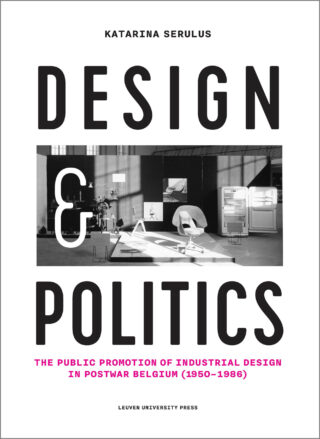
Design and Politics
The Public Promotion of Industrial Design in Postwar Belgium (1950–1986)
Katarina Serulus (Author),
Category: Architecture and Urban Planning, Art, History, History 1800-present
Language: English
ISBN: 9789462701359
Publication date: October 10, 2018
€59.50 (including 6% VAT)
Buy NowNumber of pages: 324
Size: 230 x 170 x 20 mm
Number of illustrations: 170
Illustrations and other content description:
black & white images

Stock item: 124359
Standard delivery time for print books:
For Belgium: 5 to 8 working days
For EU: 2 to 3 weeks
For other countries: 4 to 5 weeks
The unique position of design in the political context of postwar Belgium
In the postwar era, design became important as a marker of modernity and progress at world fairs and international exhibitions and in the global markets. The Belgian state took a special interest in this vanguard phenomenon of ‘industrial design’ as a vital political and economic strategic tool in the context of the Cold War and the creation of the European community. This book describes the unique position that design occupied in the political context of postwar Belgium as it analyses the public promotion of design between 1950 and 1986. It traces this process, from the first government-backed manifestations and institutions in the 1950s through the 1960s and 1970s, until design lost its privileged position as a state-backed institution, a process which culminated in the closure of the Brussels Design Centre in 1986, in the midst of the Belgian federalisation process. A key figure in this history is the policymaker Josine des Cressonnières, who played a leading role in the national and international design community and succeeded in connecting very different political worlds through the medium of design.
This publication is GPRC-labeled (Guaranteed Peer-Reviewed Content).
Acknowledgements
Introduction 1. Golden Guns 2. The Public Promotion of Industrial Design in Postwar Belgium 3. Historiography 4. Design: Tackling the Polysemic 5. Design and Politics: Constant but Uneasy Bedfellows 6. Design and the Nation-State: Avoiding the Pitfalls 7. Design Promotion and National Identity 8. Structure
PART I: Competing Visions of Design
Chapter I: Prefigurations (1950–1956) 1. Introduction: The Problem of “Design” 2. Industrial Design as the Tail End of Interwar Legacies 2.1 Social Preoccupations 2.2 Resuming Interwar Efforts to Unite the Arts and Industry 3. “Not out of Love for Art”: The Inclusion of Industrial Design in Official Policies 3.1 Jean Rey’s Policies 3.2 The Art et Travail Show in Liège 3.3 Belgian Design in Milan 4. The First Institutions for Industrial Design 4.1 The Takeoff Run in Liège 4.2 The Institute for Industrial Design for Belgium and the Grand Duchy of Luxembourg (1956) 4.3 The Signe d’Or Award (1956) 5. Conclusion: A Conglomerate of Art, Industry and Politics
Chapter II: Reconfiguring Henry van de Velde (1956–1964) 1. Introduction: Henry van de Velde at the Industrial Design Show in Liège 2. The Henry van de Velde “Myth”
2.1 The Doyen of Belgian Industrial Design 2.2 His Home Country, Belgium 3. Global Freelancer 3.1 Between Reason and Intuition 3.2 Janus-Faced Exploitation 4. Turning One’s Back on Henry van de Velde 4.1 “A Purely Industrial Society” 4.2 Connecting with International Developments 5. Conclusion: The “Myth” Dismantled
PART II: Design Promotion and Cold War Politics
Chapter III: Visions and Fantasies of “European” Design in the Early Cold War Years (1961–1970) 1. Introduction: The Gallic 16 2. The Early Stages of Design Institutionalization in Belgium: Belgian or Supranational? 2.1 The Supranational Scope 2.2 The Siren Call of Europe 2.3 The Liaison Committee for Industrial Design in the Common Market 3. European Design: A Necessary Answer 3.1 Envisioning European Design 3.2 European Design: A Collage of National Design Identities? 4. The Brussels Design Centre and the Malleable Category of the National 5. Conclusion: “European” Design, a Supranational Fantasy
Chapter IV: Design Exchanges between Brussels and Moscow in the Early 1970s 1. Introduction: Leaping over the Iron Curtain 2. The Design Center as Transnational Format 2.1 Exchanging Exhibitions 3. Belgian-Soviet Design Exchanges 3.1 Glancing behind the Iron Curtain 3.2 Belgian Design in a Socialist Realistic Jacket 4. Conclusion: “des relations bien designées…”
PART III: Crafting “Belgian” Design
Chapter V: In Search of a “National Style” (1964–1970) 1. Introduction: “Belgian” design 2. The Brussels Design Centre as an Instrument of National Prestige 3. Belgian Design Myths 4. Crafting “Belgian” Design 4.1 The Interior Design of the Brussels Design Centre 4.2 “Belgian” Design: A Product of Careful Selection 4.3 The Royal Touch 5. The Design Centre’s “Belgian” Style 5.1 “A Little More Gaiety Would Not Go Amiss” 5.2 “Anti-Modern and Anti-Democratic” 6. Promoting “Good” “Belgian” Design 7. Conclusion: Hard-to-Find “Belgian” Design
Chapter VI: C’est Belge, Ça? (1970–1983) 1. Introduction 2. The National Doctrine under Pressure 2.1 Provinces Want their Piece of the Industrial Design Pie 2.2 Divergent Understandings of Design and Crafts 2.3 Counterattack: “Operation Decentralization” 3. “C’est Belge, Ça!” 3.1 Political Tensions in the Unitary Belgian State 3.2 Reinventing Belgian Souvenirs on the Eve of Belgian Federalization 4. Design for the State 4.1 Changing Design Scene 4.2 Design Commission 5. Conclusion: The Persistence of the Belgian Design Label
Conclusion Notes Bibliography
Het zopas verschenen 'Design & Politics. The Public Promotion of Industrial Design in Postwar Belgium (1950-1986)' is een betekenisvolle uitgave in het vooralsnog weinig zichtbare domein van de Belgische designgeschiedenis. [...] dit is een designhistorische publicatie, die zich op bijzonder overtuigende wijze inschrijft in een op internationaal vlak al decennialang erkend onderzoeksveld.Fredie Floré, De Witte Raaf, Editie 196 november-december 2018
Design and Politics: The Public Promotion of Industrial Design in Postwar Belgium (1950–1986) by Katarina Serulus is a fascinating and highly informative book. [...] It contains a wealth of well-researched and contextualized information on a little-known episode of postwar design history and, as such, is well worth reading.
Katharina Pfützner, Journal of Design History, Volume 32, Issue 4, November 2019, Pages 408–410, https://doi.org/10.1093/jdh/epz033
Frequently Asked Questions
What is "Design and Politics" about?
The unique position of design in the political context of postwar Belgium
In the postwar era, design became important as a marker of modernity and progress at world fairs and international exhibitions and in the global markets. The Belgian state took a special interest in this vanguard phenomenon of ‘industrial design’ as a vital political and economic strategic tool in the context of the Cold War and the creation of the European community. This book describes the unique position that design occupied in the political context of postwar Belgium as it analyses the public promotion of design between 1950 and 1986. It traces this process, from the first government-backed manifestations and institutions in the 1950s through the 1960s and 1970s, until design lost its privileged position as a state-backed institution, a process which culminated in the closure of the Brussels Design Centre in 1986, in the midst of the Belgian federalisation process. A key figure in this history is the policymaker Josine des Cressonnières, who played a leading role in the national and international design community and succeeded in connecting very different political worlds through the medium of design.
This publication is GPRC-labeled (Guaranteed Peer-Reviewed Content).
Who wrote "Design and Politics"?
"Design and Politics" was written by Katarina Serulus.
Katarina Serulus is fellow researcher at the Faculty of Architecture at KU Leuven.
What is the Table of Contents for "Design and Politics"?
Acknowledgements
Introduction 1. Golden Guns 2. The Public Promotion of Industrial Design in Postwar Belgium 3. Historiography 4. Design: Tackling the Polysemic 5. Design and Politics: Constant but Uneasy Bedfellows 6. Design and the Nation-State: Avoiding the Pitfalls 7. Design Promotion and National Identity 8. Structure
PART I: Competing Visions of Design
Chapter I: Prefigurations (1950–1956) 1. Introduction: The Problem of “Design” 2. Industrial Design as the Tail End of Interwar Legacies 2.1 Social Preoccupations 2.2 Resuming Interwar Efforts to Unite the Arts and Industry 3. “Not out of Love for Art”: The Inclusion of Industrial Design in Official Policies 3.1 Jean Rey’s Policies 3.2 The Art et Travail Show in Liège 3.3 Belgian Design in Milan 4. The First Institutions for Industrial Design 4.1 The Takeoff Run in Liège 4.2 The Institute for Industrial Design for Belgium and the Grand Duchy of Luxembourg (1956) 4.3 The Signe d’Or Award (1956) 5. Conclusion: A Conglomerate of Art, Industry and Politics
Chapter II: Reconfiguring Henry van de Velde (1956–1964) 1. Introduction: Henry van de Velde at the Industrial Design Show in Liège 2. The Henry van de Velde “Myth”
2.1 The Doyen of Belgian Industrial Design 2.2 His Home Country, Belgium 3. Global Freelancer 3.1 Between Reason and Intuition 3.2 Janus-Faced Exploitation 4. Turning One’s Back on Henry van de Velde 4.1 “A Purely Industrial Society” 4.2 Connecting with International Developments 5. Conclusion: The “Myth” Dismantled
PART II: Design Promotion and Cold War Politics
Chapter III: Visions and Fantasies of “European” Design in the Early Cold War Years (1961–1970) 1. Introduction: The Gallic 16 2. The Early Stages of Design Institutionalization in Belgium: Belgian or Supranational? 2.1 The Supranational Scope 2.2 The Siren Call of Europe 2.3 The Liaison Committee for Industrial Design in the Common Market 3. European Design: A Necessary Answer 3.1 Envisioning European Design 3.2 European Design: A Collage of National Design Identities? 4. The Brussels Design Centre and the Malleable Category of the National 5. Conclusion: “European” Design, a Supranational Fantasy
Chapter IV: Design Exchanges between Brussels and Moscow in the Early 1970s 1. Introduction: Leaping over the Iron Curtain 2. The Design Center as Transnational Format 2.1 Exchanging Exhibitions 3. Belgian-Soviet Design Exchanges 3.1 Glancing behind the Iron Curtain 3.2 Belgian Design in a Socialist Realistic Jacket 4. Conclusion: “des relations bien designées…”
PART III: Crafting “Belgian” Design
Chapter V: In Search of a “National Style” (1964–1970) 1. Introduction: “Belgian” design 2. The Brussels Design Centre as an Instrument of National Prestige 3. Belgian Design Myths 4. Crafting “Belgian” Design 4.1 The Interior Design of the Brussels Design Centre 4.2 “Belgian” Design: A Product of Careful Selection 4.3 The Royal Touch 5. The Design Centre’s “Belgian” Style 5.1 “A Little More Gaiety Would Not Go Amiss” 5.2 “Anti-Modern and Anti-Democratic” 6. Promoting “Good” “Belgian” Design 7. Conclusion: Hard-to-Find “Belgian” Design
Chapter VI: C’est Belge, Ça? (1970–1983) 1. Introduction 2. The National Doctrine under Pressure 2.1 Provinces Want their Piece of the Industrial Design Pie 2.2 Divergent Understandings of Design and Crafts 2.3 Counterattack: “Operation Decentralization” 3. “C’est Belge, Ça!” 3.1 Political Tensions in the Unitary Belgian State 3.2 Reinventing Belgian Souvenirs on the Eve of Belgian Federalization 4. Design for the State 4.1 Changing Design Scene 4.2 Design Commission 5. Conclusion: The Persistence of the Belgian Design Label
Conclusion Notes Bibliography
Related titles

 Margarete Schütte-Lihotzky and the Architecture of Collective Dissidence, 1918–1989
S.E. Eisterer (Author),
April 2027
 Collective Trauma and Future Fantasies
Raika Khorshidian (Editor), Birgit Mersmann (Editor), Cathrine Bublatzky (Editor), Julia Stenzel (Editor),
November 2026


 Infrastructuring Arrival
Karel Arnaut (Editor), Luce Beeckmans (Editor), Bruno Meeus (Editor),
November 2026
 Toekomstdromen
Maarten Van Dijck (Editor), Gerrit Verhoeven (Editor), Hans Cools (Editor),
November 2026

 Feminists Resisting Gendered Violence
Hemangini Gupta (Editor), Fiona Mackay (Editor), Jan Breckenridge (Editor), Louise Chappell (Editor), Rachna Mehra (Editor), Rukmini Sen (Editor), Mailin Suchting (Editor),
October 2026


 A City in Practice
Aude Tournaye (Editor), Filip De Boeck (Editor), Picha Collective (Editor),
September 2026
 Ecologies of Photography in the American West
Monica Bravo (Editor), Carolin Görgen (Editor),
September 2026
 German–Rapanui Entanglements
Cristián Moreno Pakarati (Editor), Diego Muñoz (Editor), Philipp Schorch (Editor),
August 2026
 Trend en toeval – vierde editie
Bruno Blondé (Author), Isabelle Devos (Author), Jord Hanus (Author), Wouter Ryckbosch (Author),
August 2026
 Cinema in Post-War Belgium
Gertjan Willems (Editor), Bjorn Gabriels (Editor), Bénédicte Rochet (Editor),
May 2026

 Performing Magnetism
Eleonora Paklons (Editor), Kristof Smeyers (Editor), Kurt Vanhoutte (Editor), Hannah Welslau (Editor),
May 2026
 Christian Democracy and the Fall of Communism
Michael Gehler (Editor), Piotr H. Kosicki (Editor), Helmut Wohnout (Editor),
April 2026
 Political Exile in the Global Twentieth Century
Wolfram Kaiser (Editor), Piotr H. Kosicki (Editor),
April 2026