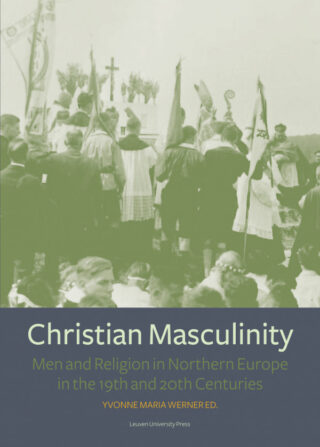

Christian Masculinity
Men and Religion in Northern Europe in the 19th and 20th Centuries
Yvonne Maria Werner (Editor),

Series: KADOC-Studies on Religion, Culture and Society 8
Category: Gender Studies, History, History 1800-present, Religion
Language: English
ISBN: 9789058678737
Publication date: June 27, 2011
€39.50 (including 6% VAT)
Buy NowNumber of pages: 324
Size: 238 x 170 x 20 mm

Stock item: 63177
Standard delivery time for print books:
For Belgium: 5 to 8 working days
For EU: 2 to 3 weeks
For other countries: 4 to 5 weeks
Series: KADOC-Studies on Religion, Culture and Society 8
Category: Gender Studies, History, History 1800-present, Religion
Language: English
ISBN: 9789461664280
Publication date: August 12, 2021
Download Free PDFNumber of pages: 324
In the mid-nineteenth century, when the idea of religion as a private matter connected to the home and the female sphere won acceptance among the bourgeois elite, Christian religious practices began to be associated with femininity and soft values. Contemporary critics claimed that religion was incompatible with true manhood, and today’s scholars talk about a feminisation of religion. But was this really the case? What expression did male religious faith take at a time when Christianity was losing its status as the foundation of society?
This is the starting point for the research presented in Christian Masculinity. Here we meet Catholic and Protestant men struggling with and for their Christian faith as priests, missionaries, and laymen, as well as ideas and reflections on Christian masculinity in media, fiction, and correspondence of various kinds. Some men engaged in social and missionary work, or strove to harness the masculine combative spirit to Christian ends, while others were eager to show the male character of Christian virtues. This book not only illustrates the importance of religion for the understanding of gender construction, but also the need to take into consideration confessional and institutional aspects of religious identity.
This publication is GPRC-labeled (Guaranteed Peer-Reviewed Content).
Studying Christian masculinity. An introduction
Yvonne Maria Werner
Part I
Key Concepts and theoretical Perspectives
The unrecognised piety of men.
Strategies and success of the re-masculinisation campaign around 1900
Olaf Blaschke
Masculinity and secularisation in twentieth-century Britain
Callum G. Brown
Part II
Visions and Ideals of Christian Manhood
Heroic men and Christian ideals
Tine Van Osselaer and Alexander Maurits
Masculinity, memory, and oblivion in the Dutch Dominican Province, 1930-1950
Marit Monteiro
The man in the clergyman. Swedish priest obituaries, 1905-1937
Anna Prestjan
Crises of faith and the making of Christian masculinities at the turn of the twentieth century
David Tjeder
Part III
Missionary Masculinity
Protestant mission in China. A proletarian perspective
Erik Sidenvall
Alternative masculinity? Catholic missionaries in Scandinavia
Yvonne Maria Werner
Part IV
Fostering Christian Men
The making of Christian men.
An evangelical mission to the Swedish army, c. 1900-1920
Elin Malmer
Danish folk high school and the creation of a new Danish man
Nanna Damsholt
Part V
Transgressing Gender Boundaries
Literary transgressions of masculinity and religion
Inger Littberger Caisou-Rousseau
A manly queen with feminine charm.
Intersectional perspectives on gender
Anders Jarlert
The new Catholic feminism.
Tradition and renewal in Catholic gender theology
Gösta Hallonsten
Bibliography
Contributors
Index
Colophon
Werner provides a significant leap forward in how we understand Christian masculinities of the time, both in terms of the masculine performances they document and the assumption that we view this period in history only through the lens of the English-speaking world.
Joseph Gelfer, Melbourne College of Divinity/AUSTRALIA, Journal of Men, Masculinities and Spirituality, Vol. 6, No. 1, January 2012 47-49
Hoewel deze bundel slechts een en een halve bijdrage bevat die betrekking hebben op de religiegeschiedenis van de Nederlanden, is hij niet zozeer daarom, maar vooral om zijn benadering, concepten en theorievorming van groot belang voor het onderzoek naar de geschiedschrijving- katholiek en protestants -van het christendom in de afgelopen twee eeuwen. De bijdragen verschaffen uitstekende aanknopingspunten om zowel het globale historische beeld van de feminisering van het negentiende-eeuwse christendom te handhaven, maar tegelijk ook scherper te krijgen hoe en waarom dat niet noodzakelijk een ontkerstening van het mannelijke deel van de kerkleden, noch een (totale) feminisering van de mannelijke functies binnen de kerk, hoefde te impliceren. Bijzonder aanbevelenswaardig.
Lodewijk Winkeler, Trajecta, Jrg 1-20, 2010-2011, aflevering 3-4
Frequently Asked Questions
What is "Christian Masculinity" about?
In the mid-nineteenth century, when the idea of religion as a private matter connected to the home and the female sphere won acceptance among the bourgeois elite, Christian religious practices began to be associated with femininity and soft values. Contemporary critics claimed that religion was incompatible with true manhood, and today's scholars talk about a feminisation of religion. But was this really the case? What expression did male religious faith take at a time when Christianity was losing its status as the foundation of society?
This is the starting point for the research presented in Christian Masculinity. Here we meet Catholic and Protestant men struggling with and for their Christian faith as priests, missionaries, and laymen, as well as ideas and reflections on Christian masculinity in media, fiction, and correspondence of various kinds. Some men engaged in social and missionary work, or strove to harness the masculine combative spirit to Christian ends, while others were eager to show the male character of Christian virtues. This book not only illustrates the importance of religion for the understanding of gender construction, but also the need to take into consideration confessional and institutional aspects of religious identity.
This publication is GPRC-labeled (Guaranteed Peer-Reviewed Content).
Who edited "Christian Masculinity"?
"Christian Masculinity" was edited by Yvonne Maria Werner.
Yvonne Maria Werner is Professor at the Department of History at the Lund University.
Is "Christian Masculinity" part of a series?
Yes, "Christian Masculinity" is part of the "KADOC-Studies on Religion, Culture and Society" series. It's book 8 in the series.


The longstanding peer-reviewed book series KADOC Studies in Religion, Culture and Society is devoted to a deeper understanding of the role of religion(s) in society in Europe and the world since 1750. By means of monographs and edited volumes, the series explores thematic frontiers and embraces innovative methodological approaches in historical, sociological and anthropological scholarship on religion, culture and society. The series particularly welcomes manuscripts adopting interreligious and transnational perspectives. Taken together, KADOC Studies in Religion, Culture and Society and its companion series KADOC Artes represent a diptych featuring the immaterial and material legacies of religions in Europe and the world from the 18th century onwards.
KADOC Studies in Religion, Culture and Society is managed by an independent Editorial Board. Books are published in English. Open Access publishing is encouraged. Financial support will be examined on a case-by-case basis and in consultation with the author.
KADOC, the Interfaculty Documentation and Research Centre on Religion, Culture and Society at KU Leuven, is an internationally oriented interdisciplinary research center as well as a heritage institution recognized by the Flemish Government with particularly rich and diverse documentary holdings.
Editorial board
Elena Arigita Maza (Universidad de Granada)
Florian Bock (Ruhr Universität Bochum)
Timothy Brittain‐Catlin (University of Cambridge)
James Chappel (Duke University)
Kim Christiaens (KADOC-KU Leuven)
Kathleen James-Chakraborty (University College Dublin)
James Kennedy (Utrecht University)
Franziska Metzger (PH Luzern)
Patrick Pasture (MoSa‐KU Leuven) - chairman
Isabelle Saint‐Martin (EPHE Paris)
Thijl Sunier (VU Amsterdam)
Árpád von Klimó (Catholic University of America)
Veerle De Laet (Leuven University Press)
Peter Heyrman (KADOC-KU Leuven) - secretary
Proposals
Proposals and enquiries can be sent to Peter Heyrman. The series welcomes monographs and edited volumes. Book proposals may relate to, for example, the political impact of religion, the dynamics between religion and welfare, and missionary history. All proposals and manuscripts are subject to double blind peer review involving at least one external reviewer (proposals) or at least two (manuscripts). The editors strive towards completing the review of proposals within two months and of complete manuscripts within five months after submission.
Please make use of the submission form to present your manuscript or proposal to our board.
Authors interested in Open Access can consult the available funding options.
Links & Resources
Is "Christian Masculinity" available Open Access?
Yes, "Christian Masculinity" is published Open Access. It is available under a BY-NC-ND license.
What is the Table of Contents for "Christian Masculinity"?
Studying Christian masculinity. An introduction
Yvonne Maria Werner
Part I
Key Concepts and theoretical Perspectives
The unrecognised piety of men.
Strategies and success of the re-masculinisation campaign around 1900
Olaf Blaschke
Masculinity and secularisation in twentieth-century Britain
Callum G. Brown
Part II
Visions and Ideals of Christian Manhood
Heroic men and Christian ideals
Tine Van Osselaer and Alexander Maurits
Masculinity, memory, and oblivion in the Dutch Dominican Province, 1930-1950
Marit Monteiro
The man in the clergyman. Swedish priest obituaries, 1905-1937
Anna Prestjan
Crises of faith and the making of Christian masculinities at the turn of the twentieth century
David Tjeder
Part III
Missionary Masculinity
Protestant mission in China. A proletarian perspective
Erik Sidenvall
Alternative masculinity? Catholic missionaries in Scandinavia
Yvonne Maria Werner
Part IV
Fostering Christian Men
The making of Christian men.
An evangelical mission to the Swedish army, c. 1900-1920
Elin Malmer
Danish folk high school and the creation of a new Danish man
Nanna Damsholt
Part V
Transgressing Gender Boundaries
Literary transgressions of masculinity and religion
Inger Littberger Caisou-Rousseau
A manly queen with feminine charm.
Intersectional perspectives on gender
Anders Jarlert
The new Catholic feminism.
Tradition and renewal in Catholic gender theology
Gösta Hallonsten
Bibliography
Contributors
Index
Colophon
Related titles
 Margarete Schütte-Lihotzky and the Architecture of Collective Dissidence, 1918–1989
S.E. Eisterer (Author),
April 2027
 The Romero Memory
Judith Gruber (Editor), Jonas Van Mulder (Editor), Stephan Parmentier (Editor), Veerle Draulans (Editor), Joren Janssens (Editor), Jacques Haers (Editor), Kim Christiaens (Editor),
December 2026
 Toekomstdromen
Maarten Van Dijck (Editor), Gerrit Verhoeven (Editor), Hans Cools (Editor),
November 2026
 Feminists Resisting Gendered Violence
Hemangini Gupta (Editor), Fiona Mackay (Editor), Jan Breckenridge (Editor), Louise Chappell (Editor), Rachna Mehra (Editor), Rukmini Sen (Editor), Mailin Suchting (Editor),
October 2026
 German–Rapanui Entanglements
Cristián Moreno Pakarati (Editor), Diego Muñoz (Editor), Philipp Schorch (Editor),
August 2026
 Trend en toeval – vierde editie
Bruno Blondé (Author), Isabelle Devos (Author), Jord Hanus (Author), Wouter Ryckbosch (Author),
August 2026
 Cinema in Post-War Belgium
Gertjan Willems (Editor), Bjorn Gabriels (Editor), Bénédicte Rochet (Editor),
May 2026
 Performing Magnetism
Eleonora Paklons (Editor), Kristof Smeyers (Editor), Kurt Vanhoutte (Editor), Hannah Welslau (Editor),
May 2026
 Political Exile in the Global Twentieth Century
Wolfram Kaiser (Editor), Piotr H. Kosicki (Editor),
April 2026
 Christian Democracy and the Fall of Communism
Michael Gehler (Editor), Piotr H. Kosicki (Editor), Helmut Wohnout (Editor),
April 2026
 Brusselse plaatsnamen
Iadine Degryse (Editor), Benjamin Wayens (Editor), Chantal Kesteloot (Editor), Dennis De Vriese (Editor), Matthijs Degraeve (Editor),
April 2026