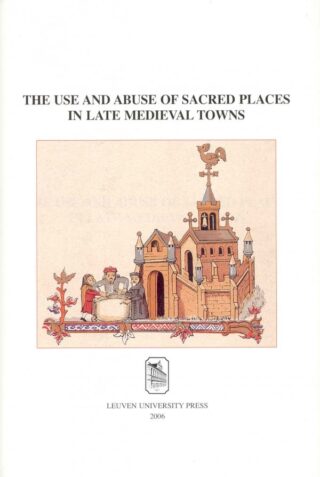
The Use and Abuse of Sacred Places in Late Medieval Towns
Paul Trio (Editor), Marjan Smet (Editor),
Reduced Price!
Now only € 10,00 instead of € 36,50
Church buildings dominated the medieval towns. Higher and stronger than most buildings in town, and often easily accessible because of their central position, they offered a venue for various kinds of activities. Naturally, the faithful first and foremost flocked towards the parish and monastic churches and chapels to attend masses, to receive the Sacraments, to offer up their prayers. But not all uses were strictly religious. Secular authorities, from the ruler to the town government, the trades or guilds, made –sometimes extensive– use of these ecclesiastical buildings, usually for practical or socio-political reasons. Indeed, ecclesiastical buildings were used for storage or preservation purposes (arms, documents, treasure, …), for defensive reasons, for accomodating large gatherings, … They were also perceived to lend a kind of sacral aura to all proceedings taking place inside, and were consequently the ideal setting for ceremonies such as crownings, for elections, meetings, …, emphasizing the legitimacy and the solemn nature of these (socio-)political activities. Apart from a mere enumeration and description of the different uses, the authors of this book also try to explain why these ‘sacred spaces’ were such appreciated venues for various kinds of secular activities, and why some churches and monasteries were more popular than other. Moreover, it will become clear that, in some cases, sacred space itself was adapted to the needs of the secular community. Naturally, the local clergy or ecclesiastical authorities could greatly influence the actual use made of these buildings, by either granting or denying the secular world the right to ‘invade’ their sacred spaces.
This book discusses uses made of churches and monasteries by secular authorities in the Low Countries, the German regions and the British Isles, focussing on the late medieval period. In this way, the reader is offered a view across borders and periods, as well as across different levels of society. Symbolic uses of churches for reasons of prestige, legitimacy or solemnity are confronted with the down-to-earth (ab)use of sacred spaces in order to survive. Long-term, traditional uses which were continued for centuries, are set against improptu decisions in answer to occasional needs or emergencies. More in particular, the topics discussed for the Low Countries range from the everyday use of parish churches (Kuys), over the use of ecclesiastical buildings for peace-proclamations (van Leeuwen), to the abuse of these buildings in times of war (De Smet), and to the representation of patronage on the paintings with which they were decorated (Dekeyzer). For the German regions, the function of these buildings for royal representation (Rahel Oesterle) and the church as a space for communication (Signori) are discussed. The London Mendicant monasteries (Röhrkasten) and a Cistercian monastery (Jamroziak) were situated within the sphere of influence of several secular authorities –among which was the court– while also the influence of urban ceremonies (Sweetinburgh) and noble patronage (Stöber) on ecclesiastical buildings in more peripheral regions receives the attention it deserves.
This book represents for the Low Countries a first attempt at the study of this subject.
Introduction
Paul Trio
Introduction
Low Countries
Marjan De Smet
Heavenly Quiet and the Din of War: Use and Abuse of Religious Buildings for Purposes of Safety, Defence and Strategy
Jan Kuys
Weltliche Funktionen spätmittelalterlicher Pfarrkirchen in den nördlichen Niederlanden
Jacoba van Leeuwen
Praise the Lord for this Peace! The Contribution of Religious Institutions to the Ceremonial Peace-Proclamations in Late Medieval Flanders (1450-1550)
Brigitte Dekeyzer
For Eternal Glory and Remembrance: On the Representation of Patrons in Late Medieval Panel Paintings in the Southern Low Countries
German Regions
Jenny Rahel Oesterle
The Liturgical Dimension of Royal Representation
Gabriela Signori
Sakral oder Profan? Der Kommunikationsraum Kirche
British Isles
Jens Röhrkasten
Secular Uses of the Mendicant Priories of Medieval London
Emilia Jamroziak
St Mary Graces: A Cistercian House in Late Medieval London
Sheila Sweetinburgh
Mayor-Making and Other Ceremonies: Shared Uses of Sacred Space among the Kentish Cinque Ports
Karen Stöber
The Role of late Medieval English Monasteries as Expressions of Patronal Authority: Some Case Studies
Conclusion
Koen Goudriaan
Conclusion
List of contributors
Index librorum manu scriptorum
Index locorum
Index nominum
Index operum
Frequently Asked Questions
What is "The Use and Abuse of Sacred Places in Late Medieval Towns" about?
Reduced Price!
Now only € 10,00 instead of € 36,50
Church buildings dominated the medieval towns. Higher and stronger than most buildings in town, and often easily accessible because of their central position, they offered a venue for various kinds of activities. Naturally, the faithful first and foremost flocked towards the parish and monastic churches and chapels to attend masses, to receive the Sacraments, to offer up their prayers. But not all uses were strictly religious. Secular authorities, from the ruler to the town government, the trades or guilds, made --sometimes extensive-- use of these ecclesiastical buildings, usually for practical or socio-political reasons. Indeed, ecclesiastical buildings were used for storage or preservation purposes (arms, documents, treasure, ...), for defensive reasons, for accomodating large gatherings, ... They were also perceived to lend a kind of sacral aura to all proceedings taking place inside, and were consequently the ideal setting for ceremonies such as crownings, for elections, meetings, ..., emphasizing the legitimacy and the solemn nature of these (socio-)political activities. Apart from a mere enumeration and description of the different uses, the authors of this book also try to explain why these 'sacred spaces' were such appreciated venues for various kinds of secular activities, and why some churches and monasteries were more popular than other. Moreover, it will become clear that, in some cases, sacred space itself was adapted to the needs of the secular community. Naturally, the local clergy or ecclesiastical authorities could greatly influence the actual use made of these buildings, by either granting or denying the secular world the right to 'invade' their sacred spaces.
This book discusses uses made of churches and monasteries by secular authorities in the Low Countries, the German regions and the British Isles, focussing on the late medieval period. In this way, the reader is offered a view across borders and periods, as well as across different levels of society. Symbolic uses of churches for reasons of prestige, legitimacy or solemnity are confronted with the down-to-earth (ab)use of sacred spaces in order to survive. Long-term, traditional uses which were continued for centuries, are set against improptu decisions in answer to occasional needs or emergencies. More in particular, the topics discussed for the Low Countries range from the everyday use of parish churches (Kuys), over the use of ecclesiastical buildings for peace-proclamations (van Leeuwen), to the abuse of these buildings in times of war (De Smet), and to the representation of patronage on the paintings with which they were decorated (Dekeyzer). For the German regions, the function of these buildings for royal representation (Rahel Oesterle) and the church as a space for communication (Signori) are discussed. The London Mendicant monasteries (Röhrkasten) and a Cistercian monastery (Jamroziak) were situated within the sphere of influence of several secular authorities --among which was the court-- while also the influence of urban ceremonies (Sweetinburgh) and noble patronage (Stöber) on ecclesiastical buildings in more peripheral regions receives the attention it deserves.
This book represents for the Low Countries a first attempt at the study of this subject.
Who edited "The Use and Abuse of Sacred Places in Late Medieval Towns"?
"The Use and Abuse of Sacred Places in Late Medieval Towns" was edited by Paul Trio and Marjan Smet.
Paul Trio is professor of Medieval History at the KU Leuven.
Is "The Use and Abuse of Sacred Places in Late Medieval Towns" part of a series?
Yes, "The Use and Abuse of Sacred Places in Late Medieval Towns" is part of the "Mediaevalia Lovaniensia" series. It's book 38 in the series.

The longstanding, peer-reviewed book series Mediaevalia Lovaniensia. Studies in Medieval History, Society, and Culture publishes high-quality scholarship on the history and culture of the Middle Ages (c. 500–1550). Topics of particular interest to the series include, but are not limited to, social behaviour and power relations in medieval society, processes of identity formation, religious and urban culture, medieval thought and literature, and gender history. The series focuses on Europe and the wider Mediterranean world and is particularly rich in interdisciplinary approaches. By means of monographs and edited volumes, the series explores thematic frontiers and embraces innovative methodological approaches in historical and philological scholarship that is based on an in-depth source-based study.
Mediaevalia Lovaniensia accepts monographs as well as thematically coherent volumes in English. Moreover, it offers scholars the possibility to publish critical editions of primary texts with broader relevance to the understanding of medieval culture and society. The series aspires to publish books that have the potential to become reference works in the field of Medieval Studies.
We encourage early career (postdoctoral) researchers to submit a reworked version of their PhD thesis to this series. Leuven University Press provides authors with two publishing scenarios: traditional (non-Open Access) and the option to publish in Open Access (including language editing).
Editorial Board
Jelle Haemers (KU Leuven)
Jeroen Deploige (Ghent University)
Brigitte Meijns (KU Leuven)
Chanelle Delameillieure (KU Leuven - KULAK)
Baudouin Van den Abeele (UCLouvain)
Proposals
Proposals and enquiries can be sent to one of the editorial board members. Please send a short abstract. Upon approval of the proposal, the full manuscript will be submitted to international blind peer review by two (external) experts. The editors strive towards completing the review of proposals within one month and of complete manuscripts within five months after submission. Manuscripts should preferably be (+/-) 80.000 to 120.000 words in length.
Please make use of the submission form to present your manuscript or proposal to our board.
Authors interested in Open Access can consult the available funding options.
Links & Resources
What is the Table of Contents for "The Use and Abuse of Sacred Places in Late Medieval Towns"?
Introduction
Paul Trio
Introduction
Low Countries
Marjan De Smet
Heavenly Quiet and the Din of War: Use and Abuse of Religious Buildings for Purposes of Safety, Defence and Strategy
Jan Kuys
Weltliche Funktionen spätmittelalterlicher Pfarrkirchen in den nördlichen Niederlanden
Jacoba van Leeuwen
Praise the Lord for this Peace! The Contribution of Religious Institutions to the Ceremonial Peace-Proclamations in Late Medieval Flanders (1450-1550)
Brigitte Dekeyzer
For Eternal Glory and Remembrance: On the Representation of Patrons in Late Medieval Panel Paintings in the Southern Low Countries
German Regions
Jenny Rahel Oesterle
The Liturgical Dimension of Royal Representation
Gabriela Signori
Sakral oder Profan? Der Kommunikationsraum Kirche
British Isles
Jens Röhrkasten
Secular Uses of the Mendicant Priories of Medieval London
Emilia Jamroziak
St Mary Graces: A Cistercian House in Late Medieval London
Sheila Sweetinburgh
Mayor-Making and Other Ceremonies: Shared Uses of Sacred Space among the Kentish Cinque Ports
Karen Stöber
The Role of late Medieval English Monasteries as Expressions of Patronal Authority: Some Case Studies
Conclusion
Koen Goudriaan
Conclusion
List of contributors
Index librorum manu scriptorum
Index locorum
Index nominum
Index operum
What is the DOI for "The Use and Abuse of Sacred Places in Late Medieval Towns"?
The Digital Object Identifier (DOI) for "The Use and Abuse of Sacred Places in Late Medieval Towns" is 10.11116/9789461661159.
Related titles
 Orality and Scribal Culture in the High Middle Ages
Timothy B. Noone (Author), Mark J. Clark (Author),
November 2026
 Toekomstdromen
Maarten Van Dijck (Editor), Gerrit Verhoeven (Editor), Hans Cools (Editor),
November 2026
 The Medieval Aristotle
Nena Bobovnik (Editor), Clelia V. Crialesi (Editor), Lisa Devriese (Editor),
August 2026

 Trend en toeval – vierde editie
Bruno Blondé (Author), Isabelle Devos (Author), Jord Hanus (Author), Wouter Ryckbosch (Author),
August 2026
 Political Exile in the Global Twentieth Century
Wolfram Kaiser (Editor), Piotr H. Kosicki (Editor),
April 2026
 Christian Democracy and the Fall of Communism
Michael Gehler (Editor), Piotr H. Kosicki (Editor), Helmut Wohnout (Editor),
April 2026
 Brusselse plaatsnamen
Iadine Degryse (Editor), Benjamin Wayens (Editor), Chantal Kesteloot (Editor), Dennis De Vriese (Editor), Matthijs Degraeve (Editor),
April 2026
 Cartographies of Catastrophes
Laura Demeter (Editor), Carmen M. Enss (Editor), Piotr Kisiel (Editor), Carol Ludwig (Editor),
February 2026
 Thomas Aquinas and Hervaeus Natalis on Concepts and Intentional Objects
Fabrizio Amerini (Author),
February 2026