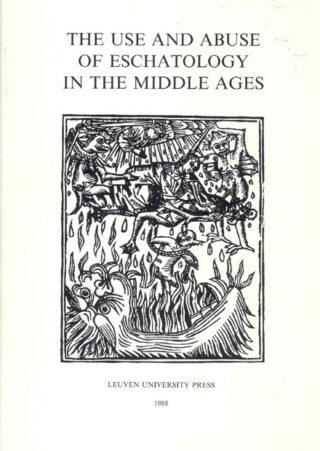
The Use and Abuse of Eschatology in the Middle Ages
Werner Verbeke (Author), Daniël Verhelst (Author),
The editors hope that enough material has been assembled to illustrate both the positive and the negative aspects of the eschatological element in mediaeval thought. An interdisciplinary approach, wit hits comparative study of sources, helps to highlight the intellectual preoccupations of many religious thinkers who grappled with the overwhelming prospect of Universal destruction, questioned the role of the individual in the economy of salvation, and attempted to see the relevance of everyday social and political events to a vision of history in which the end is nearer than the beginning.
Preface
Bernard McGinn, Portraying Antichrist in the Middle Ages
Jos Vaesen, Sulpice Sévère et la fin des temps
Jacques Chocheyras, Fin des terres et fin des temps d’Hésychius
G.J. Reinink, Pseudo-Methodius und die Legende vom römischen Endkaiser
Marc Laureys – Daniel Verhelst, Pseudo-Methodius, Revelationes
Richard Landes, Lest the Millennium be fulfilled
Henricus Fros, L’eschatologie médiévale dans quelques écrits hagiographiques
Guy Lobrichon, L’ordre de ce temps et les désordres de la fin
Coloman Viola, Jugements de Dieu et jugement dernier
Daniel Verhelst, Les textes eschatologiques dans le Liber Floridus
Hans-Werner Goetz, Endzeiterwartung und Endzeitvorstellung in Rahmen des Geschichtsbildes des fruheren 12. Jahrhunderts
Horst Dieter Rauh, Eschatologie und Geschichte im 12. Jahrhundert: Antichrist-Typologie als Medium der Gegenwartskritik
Robert E. Lerner, Frederick II, Alive, Aloft and Allayed
George Marcil, The Enemies in Angelo Clareno’s History of the Franciscan Order
Anne Cazenave, La vision eschatologique des spirituels franciscains autour de leur condamnation
Richard Kenneth Emmerson – Ronald B. Herzmann, The Canterbury Tales in Eschatological Perspective
P.C. Van der Eerden, Eschatology in the Boec van der Wraken
Roberto Rusconi, ‘Ex quodam antiquissimo libello’
Stanislaw Bylina, Le problème du purgatoire en Europe centrale et oriëntale au bas Moyen Age
Henricus Fros, Visionum medii aevi latini repertorium
Index codicum manu scriptorum
Index locorum sacrae scripturae
Index nominum
Frequently Asked Questions
What is "The Use and Abuse of Eschatology in the Middle Ages" about?
The editors hope that enough material has been assembled to illustrate both the positive and the negative aspects of the eschatological element in mediaeval thought. An interdisciplinary approach, wit hits comparative study of sources, helps to highlight the intellectual preoccupations of many religious thinkers who grappled with the overwhelming prospect of Universal destruction, questioned the role of the individual in the economy of salvation, and attempted to see the relevance of everyday social and political events to a vision of history in which the end is nearer than the beginning.
Who wrote "The Use and Abuse of Eschatology in the Middle Ages"?
"The Use and Abuse of Eschatology in the Middle Ages" was written by Werner Verbeke and Daniël Verhelst.
Werner Verbeke is Professor Emeritus of Medieval History at KU Leuven.
Is "The Use and Abuse of Eschatology in the Middle Ages" part of a series?
Yes, "The Use and Abuse of Eschatology in the Middle Ages" is part of the "Mediaevalia Lovaniensia" series. It's book 15 in the series.

The longstanding, peer-reviewed book series Mediaevalia Lovaniensia. Studies in Medieval History, Society, and Culture publishes high-quality scholarship on the history and culture of the Middle Ages (c. 500–1550). Topics of particular interest to the series include, but are not limited to, social behaviour and power relations in medieval society, processes of identity formation, religious and urban culture, medieval thought and literature, and gender history. The series focuses on Europe and the wider Mediterranean world and is particularly rich in interdisciplinary approaches. By means of monographs and edited volumes, the series explores thematic frontiers and embraces innovative methodological approaches in historical and philological scholarship that is based on an in-depth source-based study.
Mediaevalia Lovaniensia accepts monographs as well as thematically coherent volumes in English. Moreover, it offers scholars the possibility to publish critical editions of primary texts with broader relevance to the understanding of medieval culture and society. The series aspires to publish books that have the potential to become reference works in the field of Medieval Studies.
We encourage early career (postdoctoral) researchers to submit a reworked version of their PhD thesis to this series. Leuven University Press provides authors with two publishing scenarios: traditional (non-Open Access) and the option to publish in Open Access (including language editing).
Editorial Board
Jelle Haemers (KU Leuven)
Jeroen Deploige (Ghent University)
Brigitte Meijns (KU Leuven)
Chanelle Delameillieure (KU Leuven - KULAK)
Baudouin Van den Abeele (UCLouvain)
Proposals
Proposals and enquiries can be sent to one of the editorial board members. Please send a short abstract. Upon approval of the proposal, the full manuscript will be submitted to international blind peer review by two (external) experts. The editors strive towards completing the review of proposals within one month and of complete manuscripts within five months after submission. Manuscripts should preferably be (+/-) 80.000 to 120.000 words in length.
Please make use of the submission form to present your manuscript or proposal to our board.
Authors interested in Open Access can consult the available funding options.
Links & Resources
What is the Table of Contents for "The Use and Abuse of Eschatology in the Middle Ages"?
Preface
Bernard McGinn, Portraying Antichrist in the Middle Ages
Jos Vaesen, Sulpice Sévère et la fin des temps
Jacques Chocheyras, Fin des terres et fin des temps d'Hésychius
G.J. Reinink, Pseudo-Methodius und die Legende vom römischen Endkaiser
Marc Laureys - Daniel Verhelst, Pseudo-Methodius, Revelationes
Richard Landes, Lest the Millennium be fulfilled
Henricus Fros, L'eschatologie médiévale dans quelques écrits hagiographiques
Guy Lobrichon, L'ordre de ce temps et les désordres de la fin
Coloman Viola, Jugements de Dieu et jugement dernier
Daniel Verhelst, Les textes eschatologiques dans le Liber Floridus
Hans-Werner Goetz, Endzeiterwartung und Endzeitvorstellung in Rahmen des Geschichtsbildes des fruheren 12. Jahrhunderts
Horst Dieter Rauh, Eschatologie und Geschichte im 12. Jahrhundert: Antichrist-Typologie als Medium der Gegenwartskritik
Robert E. Lerner, Frederick II, Alive, Aloft and Allayed
George Marcil, The Enemies in Angelo Clareno's History of the Franciscan Order
Anne Cazenave, La vision eschatologique des spirituels franciscains autour de leur condamnation
Richard Kenneth Emmerson - Ronald B. Herzmann, The Canterbury Tales in Eschatological Perspective
P.C. Van der Eerden, Eschatology in the Boec van der Wraken
Roberto Rusconi, 'Ex quodam antiquissimo libello'
Stanislaw Bylina, Le problème du purgatoire en Europe centrale et oriëntale au bas Moyen Age
Henricus Fros, Visionum medii aevi latini repertorium
Index codicum manu scriptorum
Index locorum sacrae scripturae
Index nominum
Related titles
 Orality and Scribal Culture in the High Middle Ages
Timothy B. Noone (Author), Mark J. Clark (Author),
November 2026
 Toekomstdromen
Maarten Van Dijck (Editor), Gerrit Verhoeven (Editor), Hans Cools (Editor),
November 2026
 The Medieval Aristotle
Nena Bobovnik (Editor), Clelia V. Crialesi (Editor), Lisa Devriese (Editor),
August 2026

 Trend en toeval – vierde editie
Bruno Blondé (Author), Isabelle Devos (Author), Jord Hanus (Author), Wouter Ryckbosch (Author),
August 2026
 Christian Democracy and the Fall of Communism
Michael Gehler (Editor), Piotr H. Kosicki (Editor), Helmut Wohnout (Editor),
April 2026
 Political Exile in the Global Twentieth Century
Wolfram Kaiser (Editor), Piotr H. Kosicki (Editor),
April 2026
 Brusselse plaatsnamen
Iadine Degryse (Editor), Benjamin Wayens (Editor), Chantal Kesteloot (Editor), Dennis De Vriese (Editor), Matthijs Degraeve (Editor),
April 2026
 Cartographies of Catastrophes
Laura Demeter (Editor), Carmen M. Enss (Editor), Piotr Kisiel (Editor), Carol Ludwig (Editor),
February 2026
 Thomas Aquinas and Hervaeus Natalis on Concepts and Intentional Objects
Fabrizio Amerini (Author),
February 2026