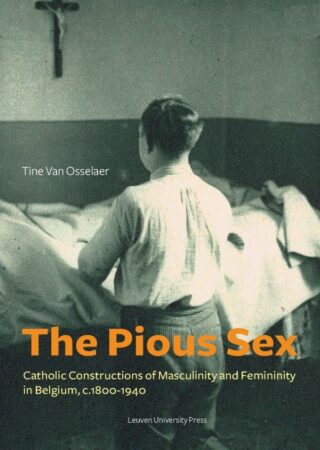
The Pious Sex
Catholic Constructions of Masculinity and Femininity in Belgium, c. 1800–1940
Tine Van Osselaer (Author),
Series: KADOC-Studies on Religion, Culture and Society 12
Category: Gender Studies, History, History 1800-present
Language: English
ISBN: 9789058679505
Publication date: December 10, 2013
€49.50 (including 6% VAT)
Buy NowNumber of pages: 271
Size: 238 x 170 x 15 mm

Stock item: 83719
Standard delivery time for print books:
For Belgium: 5 to 8 working days
For EU: 2 to 3 weeks
For other countries: 4 to 5 weeks
Series: KADOC-Studies on Religion, Culture and Society 12
Category: Gender Studies, History, History 1800-present
Language: English
ISBN: 9789461662132
Publication date: December 10, 2013
€37.00 (including 6% VAT)
Buy NowNumber of pages: 271
The construction of gender in Belgian Catholicism
Although women were called the ‘pious sex’ much earlier, it was during the nineteenth century, when the differences between men and women were being made more explicit, that an intense bond between women and religion was developed. Religiosity was thought to be a ‘natural’ part of femininity and turned religious masculinity into an oddity. This clear-cut gender ideology, however, remains an ideology (prescribed and contested) that needs to be put in the perspective of its context of origin, the bourgeois milieu. How were these gender identities constructed and by whom?
With this volume Van Osselaer seeks to clarify how the gender differentiation was created among Belgian Catholics. She brings to light the extent to which religiosity was inscribed in these constructions and how religious teachings contributed to it. It is clear that the limitations of the ‘feminization’ thesis, a master narrative that has strongly contributed to the introduction of women in religious history, have gradually become more visible. Documenting pastoral care, the devotion to the Sacred Heart of Jesus and Catholic Action, The Pious Sex offers critical commentaries on the master narratives, suggesting that even men could belong to a ‘pious sex’.
This publication is GPRC-labeled (Guaranteed Peer-Reviewed Content).
PART I GENDERING RELIGION
Gender & Religion
‘Plus une femme est sainte, … , plus elle est femme’: ‘Naturalising’ religiosity
On the intersection of gender studies and religious studies
The ‘Feminisation’ Thesis: a Primer
Approach
Introducing Belgian Catholics
Opening perspectives
Gender dualisms
Sacred Heart devotion
Catholic Action
Sermons
Pastoral manuals and periodicals
Constructing gender identities
PART II ‘GOOD’ CATHOLICS
The ‘Pious Sex’
Topography of a theme
‘The other sex’
Women’s piety
Communicating with the ‘pious sex’
‘La classe dévote’
Women’s spiritual guidance: concluding remarks
Only fit for women
‘Handle with care’: communicating with male parishioners
Winning men through ‘masculine’ behaviour
The pastor and his flock
Gender Ideology in Church
Setting
Pharisees, porch guards and lovers: gender prejudices and ideals pervading the sermons
Creating a problem?
Considering Belgium
Considering Catholic practice
Considering a crisis
Gender Ideology for the ‘Little Church’, the Catholic Home
Introducing the Catholic family, cornerstone of Christian society
A family model and model family
‘Mulieri non permitto… dominari in virum’
A good wife is God-given
In the name of the Father
Concluding remarks
PART III DEVOTED CATHOLICS
The Sacred Heart Devotion in Belgium
For the love of Christ
For the heart of the nation: Belgium and the Sacred Heart
Devotional practices and movements
Changing Apostles
‘More effective than the sound of the bell’: the Apostleship of Prayer at the end of the 1860s
The Apostleship in the 1890s: defining a problem
‘Divide et impera’: reintroducing women in the 1930s
Conclusion
Gendering Heroism
Catholic heroism
Heroic women
Heroic men
Becoming a hero and heroine
Models for Christians
PART IV CATHOLICS IN ACTION
Setting the Stage: Adult Catholic Action Movements
Catholics in action
Introducing the Catholic Action in Belgium
Catholic Action in Belgium: youth organisations
New style adult Catholic Action movements
Young prophets and veterans
Mobilising the laity
Unity and difference
Mobilising Men
‘Militant’ and ‘modern’ movements
A lay movement
Promoters and militants
A focus on men
‘Real’ men
A single-sex movement
‘En service commandé’
Catholic Action and new ideologies
Differentiating
Concluding remarks
Mobilising Mothers
Women’s Catholic Action
‘Helpers’
‘Militantes’
Women’s movement
Motherhood duties?
‘Real’ women
Regarding men
Concluding remarks
PART V MAKING A DIFFERENCE
Adam, Eve and the Others
Gender dyads
Gender difference
Dichotomous constructions?
‘Feminisation’ and ‘Masculinisation’
Epilogue
Abbreviations
Bibliography
Index
Colophon
Feuilleter cet ouvrage permet d'apprécier une belle étude historique (beaucoup de sources), qui montre comment s'est construite l'image prescrite d'une féminité par essence voulue "pieuse"... Sondant les stéréotypes, l'auteure, Tine Van Osselaert, finit par suggérer que les hommes aussi, dans le fond, peuvent appartenir au "sexe pieux"...
Blog de Sébastien Fath >>>
The 'Pious Sex' is a must-read for gender historians, theologians, feminist theorists, religious historians and anyone else who wishes to move beyond the simple stereotypes of 'female piety' to gain deeper insights into the logic and contradictions of Catholic devotion in the 'long' nineteenth century and throughout the 1920s and 1930s.
Mary Heimann, University of Strathclyde, The Innes Review 65.2 (2014): 158-;184
Van Osselaer heeft een helder gestructureerd boek geschreven. Door de structuur steeds duidelijk aan te geven neemt zij de lezer mee aan de hand. Dit schept overzicht, al haalt het soms ook een deel van de spanning weg. Van Osselaer heeft voortdurend oog voor de bredere historische ontwikkelingen en ruimere context waarin haar empirische materiaal te begrijpen valt. Haar proefschrift bevat een uitgebreide geschiedenis van de religieuze bewegingen die zij beschrijft, en maatschappelijke ontwikkelingen krijgen een centrale plek in haar betoog. Van Osselaers belangrijkste bijdrage is echter haar scherpzinnige en genuanceerde genderanalyse van het gevarieerde bronnenmateriaal. Zij heeft een indrukwekkende hoeveelheid bronnen bestudeerd en plaatst haar analyse in de context van de internationale secundaire literatuur. Het boek eindigt met een oproep om binnen religiegeschiedenis meer aandacht te besteden aan de historische en geografische veranderlijkheid van genderconstructies. Van Osselaers studie laat het belang van een dergelijke benadering zien.
Saskia Bultman, Radboud Universiteit Nijmegen, Tijdschrift voor Geschiedenis, Volume 127, Number 4, November 2014, pp. 728-729(2)
Van Osselaer's sources are so abundant and voluminous (the book's materials are in Flemish, French, German and English) and she reads them so well, that many fresh, new insights surface. [...] The chapters express an abiding curiosity about the centrality of femininity and masculinity in European Catholicism, and a willingness to read carefully and think deeply about ideas different from one's own. So, not only for the richness of her data, but also as an exemplum of a scholarly ideal, The Pious Sex deserves considerable praise.
Brenna Moore, Fordham University, USA, European History Quarterly, Vol. 45 No. 1
Throughout the book, Van Osselaer insists on this dual view, showing that the Pious Sex of the title could be defined as both male and female throughout the nineteenth and early-twentieth centuries in Catholic Belgium. Her analysis of several Catholic initiatives impressing the laity with carefully designed images of “devout” masculine and feminine identities shows that, although the relation between men and women within Belgian Catholic circles was highly dichotomous and hierarchical, and although women’s roles within these organizations changed substantially throughout the modern period, these changes cannot be qualified as a process of feminization, but rather as one of increasing differentiation. Whereas the introduction offers a sharply drawn theoretical critique of the feminization narrative based mainly on current debates in gender studies, the
empirical chapters show a wide array of roles and models held up to laymen, laywomen, and children.
Josephine Hoegaerts, Catholic University of Leuven, The Catholic Historical Review 2015, vol. 101, no. 2
Tine Van Osselaer’s meticulously researched The Pious Sex constitutes the most recent comprehensive product of the first generation of scholars that thoroughly developed the study of gender, and specifically masculinity, in the modern history of the Low Countries.Stefan Meysman, BMGN - Low Countries Historical Review. 132, 2017
BMGN - Low Countries Historical Review
Frequently Asked Questions
What is "The Pious Sex" about?
The construction of gender in Belgian Catholicism
Although women were called the ‘pious sex’ much earlier, it was during the nineteenth century, when the differences between men and women were being made more explicit, that an intense bond between women and religion was developed. Religiosity was thought to be a ‘natural’ part of femininity and turned religious masculinity into an oddity. This clear-cut gender ideology, however, remains an ideology (prescribed and contested) that needs to be put in the perspective of its context of origin, the bourgeois milieu. How were these gender identities constructed and by whom?
With this volume Van Osselaer seeks to clarify how the gender differentiation was created among Belgian Catholics. She brings to light the extent to which religiosity was inscribed in these constructions and how religious teachings contributed to it. It is clear that the limitations of the ‘feminization’ thesis, a master narrative that has strongly contributed to the introduction of women in religious history, have gradually become more visible. Documenting pastoral care, the devotion to the Sacred Heart of Jesus and Catholic Action, The Pious Sex offers critical commentaries on the master narratives, suggesting that even men could belong to a ‘pious sex’.
This publication is GPRC-labeled (Guaranteed Peer-Reviewed Content).
Who wrote "The Pious Sex"?
"The Pious Sex" was written by Tine Van Osselaer.
Tine Van Osselaer is research professor at Universiteit Antwerpen (Ruusbroec Institute).
Is "The Pious Sex" part of a series?
Yes, "The Pious Sex" is part of the "KADOC-Studies on Religion, Culture and Society" series. It's book 12 in the series.


The longstanding peer-reviewed book series KADOC Studies in Religion, Culture and Society is devoted to a deeper understanding of the role of religion(s) in society in Europe and the world since 1750. By means of monographs and edited volumes, the series explores thematic frontiers and embraces innovative methodological approaches in historical, sociological and anthropological scholarship on religion, culture and society. The series particularly welcomes manuscripts adopting interreligious and transnational perspectives. Taken together, KADOC Studies in Religion, Culture and Society and its companion series KADOC Artes represent a diptych featuring the immaterial and material legacies of religions in Europe and the world from the 18th century onwards.
KADOC Studies in Religion, Culture and Society is managed by an independent Editorial Board. Books are published in English. Open Access publishing is encouraged. Financial support will be examined on a case-by-case basis and in consultation with the author.
KADOC, the Interfaculty Documentation and Research Centre on Religion, Culture and Society at KU Leuven, is an internationally oriented interdisciplinary research center as well as a heritage institution recognized by the Flemish Government with particularly rich and diverse documentary holdings.
Editorial board
Elena Arigita Maza (Universidad de Granada)
Florian Bock (Ruhr Universität Bochum)
Timothy Brittain‐Catlin (University of Cambridge)
James Chappel (Duke University)
Kim Christiaens (KADOC-KU Leuven)
Kathleen James-Chakraborty (University College Dublin)
James Kennedy (Utrecht University)
Franziska Metzger (PH Luzern)
Patrick Pasture (MoSa‐KU Leuven) - chairman
Isabelle Saint‐Martin (EPHE Paris)
Thijl Sunier (VU Amsterdam)
Árpád von Klimó (Catholic University of America)
Veerle De Laet (Leuven University Press)
Peter Heyrman (KADOC-KU Leuven) - secretary
Proposals
Proposals and enquiries can be sent to Peter Heyrman. The series welcomes monographs and edited volumes. Book proposals may relate to, for example, the political impact of religion, the dynamics between religion and welfare, and missionary history. All proposals and manuscripts are subject to double blind peer review involving at least one external reviewer (proposals) or at least two (manuscripts). The editors strive towards completing the review of proposals within two months and of complete manuscripts within five months after submission.
Please make use of the submission form to present your manuscript or proposal to our board.
Authors interested in Open Access can consult the available funding options.
Links & Resources
What is the Table of Contents for "The Pious Sex"?
PART I GENDERING RELIGION
Gender & Religion
'Plus une femme est sainte, ... , plus elle est femme': 'Naturalising' religiosity
On the intersection of gender studies and religious studies
The 'Feminisation' Thesis: a Primer
Approach
Introducing Belgian Catholics
Opening perspectives
Gender dualisms
Sacred Heart devotion
Catholic Action
Sermons
Pastoral manuals and periodicals
Constructing gender identities
PART II 'GOOD' CATHOLICS
The 'Pious Sex'
Topography of a theme
'The other sex'
Women's piety
Communicating with the 'pious sex'
'La classe dévote'
Women's spiritual guidance: concluding remarks
Only fit for women
'Handle with care': communicating with male parishioners
Winning men through 'masculine' behaviour
The pastor and his flock
Gender Ideology in Church
Setting
Pharisees, porch guards and lovers: gender prejudices and ideals pervading the sermons
Creating a problem?
Considering Belgium
Considering Catholic practice
Considering a crisis
Gender Ideology for the 'Little Church', the Catholic Home
Introducing the Catholic family, cornerstone of Christian society
A family model and model family
'Mulieri non permitto… dominari in virum'
A good wife is God-given
In the name of the Father
Concluding remarks
PART III DEVOTED CATHOLICS
The Sacred Heart Devotion in Belgium
For the love of Christ
For the heart of the nation: Belgium and the Sacred Heart
Devotional practices and movements
Changing Apostles
'More effective than the sound of the bell': the Apostleship of Prayer at the end of the 1860s
The Apostleship in the 1890s: defining a problem
'Divide et impera': reintroducing women in the 1930s
Conclusion
Gendering Heroism
Catholic heroism
Heroic women
Heroic men
Becoming a hero and heroine
Models for Christians
PART IV CATHOLICS IN ACTION
Setting the Stage: Adult Catholic Action Movements
Catholics in action
Introducing the Catholic Action in Belgium
Catholic Action in Belgium: youth organisations
New style adult Catholic Action movements
Young prophets and veterans
Mobilising the laity
Unity and difference
Mobilising Men
'Militant' and 'modern' movements
A lay movement
Promoters and militants
A focus on men
'Real' men
A single-sex movement
'En service commandé'
Catholic Action and new ideologies
Differentiating
Concluding remarks
Mobilising Mothers
Women's Catholic Action
'Helpers'
'Militantes'
Women's movement
Motherhood duties?
'Real' women
Regarding men
Concluding remarks
PART V MAKING A DIFFERENCE
Adam, Eve and the Others
Gender dyads
Gender difference
Dichotomous constructions?
'Feminisation' and 'Masculinisation'
Epilogue
Abbreviations
Bibliography
Index
Colophon
What is the DOI for "The Pious Sex"?
The Digital Object Identifier (DOI) for "The Pious Sex" is 10.11116/9789461662132.
Related titles
 Margarete Schütte-Lihotzky and the Architecture of Collective Dissidence, 1918–1989
S.E. Eisterer (Author),
April 2027
 Toekomstdromen
Maarten Van Dijck (Editor), Gerrit Verhoeven (Editor), Hans Cools (Editor),
November 2026
 Feminists Resisting Gendered Violence
Hemangini Gupta (Editor), Fiona Mackay (Editor), Jan Breckenridge (Editor), Louise Chappell (Editor), Rachna Mehra (Editor), Rukmini Sen (Editor), Mailin Suchting (Editor),
October 2026
 German–Rapanui Entanglements
Cristián Moreno Pakarati (Editor), Diego Muñoz (Editor), Philipp Schorch (Editor),
August 2026

 Trend en toeval – vierde editie
Bruno Blondé (Author), Isabelle Devos (Author), Jord Hanus (Author), Wouter Ryckbosch (Author),
August 2026
 Cinema in Post-War Belgium
Gertjan Willems (Editor), Bjorn Gabriels (Editor), Bénédicte Rochet (Editor),
May 2026

 Performing Magnetism
Eleonora Paklons (Editor), Kristof Smeyers (Editor), Kurt Vanhoutte (Editor), Hannah Welslau (Editor),
May 2026
 Political Exile in the Global Twentieth Century
Wolfram Kaiser (Editor), Piotr H. Kosicki (Editor),
April 2026
 Christian Democracy and the Fall of Communism
Michael Gehler (Editor), Piotr H. Kosicki (Editor), Helmut Wohnout (Editor),
April 2026
 Brusselse plaatsnamen
Iadine Degryse (Editor), Benjamin Wayens (Editor), Chantal Kesteloot (Editor), Dennis De Vriese (Editor), Matthijs Degraeve (Editor),
April 2026
 Cartographies of Catastrophes
Laura Demeter (Editor), Carmen M. Enss (Editor), Piotr Kisiel (Editor), Carol Ludwig (Editor),
February 2026