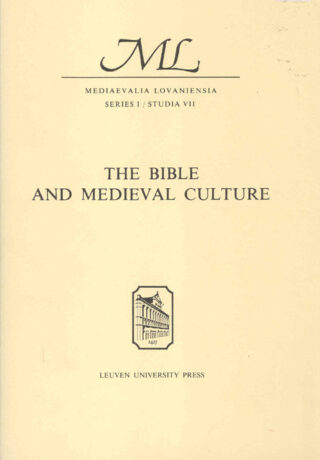
The Bible and Medieval Culture
Willem Lourdaux (Editor),
From May 16th to 19th 1977, philologist, historians, sociologists, philosophers and theologians gathered in Louvain, to attend the Vllth International Colloquium organized by the ‘Instituut voor Middeleeuwse Studies’ of the ‘Katholieke Universiteit te Leuven’, to discuss and investigate the influence of the Bible on medieval culture.
It is indisputable that medieval society in its various aspects was deeply penetrated and strongly influenced by the Bible. Many important studies have already been published on this subject, but the organizers of the Colloquium recognized that much further work was still required, and focussed attention on three fundamental problems, to which the attention of participants was directed.
Firstly, some centuries passed before the Bible was translated into vernacular languages, as a result of the Church’s policy that the Bible should only be read in one of the ‘sacred languages’ – Hebrew, Greek or Latin. The vulgate version for Western christendom was St Jerome’s Latin translation, but a stimulus and demand gradually grew for vernacular translations. In the course of the 9th century, the Frankish Otfrid of Weissenburg raised the significant question
whether the language of the Franks was indeed to trivial or inferior that it was worthless or useless for speaking to God. But the Church was reluctant to permit the Bible to be translated into the common tongues, through fear of the confusion and uncertainty which might result for uneducated people.
Nevertheless, and secondly, in spite of many obstacles, such translations in fact appeared, principally in German, Anglo-Saxon, French and Dutch.
And thirtly, in consequence of these developments, the Bible impacted a specific outlook to medieval society, and the translators recorded in their versions the contemporary customs and habits of their people. The Bible translations created a new vocabulary, and the translators used their own language and idioms to render the Bible stories more lively and comprehensible.
The various contributions to the International Colloquium dealt with these three themes, as well as other aspects of medieval life on which the Bible left its mark.
Preface
Dekkers Eligius, L’Eglise devant la Bible en langue vernaculaire: ouverture de principe et difficultés concrétes
Richter Michael, Latina lingua – sacra seu vulgaris?
Henss Walter, Die Integritat der Bibelubersetzung im religiosen
Schwarz Alexander, Die Bibel und die Grundlegung einer frankischen Literatur
Larès Micheline-Maurice, Types et optiques de traductions et adaptations de l’Ancien Testament en anglais du haut moyen âge
Leclerq Jean, Usage et abus de la Bible au temps de la réforme grégorienne
Gregory Stewart, The Twelfth Century Psalter Commentary in French
Sneddon Clive R., The Bible du XIIIe siècle: its Medieval Public in the Light of its Manuscript Tradition
Thouzellier Christine, L’emploi de la Bible par les Cathares
Manselli Raoul, L’Apocalisse e l’interpretazione francescana della storia
Hargreaves Henry, Popularising Biblical Scholarship
De Bruin Cebus C., De prologen van de eerste Historiebijbel geplaatst in het raam van hun tijd
Smeets Jean-Robert, La Bible de Jehan Malkaraume
Dronke Peter, The Song of Songs and Medieval Love-Lyric
Leclerq Jean, Les traductions de la Bible et la spiritualité médiévale
Index nominum
Index codicum manuscriptorum
Frequently Asked Questions
What is "The Bible and Medieval Culture" about?
From May 16th to 19th 1977, philologist, historians, sociologists, philosophers and theologians gathered in Louvain, to attend the Vllth International Colloquium organized by the 'Instituut voor Middeleeuwse Studies' of the 'Katholieke Universiteit te Leuven', to discuss and investigate the influence of the Bible on medieval culture.
It is indisputable that medieval society in its various aspects was deeply penetrated and strongly influenced by the Bible. Many important studies have already been published on this subject, but the organizers of the Colloquium recognized that much further work was still required, and focussed attention on three fundamental problems, to which the attention of participants was directed.
Firstly, some centuries passed before the Bible was translated into vernacular languages, as a result of the Church's policy that the Bible should only be read in one of the 'sacred languages' - Hebrew, Greek or Latin. The vulgate version for Western christendom was St Jerome's Latin translation, but a stimulus and demand gradually grew for vernacular translations. In the course of the 9th century, the Frankish Otfrid of Weissenburg raised the significant question
whether the language of the Franks was indeed to trivial or inferior that it was worthless or useless for speaking to God. But the Church was reluctant to permit the Bible to be translated into the common tongues, through fear of the confusion and uncertainty which might result for uneducated people.
Nevertheless, and secondly, in spite of many obstacles, such translations in fact appeared, principally in German, Anglo-Saxon, French and Dutch.
And thirtly, in consequence of these developments, the Bible impacted a specific outlook to medieval society, and the translators recorded in their versions the contemporary customs and habits of their people. The Bible translations created a new vocabulary, and the translators used their own language and idioms to render the Bible stories more lively and comprehensible.
The various contributions to the International Colloquium dealt with these three themes, as well as other aspects of medieval life on which the Bible left its mark.
Who edited "The Bible and Medieval Culture"?
"The Bible and Medieval Culture" was edited by Willem Lourdaux.
Is "The Bible and Medieval Culture" part of a series?
Yes, "The Bible and Medieval Culture" is part of the "Mediaevalia Lovaniensia" series. It's book 7 in the series.

The longstanding, peer-reviewed book series Mediaevalia Lovaniensia. Studies in Medieval History, Society, and Culture publishes high-quality scholarship on the history and culture of the Middle Ages (c. 500–1550). Topics of particular interest to the series include, but are not limited to, social behaviour and power relations in medieval society, processes of identity formation, religious and urban culture, medieval thought and literature, and gender history. The series focuses on Europe and the wider Mediterranean world and is particularly rich in interdisciplinary approaches. By means of monographs and edited volumes, the series explores thematic frontiers and embraces innovative methodological approaches in historical and philological scholarship that is based on an in-depth source-based study.
Mediaevalia Lovaniensia accepts monographs as well as thematically coherent volumes in English. Moreover, it offers scholars the possibility to publish critical editions of primary texts with broader relevance to the understanding of medieval culture and society. The series aspires to publish books that have the potential to become reference works in the field of Medieval Studies.
We encourage early career (postdoctoral) researchers to submit a reworked version of their PhD thesis to this series. Leuven University Press provides authors with two publishing scenarios: traditional (non-Open Access) and the option to publish in Open Access (including language editing).
Editorial Board
Jelle Haemers (KU Leuven)
Jeroen Deploige (Ghent University)
Brigitte Meijns (KU Leuven)
Chanelle Delameillieure (KU Leuven - KULAK)
Baudouin Van den Abeele (UCLouvain)
Proposals
Proposals and enquiries can be sent to one of the editorial board members. Please send a short abstract. Upon approval of the proposal, the full manuscript will be submitted to international blind peer review by two (external) experts. The editors strive towards completing the review of proposals within one month and of complete manuscripts within five months after submission. Manuscripts should preferably be (+/-) 80.000 to 120.000 words in length.
Please make use of the submission form to present your manuscript or proposal to our board.
Authors interested in Open Access can consult the available funding options.
Links & Resources
What is the Table of Contents for "The Bible and Medieval Culture"?
Preface
Dekkers Eligius, L'Eglise devant la Bible en langue vernaculaire: ouverture de principe et difficultés concrétes
Richter Michael, Latina lingua - sacra seu vulgaris?
Henss Walter, Die Integritat der Bibelubersetzung im religiosen
Schwarz Alexander, Die Bibel und die Grundlegung einer frankischen Literatur
Larès Micheline-Maurice, Types et optiques de traductions et adaptations de l'Ancien Testament en anglais du haut moyen âge
Leclerq Jean, Usage et abus de la Bible au temps de la réforme grégorienne
Gregory Stewart, The Twelfth Century Psalter Commentary in French
Sneddon Clive R., The Bible du XIIIe siècle: its Medieval Public in the Light of its Manuscript Tradition
Thouzellier Christine, L'emploi de la Bible par les Cathares
Manselli Raoul, L'Apocalisse e l'interpretazione francescana della storia
Hargreaves Henry, Popularising Biblical Scholarship
De Bruin Cebus C., De prologen van de eerste Historiebijbel geplaatst in het raam van hun tijd
Smeets Jean-Robert, La Bible de Jehan Malkaraume
Dronke Peter, The Song of Songs and Medieval Love-Lyric
Leclerq Jean, Les traductions de la Bible et la spiritualité médiévale
Index nominum
Index codicum manuscriptorum
Related titles
 Orality and Scribal Culture in the High Middle Ages
Timothy B. Noone (Author), Mark J. Clark (Author),
November 2026
 Toekomstdromen
Maarten Van Dijck (Editor), Gerrit Verhoeven (Editor), Hans Cools (Editor),
November 2026
 The Medieval Aristotle
Nena Bobovnik (Editor), Clelia V. Crialesi (Editor), Lisa Devriese (Editor),
August 2026

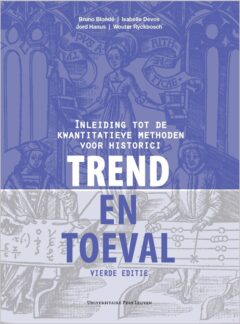 Trend en toeval – vierde editie
Bruno Blondé (Author), Isabelle Devos (Author), Jord Hanus (Author), Wouter Ryckbosch (Author),
August 2026
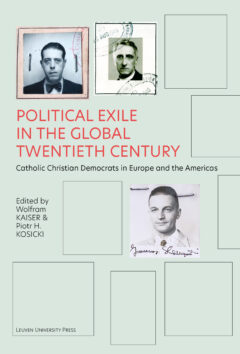 Political Exile in the Global Twentieth Century
Wolfram Kaiser (Editor), Piotr H. Kosicki (Editor),
April 2026
 Christian Democracy and the Fall of Communism
Michael Gehler (Editor), Piotr H. Kosicki (Editor), Helmut Wohnout (Editor),
April 2026
 Brusselse plaatsnamen
Iadine Degryse (Editor), Benjamin Wayens (Editor), Chantal Kesteloot (Editor), Dennis De Vriese (Editor), Matthijs Degraeve (Editor),
April 2026
 Cartographies of Catastrophes
Laura Demeter (Editor), Carmen M. Enss (Editor), Piotr Kisiel (Editor), Carol Ludwig (Editor),
February 2026
 Thomas Aquinas and Hervaeus Natalis on Concepts and Intentional Objects
Fabrizio Amerini (Author),
February 2026