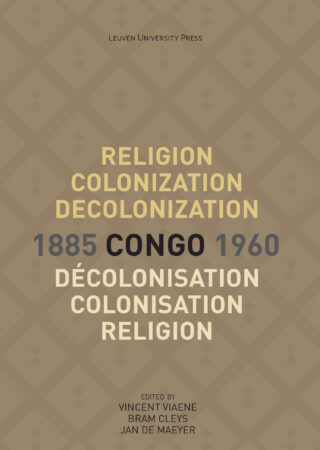
Religion, Colonization and Decolonization in Congo, 1885-1960. Religion, colonisation et décolonisation au Congo, 1885-1960
Vincent Viaene (Editor), Bram Cleys (Editor), Jan De Maeyer (Editor),
Series: KADOC-Studies on Religion, Culture and Society 22
Category: African Studies, History, History 1800-present, Postcolonial Studies, Religion
ISBN: 9789462701427
Publication date: October 22, 2020
€25.00 (including 6% VAT)
Buy NowNumber of pages: 336
Size: 238 x 170 x 21 mm

Stock item: 137925
Standard delivery time for print books:
For Belgium: 5 to 8 working days
For EU: 2 to 3 weeks
For other countries: 4 to 5 weeks
Series: KADOC-Studies on Religion, Culture and Society 22
Category: African Studies, History, History 1800-present, Postcolonial Studies, Religion
ISBN: 9789461662941
Publication date: October 22, 2020
€37.00 (including 6% VAT)
Buy NowNumber of pages: 336
The contributions in this book provide insight into the multifaceted history of the interaction between religion and colonization.
A comprehensive history of the interaction between religion and colonization
Religion in today’s Democratic Republic of Congo has many faces: from the overflowing seminaries and Marian shrines of the Catholic Church to the Islamic brotherhoods, from the healers of Kimban-guism to the televangelism of the booming Pentecostalist churches in the great cities, from the Orthodox communities of Kasai to the ‘invisible’ Mai Mai warriors in the brousse of Kivu. During the colonial period religion was no less central to people’s lives than it is today. More surprisingly, behind the seemingly smooth facade of missions linked closely to imperial power, faith and worship were already marked by diversity and dynamism, tying the Congo into broader African and global movements.
The contributions in this book provide insight into the multifaceted history of the interaction between religion and colonization. The authors outline the institutional political framework, and focus on the challenge that old and new forms of slavery entailed for the missions. The atrocities committed at the time of the Congo Free State became an existential question for young Christian communities. In the Belgian Congo after 1908, more structural forms of colonial violence remained a key issue marking religious experiences. And yet, religion also acted as a bridge. The authors emphasize the role intermediaries such as catechists or medical assistants played in the African “appropriation” of Christianity. They examine the complex interaction with indigenous religious beliefs and practices, and zoom in on the part religions played in the independence movement, as well as on their reaction to independence itself. Coming at a moment when Belgium confronts its colonial past, this volume provides a timely reassessment of religion as a key factor.
This publication is GPRC-labeled (Guaranteed Peer-Reviewed Content).
Contributors: Piet Clement (Bank of International Settlements), Bram Cleys (Vrije Universiteit Brussel), Anne Cornet (Royal Museum for Central Africa, Tervuren) Marie Dunkerley (Exeter University), Zana Aziza Etambala (Royal Museum for Central Africa, Tervuren), Anne-Sophie Gijs (Université Catholique de Louvain), Miguel Bandeira Jerónimo (University of Coimbra), Emery Kalema Masua (University of the Witwatersrand), Sindani E. Kiangu (Université de Kinshasa), Elisabeth Mudimbe-Boyi (Stanford University) Dominic Pistor (Simon Fraser University), Jean-Luc Vellut (Université Catholique de Louvain), Vincent Viaene
Introduction Religion, Colonization and Decolonization in Congo, 1885-1960 Vincent Viaene, Bram Cleys and Jan De Maeyer
Introduction Religion, colonisation et décolonisation au Congo, 1885-1960 Vincent Viaene, Bram Cleys et Jan De Maeyer
RELIGIONS AND THE COLONIAL STATE / LES RELIGIONS ET L’ÉTAT COLONIAL Premières évangélisations de l’Afrique centrale et éthique sociale, 1500-1900. Entre morale de conviction et morale de responsabilité Jean-Luc Vellut
Internationalism, Religion and the Congo Question An introduction, 1875-1905 39 Vincent Viaene
Religion and Politics in the ‘Congo’. Portugal and the European inter-imperial competition, c. 1865-1890 Miguel Bandeira Jerónimo
Les droits des autochtones. Un enjeu dans les relations jésuites-État, fin XIXe-début XXe siècle Anne-Sophie Gijs
Catholic Missionaries and the Production of Kasai as a Colonial Landscape, 1890-1960 Bram Cleys
INTERMEDIARIES / INTERMÉDIAIRES
Musique et univers sonores dans le champ missionnaire des Grands Lacs. Perception, emprunts et transferts au Kivu, Rwanda et Burundi, 1908-1940 Anne Cornet
Home is where the Heart is? Debates between missions and colonial administrators over accommodation for Congolese students at the École Unique des Assistants Médicaux Indigènes, Léopoldville, 1929-1946 Marie Bryce
Religion et médecine au Congo Belge. Pratiques et savoirs des 1assistants médicaux «indigènes» issus de Kisantu (Fomulac) et de leurs patients, 1937-1961 Emery M. Kalema
Vivre (à) la Mission. Mémoires individuelles, histoire collective Elisabeth Mudimbe-Boyi
THE CRISIS OF THE COLONIAL MISSIONS / LA CRISE DES MISSIONS COLONIALES
Tempels Revisited. The conversion of a missionary in the Belgian Congo, 1930s-1960s Piet Clement
Developmental Colonialism and Kitawala Policy in 1950s Belgian Congo Dominic Pistor
Les missions catholiques et les émeutes de Léopoldville, 4 janvier 1959 Zana Etambala
Le mouvement muleliste comme théorie et pratique religieuses en diocèse d’Idiofa (Province du Kwilu, R.D.C.) Sindani E. Kiangu
Index Authors / Auteurs Colophon
Al vanaf de eerste bladzijde van de inleiding poneren zij immers dat ze vooral de verscheidenheid van de religieuze ervaringen ten tijde van kolonisatie en dekolonisatie tot hun recht willen laten komen. Daarmee nemen ze expliciet afstand van de te eenzijdige focus op missionering die de religieuze geschiedenis van koloniaal Congo tot dan had beheerst. Religie was er veel méér, zo betogen ze, dan de pogingen van katholieke (en in snel verminderende mate ook protestantse) missionarissen om hun geloof aan de Congolese bevolking op te dringen. [...] Dat deze verscheidenheid door de samenstellers van dit boek in de schijnwerpers wordt geplaatst, is vanzelfsprekend positief. Zoals ze het zelf verwoorden in hun inleiding: “The picture is one of vivid colours. It is not yet high definition, but it is no longer monochrome.”
Marnix Beyen, Volkskunde 2021 - 1
Hiermee zijn een aantal aspecten uit de geschiedenis van Congo aangesneden, maar die toch ook wel doen verlangen naar een nieuw standaardwerk over de rol van missionarissen en kerken vanaf de 19e eeuw tot de huidige Democratische Republiek Congo. Hoe de verschillende congregaties en ordes te werk gingen in de hun toegewezen gebieden, hoe de verhoudingen met de staatsinstellingen verliepen, hoe zich geleidelijk aan een inlandse clerus en kerk ontwikkelde, en welke rol de verschillende (christelijke) kerken en andere geloofsgemeenschappen vandaag spelen in dit onmetelijke land. Dekolonisatie betekent niet dat men eenvoudig weg de geschiedenis achter zich kan laten. Integendeel. De spanningsvelden die er in de huidige RDC zijn hebben hun historische wortels. Dit soort werken, zoals de bundel die nu voorligt, kunnen er toe bijdragen om niet alleen de politieke of sociale geschiedenis van het land te beschrijven, maar ook aandacht te hebben voor de belangrijke rol van religies, onder welke vorm dan ook.Herman Lodewyckx, Acta Comparanda, 2021
L’ année 2010 est marquée par la commémoration du cinquantenaire de l’ indépendance de la République du Congo. Parmi les très nombreuses manifestations scientifiques qui prennent alors place, le KADOC organise un colloque international intitulé ‘Religion, Colonization and Decolonization in Congo 1885-1960’. Celui-ci réunit une trentaine d’intervenants, historiens et hommes d’Église surtout, dont la plupart proviennent de Belgique, de la République démocratique du Congo ou des États-Unis. Les actes de cette rencontre internationale paraissent dix ans plus tard sous le titre bilingue ‘Religion, Colonization and Decolonization in Congo 1885-1960. Religion, colonisation et décolonisation au Congo, 1885-1960.’ Bérengère PIRET, Tijdschrift voor Nieuwste Geschiedenis, LI, 2021, 3
The book is engaging, enjoyable, and a high-quality product, with all chapters well written and capably edited. Students of the colonial encounter, and in particular of missionary action in Congo, will find rich references and numerous suggested avenues for future research.
Matthew G. Stanard, TSEG, VOL. 18, NO. 2, 2021, https://tseg.nl/article/view/10788/12072, DOI: 10.52024/tseg10788
Its three sections proceed, as the editors explain, from the political to the socio-cultural and personal order, yet, each section exemplifies the deep entanglements of these domains. The authors aim to put religious agency at centre stage, focusing on the cultural interface created by the missionary encounter. This approach highlights both the interplay between objectives and interests of consecutive colonial administrations, policies of Protestant and Catholic missionary organisations, practices of missionaries on the ground and mediation and appropriations by their converts: African Christians who became key players in carving out multiple meanings of religion in Congo.Marit Monteiro, SZRKG/RSHRC/RSSRC, 116 (2022), 403–506, DOI: 10.24894/2673-3641.00127
[...] a worthwhile contribution to scholarship on Congo [...] hopefully it should help stimulate new research in twentieth- and twenty-first-century Congolese religious history.David Maxwell, The English Historical Review, 2022, ceac253, https://doi.org/10.1093/ehr/ceac253
Frequently Asked Questions
What is "Religion, Colonization and Decolonization in Congo, 1885-1960. Religion, colonisation et décolonisation au Congo, 1885-1960" about?
A comprehensive history of the interaction between religion and colonization
Religion in today’s Democratic Republic of Congo has many faces: from the overflowing seminaries and Marian shrines of the Catholic Church to the Islamic brotherhoods, from the healers of Kimban-guism to the televangelism of the booming Pentecostalist churches in the great cities, from the Orthodox communities of Kasai to the ‘invisible’ Mai Mai warriors in the brousse of Kivu. During the colonial period religion was no less central to people’s lives than it is today. More surprisingly, behind the seemingly smooth facade of missions linked closely to imperial power, faith and worship were already marked by diversity and dynamism, tying the Congo into broader African and global movements.
The contributions in this book provide insight into the multifaceted history of the interaction between religion and colonization. The authors outline the institutional political framework, and focus on the challenge that old and new forms of slavery entailed for the missions. The atrocities committed at the time of the Congo Free State became an existential question for young Christian communities. In the Belgian Congo after 1908, more structural forms of colonial violence remained a key issue marking religious experiences. And yet, religion also acted as a bridge. The authors emphasize the role intermediaries such as catechists or medical assistants played in the African “appropriation” of Christianity. They examine the complex interaction with indigenous religious beliefs and practices, and zoom in on the part religions played in the independence movement, as well as on their reaction to independence itself. Coming at a moment when Belgium confronts its colonial past, this volume provides a timely reassessment of religion as a key factor.
This publication is GPRC-labeled (Guaranteed Peer-Reviewed Content).
Contributors: Piet Clement (Bank of International Settlements), Bram Cleys (Vrije Universiteit Brussel), Anne Cornet (Royal Museum for Central Africa, Tervuren) Marie Dunkerley (Exeter University), Zana Aziza Etambala (Royal Museum for Central Africa, Tervuren), Anne-Sophie Gijs (Université Catholique de Louvain), Miguel Bandeira Jerónimo (University of Coimbra), Emery Kalema Masua (University of the Witwatersrand), Sindani E. Kiangu (Université de Kinshasa), Elisabeth Mudimbe-Boyi (Stanford University) Dominic Pistor (Simon Fraser University), Jean-Luc Vellut (Université Catholique de Louvain), Vincent Viaene
Who edited "Religion, Colonization and Decolonization in Congo, 1885-1960. Religion, colonisation et décolonisation au Congo, 1885-1960"?
"Religion, Colonization and Decolonization in Congo, 1885-1960. Religion, colonisation et décolonisation au Congo, 1885-1960" was edited by Vincent Viaene, Bram Cleys and Jan De Maeyer.
Vincent Viaene studied history and international relations at KU Leuven, the Sorbonne, and Yale University. He was a postdoctoral researcher and lecturer at KU Leuven, a senior Fellow at KADOC and a Marie Curie Fellow at Oxford University. In 2012 he joined the Belgian diplomatic corps. Since 2015 he is seconded to the Belgian Royal Household as Advisor of His Majesty King Philip.
Bram Cleys studied history at KU Leuven and is education officer at the University Centre for Development Cooperation (UCOS), a Belgian NGO.
Jan De Maeyer is professor emeritus of contemporary church history at KU Leuven and honorary director of KADOC-KU Leuven. His research focuses on political and social Catholicism, material Christianity, and the development of religious institutions and congregations.
Is "Religion, Colonization and Decolonization in Congo, 1885-1960. Religion, colonisation et décolonisation au Congo, 1885-1960" part of a series?
Yes, "Religion, Colonization and Decolonization in Congo, 1885-1960. Religion, colonisation et décolonisation au Congo, 1885-1960" is part of the "KADOC-Studies on Religion, Culture and Society" series. It's book 22 in the series.


The longstanding peer-reviewed book series KADOC Studies in Religion, Culture and Society is devoted to a deeper understanding of the role of religion(s) in society in Europe and the world since 1750. By means of monographs and edited volumes, the series explores thematic frontiers and embraces innovative methodological approaches in historical, sociological and anthropological scholarship on religion, culture and society. The series particularly welcomes manuscripts adopting interreligious and transnational perspectives. Taken together, KADOC Studies in Religion, Culture and Society and its companion series KADOC Artes represent a diptych featuring the immaterial and material legacies of religions in Europe and the world from the 18th century onwards.
KADOC Studies in Religion, Culture and Society is managed by an independent Editorial Board. Books are published in English. Open Access publishing is encouraged. Financial support will be examined on a case-by-case basis and in consultation with the author.
KADOC, the Interfaculty Documentation and Research Centre on Religion, Culture and Society at KU Leuven, is an internationally oriented interdisciplinary research center as well as a heritage institution recognized by the Flemish Government with particularly rich and diverse documentary holdings.
Editorial board
Elena Arigita Maza (Universidad de Granada)
Florian Bock (Ruhr Universität Bochum)
Timothy Brittain‐Catlin (University of Cambridge)
James Chappel (Duke University)
Kim Christiaens (KADOC-KU Leuven)
Kathleen James-Chakraborty (University College Dublin)
James Kennedy (Utrecht University)
Franziska Metzger (PH Luzern)
Patrick Pasture (MoSa‐KU Leuven) - chairman
Isabelle Saint‐Martin (EPHE Paris)
Thijl Sunier (VU Amsterdam)
Árpád von Klimó (Catholic University of America)
Veerle De Laet (Leuven University Press)
Peter Heyrman (KADOC-KU Leuven) - secretary
Proposals
Proposals and enquiries can be sent to Peter Heyrman. The series welcomes monographs and edited volumes. Book proposals may relate to, for example, the political impact of religion, the dynamics between religion and welfare, and missionary history. All proposals and manuscripts are subject to double blind peer review involving at least one external reviewer (proposals) or at least two (manuscripts). The editors strive towards completing the review of proposals within two months and of complete manuscripts within five months after submission.
Please make use of the submission form to present your manuscript or proposal to our board.
Authors interested in Open Access can consult the available funding options.
Links & Resources
What is the Table of Contents for "Religion, Colonization and Decolonization in Congo, 1885-1960. Religion, colonisation et décolonisation au Congo, 1885-1960"?
Introduction Religion, Colonization and Decolonization in Congo, 1885-1960 Vincent Viaene, Bram Cleys and Jan De Maeyer
Introduction Religion, colonisation et décolonisation au Congo, 1885-1960 Vincent Viaene, Bram Cleys et Jan De Maeyer
RELIGIONS AND THE COLONIAL STATE / LES RELIGIONS ET L’ÉTAT COLONIAL Premières évangélisations de l’Afrique centrale et éthique sociale, 1500-1900. Entre morale de conviction et morale de responsabilité Jean-Luc Vellut
Internationalism, Religion and the Congo Question An introduction, 1875-1905 39 Vincent Viaene
Religion and Politics in the ‘Congo’. Portugal and the European inter-imperial competition, c. 1865-1890 Miguel Bandeira Jerónimo
Les droits des autochtones. Un enjeu dans les relations jésuites-État, fin XIXe-début XXe siècle Anne-Sophie Gijs
Catholic Missionaries and the Production of Kasai as a Colonial Landscape, 1890-1960 Bram Cleys
INTERMEDIARIES / INTERMÉDIAIRES
Musique et univers sonores dans le champ missionnaire des Grands Lacs. Perception, emprunts et transferts au Kivu, Rwanda et Burundi, 1908-1940 Anne Cornet
Home is where the Heart is? Debates between missions and colonial administrators over accommodation for Congolese students at the École Unique des Assistants Médicaux Indigènes, Léopoldville, 1929-1946 Marie Bryce
Religion et médecine au Congo Belge. Pratiques et savoirs des 1assistants médicaux «indigènes» issus de Kisantu (Fomulac) et de leurs patients, 1937-1961 Emery M. Kalema
Vivre (à) la Mission. Mémoires individuelles, histoire collective Elisabeth Mudimbe-Boyi
THE CRISIS OF THE COLONIAL MISSIONS / LA CRISE DES MISSIONS COLONIALES
Tempels Revisited. The conversion of a missionary in the Belgian Congo, 1930s-1960s Piet Clement
Developmental Colonialism and Kitawala Policy in 1950s Belgian Congo Dominic Pistor
Les missions catholiques et les émeutes de Léopoldville, 4 janvier 1959 Zana Etambala
Le mouvement muleliste comme théorie et pratique religieuses en diocèse d’Idiofa (Province du Kwilu, R.D.C.) Sindani E. Kiangu
Index Authors / Auteurs Colophon
Related titles
 Margarete Schütte-Lihotzky and the Architecture of Collective Dissidence, 1918–1989
S.E. Eisterer (Author),
April 2027
 The Romero Memory
Judith Gruber (Editor), Jonas Van Mulder (Editor), Kim Christiaens (Editor), Veerle Draulans (Editor), Jacques Haers (Editor), Joren Janssens (Editor), Stephan Parmentier (Editor),
December 2026

 Toekomstdromen
Maarten Van Dijck (Editor), Gerrit Verhoeven (Editor), Hans Cools (Editor),
November 2026
 A City in Practice
Aude Tournaye (Editor), Filip De Boeck (Editor), Picha Collective (Editor),
September 2026
 German–Rapanui Entanglements
Cristián Moreno Pakarati (Editor), Diego Muñoz (Editor), Philipp Schorch (Editor),
August 2026
 Trend en toeval – vierde editie
Bruno Blondé (Author), Isabelle Devos (Author), Jord Hanus (Author), Wouter Ryckbosch (Author),
August 2026
 Cinema in Post-War Belgium
Gertjan Willems (Editor), Bjorn Gabriels (Editor), Bénédicte Rochet (Editor),
May 2026
 Performing Magnetism
Eleonora Paklons (Editor), Kristof Smeyers (Editor), Kurt Vanhoutte (Editor), Hannah Welslau (Editor),
May 2026
 Jean Katambayi Mukendi
Johannes Muselaers (Editor), Stéphane Symons (Editor), Anne-Claire Schmitz (Editor), Emma Enderby (Editor),
April 2026
 Political Exile in the Global Twentieth Century
Wolfram Kaiser (Editor), Piotr H. Kosicki (Editor),
April 2026
 Christian Democracy and the Fall of Communism
Michael Gehler (Editor), Piotr H. Kosicki (Editor), Helmut Wohnout (Editor),
April 2026
 Brusselse plaatsnamen
Iadine Degryse (Editor), Benjamin Wayens (Editor), Chantal Kesteloot (Editor), Dennis De Vriese (Editor), Matthijs Degraeve (Editor),
April 2026