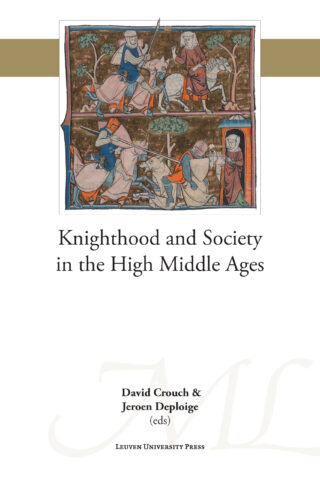
Knighthood and Society in the High Middle Ages
David Crouch (Editor), Jeroen Deploige (Editor),
Series: Mediaevalia Lovaniensia 48
Category: History, History 500-1500
Language: English
ISBN: 9789462701700
Publication date: November 26, 2020
€61.50 (including 6% VAT)
Buy NowNumber of pages: 330
Size: 234 x 156 x 18 mm
Number of illustrations: 21
Illustrations and other content description:
11 colour images, 10 b&w

Stock item: 138543
Standard delivery time for print books:
For Belgium: 5 to 8 working days
For EU: 2 to 3 weeks
For other countries: 4 to 5 weeks
Series: Mediaevalia Lovaniensia 48
Category: History, History 500-1500
Language: English
ISBN: 9789461662750
Publication date: November 26, 2020
€52.00 (including 6% VAT)
Buy NowNumber of pages: 330
Number of illustrations: 21
Illustrations and other content description:
11 colour images, 10 b&w
Chivalry and elite conduct in medieval Europe In popular imagination few phenomena are as strongly associated with medieval society as knighthood and chivalry. At the same time, and due to a long tradition of differing national perspectives and ideological assumptions, few phenomena have continued to be the object of so much academic debate. In this volume leading scholars explore various aspects of knightly identity, taking into account both commonalities and particularities across Western Europe. Knighthood and Society in the High Middle Ages addresses how, between the eleventh and the early thirteenth centuries, knighthood evolved from a set of skills and a lifestyle that was typical of an emerging elite habitus, into the basis of a consciously expressed and idealised chivalric code of conduct. Chivalry, then, appears in this volume as the result of a process of noble identity formation, in which some five key factors are distinguished: knightly practices, lineage, crusading memories, gender roles, and chivalric didactics.
This publication is GPRC-labeled (Guaranteed Peer-Reviewed Content).
ContributorsDominique Barthélemy (Sorbonne and EPHE, Paris), David Crouch (University of Hull), Jeroen Deploige (Ghent University), John D. Hosler (U.S. Army Command and General Staff College), Sara McDougall (City University of New York), Jean-François Nieus (University of Namur), Eljas Oksanen (University of Helsinki), Nicholas L. Paul (Fordham University), Jörg Peltzer (Heidelberg University), Nicolas Ruffini-Ronzani (University of Namur), Louise J. Wilkinson (University of Lincoln), Claudia Wittig (Ghent University)
Illustrations
Acknowledgements
David Crouch and Jeroen Deploige Taking the Field: Knighthood and Society in the High Middle Ages
Part I—Noble Warriors, Warring Nobles
Dominique Barthélemy Chivalry in Feudal Society According to French Evidence
Jörg Peltzer Knighthood in the Empire
Eljas Oksanen Knights, Mercenaries and Paid Soldiers: Military Identities in the Anglo-Norman Regnum
Part II—Knighthood and Lineage
Sara McDougall The Chivalric Family
Jean-François Nieus Sigard’s Belt: The Family of Chocques and the Borders of Knighthood (ca. 980‒1100)
Part III—Martial Ideals in Crusading Memories
John D. Hosler Knightly Ideals at the Siege of Acre, 1189‒1191
Nicholas L. Paul Writing the Knight, Staging the Crusader : Manasses of Hierges and the Monks of Brogne
Part IV—Women in Chivalric Representations
Louise J. Wilkinson The Chivalric Woman
Nicolas Ruffini-Rozani The Knight, the Lady, and the Poet : Understanding Huon of Oisy’s Tournoiement des Dames (ca. 1185‒1189)
Part V—Didactics of Chivalry
Claudia Wittig Teaching Chivalry in the Empire (ca. 1150‒1250)
David Crouch When Was Chivalry? Evolution of a Code
Notes on Contributors Index
Über zahlreiche neue Erkenntnisse zu Teilaspekten und Texten hinaus, zeigen die Autoren eindrücklich auf, wie gewinnbringend es ist, auch die alten strukturgeschichtlichen Forschungsmustermuster, die von vielfach starren Voraussetzungen und Formen ausgingen, zu hinterfragen. Die Autor:innen erläutern damit, wie sich zwischen dem 11. und 13. Jahrhundert ein Normen- und Wertegeflecht einwickelte, welches für die laikale Elite habituell prägend wurde. Dadurch leisten sie einen wertvollen Beitrag dazu, die Vorbedingungen von „knighthood“ und „chivalry“ aus verschiedenen Perspektiven besser zu verstehen. Das Werden des Rittertums ist als langwieriger gesellschaftlicher Prozess zu begreifen. Seine Erforschung ist, wie auch Jörg Pelzer in seinem Beitrag schreibt (S. 69), eine gesamteuropäische – und möglicherweise auch darüberhinausgehende – Aufgabe.
Sebastian Schaarschmidt, H-Soz-Kult, 20.10.2021, <www.hsozkult.de/publicationreview/id/reb-95789>.
The volume itself is handsomely produced by Leuven University Press and contains numerous illustrations. All of the contributions have something important to offer. Specialists in their respective regions will need to read the most relevant chapters, and historians of the Iberian Peninsula, Italy and central Europe will wish to test the ideas contained here on their own patches of ground. But the editors have also managed to forge a volume which is more valuable than the sum of its collective parts. It achieves two particularly important aims. Firstly, it forces numerous national historiographies to talk to one another, which is extremely beneficial if sometimes intellectually uncomfortable. The Anglophone reader (and reviewer) in particular will find much new here, not least in the frequent use of literary evidence rather than administrative or legal material. Secondly, our understanding of the key theme of the nobilisation of the knight is greatly enhanced by the conceptual richness and sound scholarship of this volume.Matt Raven, Virtus. Journal of Nobility Studies 2021
David Crouch and Jeroen Deploige’s invaluable collection, Knighthood and Society in the High Middle Ages, offers a rich and rewarding survey of just such questions. Offering a range of perspectives informing readers of the current state of chivalric studies, this well-organized and consistently engaging collection features historians focusing on late-medieval Western Europe, primarily in French, Provencal, German, Flemish, English, and Crusading contexts. With excellent essays thinking generally about chivalry balanced with richly sourced local studies, and with each essay framed by effective abstracts and conclusions, this insightful and thought-provoking volume should be on the shelf of any medievalist working on materials related to knightly culture.Randy P. Schiff, The Medieval Review, April 2022, https://scholarworks.iu.edu/journals/index.php/tmr/article/view/34193/37618
Avec une profondeur historiographique louable, David Crouch et Jeroen Deploige proposent un état de la recherche sur la chevalerie. [...] Mais au-delà même de l’intérêt thématique spécifique de chacun des chapitres, 'Knighthood and Society in the High Middle Ages' a le mérite d’inviter à repenser la manière dont les médiévistes conceptualisent la chevalerie et conçoivent son rapport avec la société médiévale.
Arnaud Montreuil, Memini [En ligne], 28 | 2022, mis en ligne le 27 décembre. URL : http://journals.openedition.org/memini/2081 ; DOI : https://doi.org/10.4000/memini.2081
Dit soort bijdragen zorgt ervoor dat dit boek niet enkel interessant is voor specialisten. Het hoofdstuk van McDougall faciliteert bijvoorbeeld niet alleen vergelijkingen tussen verschillende Europese regio’s, maar biedt ook een comparatief kader op langere termijn. Haar ruimere begrip van de ridderlijke familie problematiseert impliciet het idee van de ‘uitstervingsgraad’, een pijler van de meeste historische onderzoeken naar de (laatmiddeleeuwse) adel. Het is dit soort prikkelende insteken die helpen om het enigszins logge onderzoeksveld in nieuwe richtingen te duwen. En door het traditionele letterlijk met het nieuwe te bundelen, levert het boek van Deploige en Crouch daar een bijdrage aan.
Jim van der Meulen, Tijdschrift voor Geschiedenis, Volume 135, Issue 1, Dec 2022, p. 128 - 129, DOI: https://doi.org/10.5117/TvG2022.1.014.MEUL
This excellent volume brings together scholars from different national backgrounds and methodological approaches in order to work toward a better understanding of chivalric identity. It includes an introduction by the editors and eleven essays divided across five thematic sections. While some of the contributors are well-known specialists in the field of chivalry and knighthood studies, others are not scholars one would necessarily expect to find in a volume dedicated to these topics. It is precisely this mix of insider and outsider perspectives that makes the volume compelling. Many of the essays address different questions—with different sources—than more traditional studies of knighthood and chivalry. The knight is examined through the lens of some of the most recent developments in economic history, military history, family history, Crusades studies, and women’s studies (to name only a few) in order to situate chivalry and knighthood more firmly in current historiographical trends.
Jonathan R. Lyon, Speculum, Volume 98, Number 2, www.journals.uchicago.edu/doi/10.1086/724373
This is a collection of essays that will repay both specialists and a general audience interested in medieval knighthood and chivalry. Richard Abels, TSEG Vol. 20 No. 1 (2023), https://doi.org/10.52024/tseg.13625
Les forces du volume sont nombreuses. On retiendra la variété des angles d’analyse : la synthèse érudite, l’histoire des femmes, les croisades et l’histoire littéraire se rencontrent ici, souvent au sein de la même contribution. Il en ressort une sensibilité sémantique très fine, chaque auteur reprenant et définissant les termes clés de miles, chevalier, cavalier, chivalry, knighthood, pour les distinguer, les préciser, et parfois mieux les entrechoquer. On perçoit ainsi « sur le terrain » comment la chevalerie a émergé en Europe aux XIe et XIIe siècles, à la fois comme phénomène social, construction littéraire et morale et réflexe identitaire soigneusement cultivé ; l’on aimerait que soit désormais décortiquée avec la même rigueur et érudition le pourquoi de cette genèse, ainsi qu’y invitent les conclusions du volume.
Amicie Pélissié du Rausas, Le Moyen Âge, 3-4/2022 (vol. 128)
Ce recueil est l’aboutissement de deux projets de recherche, « The Sacralisation of Knighthood », mené par Jeroen Deploige et « The Genesis of Chivalry : Conduct in Western European Society 1000-1350 », dirigé par David Crouch, qui ont culminé avec le colloque « Noble Warriors or Warring Nobles ? The Complications of Knightly Identity in the High Middle Ages » tenu à Gand, en décembre 2015, dont il édite les actes en compagnie de quelques contributions inédites. Il se focalise sur la figure du chevalier dont les éditeurs soulignent à la fois la dimension iconique, toujours aussi présente dans l’imaginaire et exportée par la fantasy dans le monde entier, et l’approfondissement historiographique dont elle a fait l’objet. Les dernières décennies ont ainsi permis de passer de la conception du chevalier comme représentant d’une nouvelle classe sociale émergente aux XIe-XIIe s. à celle d’une construction culturelle complexe, qui est finalement adoptée par toute la haute aristocratie et qui intègre les conceptions chrétiennes du combat spirituel et l’idéal du prud’homme. Les éditeurs ont cherché à s’affranchir des prismes imposés par les approches et les traditions historiographiques nationales et souvent divergentes qui freinaient une véritable approche comparative et ont donc privilégié un ensemble ordonné de points de vue différents, tant sur le plan national que sur le plan disciplinaire, afin d’appréhender pleinement les marqueurs de l’identité chevaleresque en développement, ses points communs et ses divergences en Europe occidentale. - C. de Vasselot, Scriptorium 2021-2
Il volume raccoglie una serie di saggi sulle connessioni tra la società e la formazione dell'identità cavalleresca tra XI e XIII secolo, divisi in cinque sezioni: 1. pratica della guerra e nobiltà, 2. cavalleria e lignaggio, 3. cavalleria e costruzione della memoria crociata, 4. le donne e la società cavalleresca, 5. formazione dell'ideale di cavalleria. L'obiettivo della miscelleanea è di riunire dati provenienti da diverse tradizioni nazionali, con una particolare attenzione rivolta all'Inghilterra, alla Francia e all'impero tedesco. - Medioevo latino, XLIV (2023), https://www.mirabileweb.it/mel/knighthood-and-society-in-the-high-middle-ages/796707
Frequently Asked Questions
What is "Knighthood and Society in the High Middle Ages" about?
Chivalry and elite conduct in medieval Europe In popular imagination few phenomena are as strongly associated with medieval society as knighthood and chivalry. At the same time, and due to a long tradition of differing national perspectives and ideological assumptions, few phenomena have continued to be the object of so much academic debate. In this volume leading scholars explore various aspects of knightly identity, taking into account both commonalities and particularities across Western Europe. Knighthood and Society in the High Middle Ages addresses how, between the eleventh and the early thirteenth centuries, knighthood evolved from a set of skills and a lifestyle that was typical of an emerging elite habitus, into the basis of a consciously expressed and idealised chivalric code of conduct. Chivalry, then, appears in this volume as the result of a process of noble identity formation, in which some five key factors are distinguished: knightly practices, lineage, crusading memories, gender roles, and chivalric didactics.
This publication is GPRC-labeled (Guaranteed Peer-Reviewed Content).
ContributorsDominique Barthélemy (Sorbonne and EPHE, Paris), David Crouch (University of Hull), Jeroen Deploige (Ghent University), John D. Hosler (U.S. Army Command and General Staff College), Sara McDougall (City University of New York), Jean-François Nieus (University of Namur), Eljas Oksanen (University of Helsinki), Nicholas L. Paul (Fordham University), Jörg Peltzer (Heidelberg University), Nicolas Ruffini-Ronzani (University of Namur), Louise J. Wilkinson (University of Lincoln), Claudia Wittig (Ghent University)
Who edited "Knighthood and Society in the High Middle Ages"?
"Knighthood and Society in the High Middle Ages" was edited by David Crouch and Jeroen Deploige.
David Crouch is former Professor of Medieval History at the University of Hull and a Fellow of the British Academy.
Jeroen Deploige is Professor of Medieval History at Ghent University and member of the Belgian Royal Historical Commission.
Is "Knighthood and Society in the High Middle Ages" part of a series?
Yes, "Knighthood and Society in the High Middle Ages" is part of the "Mediaevalia Lovaniensia" series. It's book 48 in the series.

The longstanding, peer-reviewed book series Mediaevalia Lovaniensia. Studies in Medieval History, Society, and Culture publishes high-quality scholarship on the history and culture of the Middle Ages (c. 500–1550). Topics of particular interest to the series include, but are not limited to, social behaviour and power relations in medieval society, processes of identity formation, religious and urban culture, medieval thought and literature, and gender history. The series focuses on Europe and the wider Mediterranean world and is particularly rich in interdisciplinary approaches. By means of monographs and edited volumes, the series explores thematic frontiers and embraces innovative methodological approaches in historical and philological scholarship that is based on an in-depth source-based study.
Mediaevalia Lovaniensia accepts monographs as well as thematically coherent volumes in English. Moreover, it offers scholars the possibility to publish critical editions of primary texts with broader relevance to the understanding of medieval culture and society. The series aspires to publish books that have the potential to become reference works in the field of Medieval Studies.
We encourage early career (postdoctoral) researchers to submit a reworked version of their PhD thesis to this series. Leuven University Press provides authors with two publishing scenarios: traditional (non-Open Access) and the option to publish in Open Access (including language editing).
Editorial Board
Jelle Haemers (KU Leuven)
Jeroen Deploige (Ghent University)
Brigitte Meijns (KU Leuven)
Chanelle Delameillieure (KU Leuven - KULAK)
Baudouin Van den Abeele (UCLouvain)
Proposals
Proposals and enquiries can be sent to one of the editorial board members. Please send a short abstract. Upon approval of the proposal, the full manuscript will be submitted to international blind peer review by two (external) experts. The editors strive towards completing the review of proposals within one month and of complete manuscripts within five months after submission. Manuscripts should preferably be (+/-) 80.000 to 120.000 words in length.
Please make use of the submission form to present your manuscript or proposal to our board.
Authors interested in Open Access can consult the available funding options.
Links & Resources
What is the Table of Contents for "Knighthood and Society in the High Middle Ages"?
Illustrations
Acknowledgements
David Crouch and Jeroen Deploige Taking the Field: Knighthood and Society in the High Middle Ages
Part I—Noble Warriors, Warring Nobles
Dominique Barthélemy Chivalry in Feudal Society According to French Evidence
Jörg Peltzer Knighthood in the Empire
Eljas Oksanen Knights, Mercenaries and Paid Soldiers: Military Identities in the Anglo-Norman Regnum
Part II—Knighthood and Lineage
Sara McDougall The Chivalric Family
Jean-François Nieus Sigard’s Belt: The Family of Chocques and the Borders of Knighthood (ca. 980‒1100)
Part III—Martial Ideals in Crusading Memories
John D. Hosler Knightly Ideals at the Siege of Acre, 1189‒1191
Nicholas L. Paul Writing the Knight, Staging the Crusader : Manasses of Hierges and the Monks of Brogne
Part IV—Women in Chivalric Representations
Louise J. Wilkinson The Chivalric Woman
Nicolas Ruffini-Rozani The Knight, the Lady, and the Poet : Understanding Huon of Oisy’s Tournoiement des Dames (ca. 1185‒1189)
Part V—Didactics of Chivalry
Claudia Wittig Teaching Chivalry in the Empire (ca. 1150‒1250)
David Crouch When Was Chivalry? Evolution of a Code
Notes on Contributors Index
What is the DOI for "Knighthood and Society in the High Middle Ages"?
The Digital Object Identifier (DOI) for "Knighthood and Society in the High Middle Ages" is 10.11116/9789461662750.
Related titles

 Orality and Scribal Culture in the High Middle Ages
Timothy B. Noone (Author), Mark J. Clark (Author),
November 2026
 Toekomstdromen
Maarten Van Dijck (Editor), Gerrit Verhoeven (Editor), Hans Cools (Editor),
November 2026
 The Medieval Aristotle
Nena Bobovnik (Editor), Clelia V. Crialesi (Editor), Lisa Devriese (Editor),
August 2026

 Trend en toeval – vierde editie
Bruno Blondé (Author), Isabelle Devos (Author), Jord Hanus (Author), Wouter Ryckbosch (Author),
August 2026

 Political Exile in the Global Twentieth Century
Wolfram Kaiser (Editor), Piotr H. Kosicki (Editor),
April 2026
 Christian Democracy and the Fall of Communism
Michael Gehler (Editor), Piotr H. Kosicki (Editor), Helmut Wohnout (Editor),
April 2026
 Brusselse plaatsnamen
Iadine Degryse (Editor), Benjamin Wayens (Editor), Chantal Kesteloot (Editor), Dennis De Vriese (Editor), Matthijs Degraeve (Editor),
April 2026
 Cartographies of Catastrophes
Laura Demeter (Editor), Carmen M. Enss (Editor), Piotr Kisiel (Editor), Carol Ludwig (Editor),
February 2026

 Thomas Aquinas and Hervaeus Natalis on Concepts and Intentional Objects
Fabrizio Amerini (Author),
February 2026