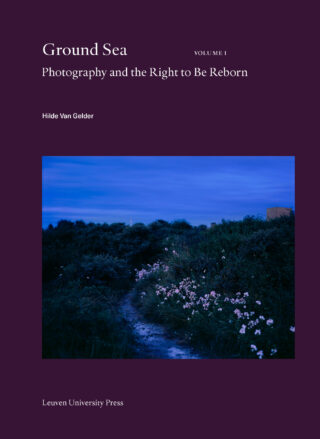

Ground Sea
Photography and the Right to Be Reborn
Hilde Van Gelder (Author),

Series: Lieven Gevaert Series 30
Category: Photography
Language: English
ISBN: 9789462702653
Publication date: September 15, 2021
€55.00 (including 6% VAT)
Buy NowNumber of pages: 1000
Size: 230 x 170 x 45 mm
Number of illustrations: 120
Illustrations and other content description:
120 illustrations

Stock item: 143293
Standard delivery time for print books:
For Belgium: 5 to 8 working days
For EU: 2 to 3 weeks
For other countries: 4 to 5 weeks
Series: Lieven Gevaert Series 30
Category: Photography
Language: English
ISBN: 9789461665768
Publication date: April 19, 2024
Download Free PDFNumber of pages: 1000
Number of illustrations: 120
Illustrations and other content description:
120 illustrations
TWO-VOLUME SET
Viewing the Strait of Dover through the lens of photography theory
Imagine a world in which each individual has a fundamental right to be reborn. This idle dream haunts Hilde Van Gelder’s associative travelogue that takes Allan Sekula’s sequence Deep Six / Passer au bleu (1996/1998) as a touchstone for a dialogue with more recent artworks zooming in on the borderscape near the Channel Tunnel, such as those by Sylvain George and Bruno Serralongue.
Combining ethnography, visual materials, political philosophy, cultural geography, and critical analysis, Ground Sea proceeds through an innovative methodological approach. Inspired by the meandering writings of W.G. Sebald, Javier Marías, and Roland Barthes, Van Gelder develops a style both interdisciplinary and personal.
Resolutely opting for an aquatic perspective, Ground Sea offers a powerful meditation on the indifference of an increasingly divided European Union with regard to considerable numbers of persons on the move, who find themselves stranded close to Calais. The contested Strait of Dover becomes a microcosm where our present global challenges of migration, climate change, human rights, and neoliberal surveillance technology converge.
Read more on the book’s dedicated website: www.groundsea.be
This publication is GPRC-labeled (Guaranteed Peer-Reviewed Content). Ebook available in Open Access.
Contents of Volume I Preface: Water-Bound Embarkation: Bone Point Acknowledgments Introduction: Sea-Stricken
PART I: Blade 1. Running on Water 2. Ground Sea Plates 3. Ossuary 4. Kairology 5. Reliquiae Notes
Deep Six / Passer au bleu (1996/1998) by Allan Sekula
Contents of Volume II
PART II: Shuttle 6. The Right to Reappear 7. Naming the Person without a Name 8. Fools & Rights: Leaves for an Illustrated Reader Plates 9. This Precious Jewel 10. Plotting
At Anchor: Pearl Diving
Notes Bibliography
Hilde Van Gelder
Hilde Van Gelder is Professor of Art History at KU Leuven.
'Ground Sea' makes a significant contribution to these debates as it raises the issue of human rights and the role of photography in the ongoing violation of fundamental freedoms.
Olga Smith, Focales, 7 | 2023 URL : http://journals.openedition.org/focales/2514
Hilde Van Gelder rassemble un corpus qui témoignent des conditions de survie de migrants qui n’ont plus rien à perdre, qui attendent le moment opportun pour se cacher dans le châssis d’un camion rejoignant un ferry et s’automutilent pour effacer leurs empreintes digitales (p. 389-351). Son écriture procède par la mise en relation des descriptions minutieuses des œuvres, avec le récit de parcours de migrants, des observations personnelles recueillies sur les lieux de ses recherches et des réflexions nourries de différentes disciplines. La photographie est envisagée comme un médium privilégié pour évoquer le transitoire ou ce qui n’est déjà plus : les écosystèmes modifiés, les dangereuses traversés, les errances, les identités malmenées, le risque de disparaître ou la construction d’une vie nouvelle. Hilde Van Gelder prend résolument partie en démontrant le manque d’humanisme et la précarité d’un monde qui se réconforte dans les nationalismes.- Lola Lorant, Critique d’art, le 01 juin 2023, DOI : https://doi.org/10.4000/critiquedart.94779
Frequently Asked Questions
What is "Ground Sea" about?
TWO-VOLUME SET
Viewing the Strait of Dover through the lens of photography theory
Imagine a world in which each individual has a fundamental right to be reborn. This idle dream haunts Hilde Van Gelder’s associative travelogue that takes Allan Sekula’s sequence Deep Six / Passer au bleu (1996/1998) as a touchstone for a dialogue with more recent artworks zooming in on the borderscape near the Channel Tunnel, such as those by Sylvain George and Bruno Serralongue.
Combining ethnography, visual materials, political philosophy, cultural geography, and critical analysis, Ground Sea proceeds through an innovative methodological approach. Inspired by the meandering writings of W.G. Sebald, Javier Marías, and Roland Barthes, Van Gelder develops a style both interdisciplinary and personal.
Resolutely opting for an aquatic perspective, Ground Sea offers a powerful meditation on the indifference of an increasingly divided European Union with regard to considerable numbers of persons on the move, who find themselves stranded close to Calais. The contested Strait of Dover becomes a microcosm where our present global challenges of migration, climate change, human rights, and neoliberal surveillance technology converge.
Read more on the book's dedicated website: www.groundsea.be
This publication is GPRC-labeled (Guaranteed Peer-Reviewed Content). Ebook available in Open Access.
Who wrote "Ground Sea"?
"Ground Sea" was written by Hilde Van Gelder.
Hilde Van Gelder is Professor of Art History at KU Leuven.
Is "Ground Sea" part of a series?
Yes, "Ground Sea" is part of the "Lieven Gevaert Series" series. It's book 30 in the series.

The series covers four types of publications:
- outstanding monographic studies
- multi-authored volumes on a specific topic
- book length projects with artists
- translations and/or reprints of classic texts.
All books are published in English and are written for an international audience of scholars.
Format
All books in the series are published in 17*23 cm paperback with French flaps, printed in black and white on white maco paper and with a maximum page extent of 300 pages (120.000 words) including images (unless agreed otherwise).
Authors interested in publishing their book in Open Access can check out the funding options here. Open access books are published under a creative commons license.
Series editors
Hilde Van Gelder, KU Leuven
Alexander Streitberger, UCLouvain
Proposals
Proposals and enquiries can be sent to the series editors.
Please make use of the submission form to present the full manuscript to our board.
Authors interested in Open Access can consult the available funding options.
Links & Resources
Is "Ground Sea" available Open Access?
Yes, "Ground Sea" is published Open Access. It is available under a BY-NC-ND license.
What is the Table of Contents for "Ground Sea"?
Contents of Volume I Preface: Water-Bound Embarkation: Bone Point Acknowledgments Introduction: Sea-Stricken
PART I: Blade 1. Running on Water 2. Ground Sea Plates 3. Ossuary 4. Kairology 5. Reliquiae Notes
Deep Six / Passer au bleu (1996/1998) by Allan Sekula
Contents of Volume II
PART II: Shuttle 6. The Right to Reappear 7. Naming the Person without a Name 8. Fools & Rights: Leaves for an Illustrated Reader Plates 9. This Precious Jewel 10. Plotting
At Anchor: Pearl Diving
Notes Bibliography
Related titles
 Ecologies of Photography in the American West
Monica Bravo (Editor), Carolin Görgen (Editor),
September 2026
 Nomadic Camera
Burcu Dogramaci (Editor), Winfried Gerling (Editor), Jens Jäger (Editor), Birgit Mersmann (Editor),
March 2026
 Dirk Lauwaert. Selected Writings, 1983-2008
Dirk Lauwaert (Author), Herman Asselberghs (Editor), Robbrecht Desmet (Editor), Bart Meuleman (Editor), Peter Jan Perquy (Editor),
October 2023
 Black Matrilineage, Photography, and Representation
Lesly Deschler Canossi (Editor), Zoraida Lopez-Diago (Editor),
September 2022
 Time and Photography
Jan Baetens (Editor), Alexander Streitberger (Editor), Hilde Van Gelder (Editor),
April 2018