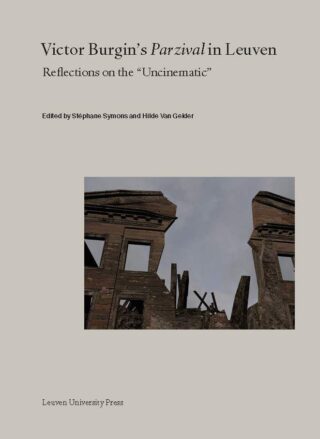
Victor Burgin’s Parzival in Leuven
Reflections on the "Uncinematic"
Stéphane Symons (Editor), Hilde Van Gelder (Editor),
Series: Lieven Gevaert Series 23
Category: Media and Visual Culture, Photography
Language: English
ISBN: 9789462700994
Publication date: March 27, 2017
€34.50 (including 6% VAT)
Buy NowNumber of pages: 158
Size: 230 x 170 x mm
Number of illustrations: 44
Illustrations and other content description:
15 color illustrations, 29 halftones

Stock item: 116177
Standard delivery time for print books:
For Belgium: 5 to 8 working days
For EU: 2 to 3 weeks
For other countries: 4 to 5 weeks
In-depth analysis of Victor Burgin’s video installation Parzival (2013).
In commemoration of the destruction of the University Library of Leuven (Belgium) in August 1914, the projection work Parzival, created by Victor Burgin (°UK, 1941) in 2013, was installed within the rebuilt Library. The installation uniquely marked the 100th anniversary of the beginning of World War I, which left its profound traces on both the consciousness and physiognomy of the city of Leuven. Parzival is a montage piece combining digital images of ruins and bombed out cities with audio-visual and literary material that references, amongst other works, Richard Wagner’s opera Parsifal (premiere in 1882), Roberto Rossellini’s Germany Year Zero (1948) and Milan Kundera’s novel Identity (1998). This publication provides an in-depth analysis of Parzival, a work that is inspired by the period of seven months that Wagner spent in Venice (1858-1859). Burgin’s Parzival raises questions about some of the most fundamental elements in Wagner’s operatic work: the longing for a savior, the complex connection between violence and catharsis, and the presentiment that destruction awaits humanity in the future (Götterdämmerung). In an associative manner, Parzival brings together various artistic and political features to confront the romantic ideal of the ruin with the horrors that might result from such a myth. In addition, this book contains a reprint of Michel Foucault’s essay “The Imagination of the Nineteenth Century” (1980).
This publication is GPRC-labeled (Guaranteed Peer-Reviewed Content).
Contributors: Geert Bouckaert (KU Leuven), Victor Burgin (University of California, University of London, University of Southampton), Alexander Streitberger (Université catholique de Louvain), Stéphane Symons (KU Leuven), Hilde Van Gelder (KU Leuven)
Preface Geert Bouckaert
Part ICollaborative Reflections on Parzival
Victor Burgin’s Parzival in Leuven Stéphane Symons and Hilde Van Gelder
Victor Burgin’s Parzival: A Monument of Melancholia Alexander Streitberger
Roundtable Victor Burgin in Conversation with Alexander Streitberger, Stéphane Symons, and Hilde Van Gelder on the Occasion of a Symposium on Parzival
Part IIContextualizing Parzival Uncinematic Time Victor Burgin
The Imagination of the Nineteenth Century Michel Foucault
A Note on Parzival Victor Burgin
Parzival Wall Texts Victor Burgin
Part IIIParzival in Leuven
Notes Contributors
Stéphane Symons
Stéphane Symons is Full Professor of Aesthetics and Philosophy of Culture at the Institute of Philosophy of KU Leuven.
Hilde Van Gelder
Hilde Van Gelder is Professor of Art History at KU Leuven.
Frequently Asked Questions
What is "Victor Burgin’s Parzival in Leuven" about?
In-depth analysis of Victor Burgin’s video installation Parzival (2013).
In commemoration of the destruction of the University Library of Leuven (Belgium) in August 1914, the projection work Parzival, created by Victor Burgin (°UK, 1941) in 2013, was installed within the rebuilt Library. The installation uniquely marked the 100th anniversary of the beginning of World War I, which left its profound traces on both the consciousness and physiognomy of the city of Leuven. Parzival is a montage piece combining digital images of ruins and bombed out cities with audio-visual and literary material that references, amongst other works, Richard Wagner’s opera Parsifal (premiere in 1882), Roberto Rossellini’s Germany Year Zero (1948) and Milan Kundera’s novel Identity (1998). This publication provides an in-depth analysis of Parzival, a work that is inspired by the period of seven months that Wagner spent in Venice (1858-1859). Burgin’s Parzival raises questions about some of the most fundamental elements in Wagner’s operatic work: the longing for a savior, the complex connection between violence and catharsis, and the presentiment that destruction awaits humanity in the future (Götterdämmerung). In an associative manner, Parzival brings together various artistic and political features to confront the romantic ideal of the ruin with the horrors that might result from such a myth. In addition, this book contains a reprint of Michel Foucault’s essay “The Imagination of the Nineteenth Century” (1980).
This publication is GPRC-labeled (Guaranteed Peer-Reviewed Content).
Contributors: Geert Bouckaert (KU Leuven), Victor Burgin (University of California, University of London, University of Southampton), Alexander Streitberger (Université catholique de Louvain), Stéphane Symons (KU Leuven), Hilde Van Gelder (KU Leuven)
Who edited "Victor Burgin’s Parzival in Leuven"?
"Victor Burgin’s Parzival in Leuven" was edited by Stéphane Symons and Hilde Van Gelder.
Stéphane Symons is Full Professor of Aesthetics and Philosophy of Culture at the Institute of Philosophy of KU Leuven.
Hilde Van Gelder is Professor of Art History at KU Leuven.
Is "Victor Burgin’s Parzival in Leuven" part of a series?
Yes, "Victor Burgin’s Parzival in Leuven" is part of the "Lieven Gevaert Series" series. It's book 23 in the series.

The series covers four types of publications:
- outstanding monographic studies
- multi-authored volumes on a specific topic
- book length projects with artists
- translations and/or reprints of classic texts.
All books are published in English and are written for an international audience of scholars.
Format
All books in the series are published in 17*23 cm paperback with French flaps, printed in black and white on white maco paper and with a maximum page extent of 300 pages (120.000 words) including images (unless agreed otherwise).
Authors interested in publishing their book in Open Access can check out the funding options here. Open access books are published under a creative commons license.
Series editors
Hilde Van Gelder, KU Leuven
Alexander Streitberger, UCLouvain
Proposals
Proposals and enquiries can be sent to the series editors.
Please make use of the submission form to present the full manuscript to our board.
Authors interested in Open Access can consult the available funding options.
Links & Resources
What is the Table of Contents for "Victor Burgin’s Parzival in Leuven"?
Preface Geert Bouckaert
Part ICollaborative Reflections on Parzival
Victor Burgin's Parzival in Leuven Stéphane Symons and Hilde Van Gelder
Victor Burgin's Parzival: A Monument of Melancholia Alexander Streitberger
Roundtable Victor Burgin in Conversation with Alexander Streitberger, Stéphane Symons, and Hilde Van Gelder on the Occasion of a Symposium on Parzival
Part IIContextualizing Parzival Uncinematic Time Victor Burgin
The Imagination of the Nineteenth Century Michel Foucault
A Note on Parzival Victor Burgin
Parzival Wall Texts Victor Burgin
Part IIIParzival in Leuven
Notes Contributors
Related titles
 Feminists Resisting Gendered Violence
Hemangini Gupta (Editor), Fiona Mackay (Editor), Jan Breckenridge (Editor), Louise Chappell (Editor), Rachna Mehra (Editor), Rukmini Sen (Editor), Mailin Suchting (Editor),
October 2026
 Ecologies of Photography in the American West
Monica Bravo (Editor), Carolin Görgen (Editor),
September 2026
 Cinema in Post-War Belgium
Gertjan Willems (Editor), Bjorn Gabriels (Editor), Bénédicte Rochet (Editor),
May 2026

 Performing Magnetism
Eleonora Paklons (Editor), Kristof Smeyers (Editor), Kurt Vanhoutte (Editor), Hannah Welslau (Editor),
May 2026
 Nomadic Camera
Burcu Dogramaci (Editor), Winfried Gerling (Editor), Jens Jäger (Editor), Birgit Mersmann (Editor),
March 2026
 Comics and the Global South
Andrea Aramburú (Editor), Dibyadyuti Roy (Editor), Joe Sutliff Sanders (Editor),
February 2026
 The Visionary Art of Franco-Belgian Comics, 1930s to 1960s
Hugo Frey (Editor), Maaheen Ahmed (Editor),
September 2025
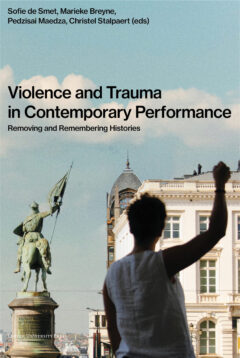 Violence and Trauma in Contemporary Performance
Sofie de Smet (Editor), Marieke Breyne (Editor), Pedzisai Maedza (Editor), Christel Stalpaert (Editor),
May 2025
 Architectures of Resistance
Angeliki Sioli (Editor), Nishat Awan (Editor), Kristopher Palagi (Editor),
August 2024