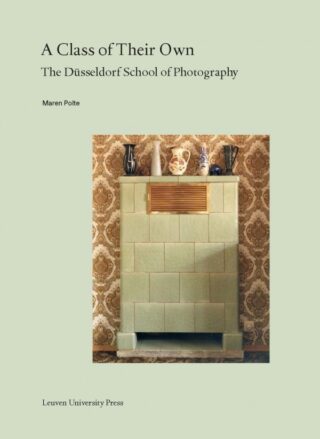
A Class of Their Own
The Düsseldorf School of Photography
Maren Polte (Author),
The pioneer group of the Düsseldorf School.
The ‘Düsseldorf School’ has become a household name in the art world for one of the most successful and influential strains of modern photography. Coined in the late 1980s, the name refers mainly to the pioneer group of students of the late Bernd Becher, who in 1976 became the first professor for creative photography at a German arts academy. His students included Andreas Gursky, Candida Höfer, Axel Hütte, Thomas Ruff, and Thomas Struth, all of them today internationally acclaimed artists in their own right. Whereas ‘Düsseldorf School’ initially was used as a handy term for a group of artists with the same university’s background, it quickly turned into a powerful brand name both in critical and commercial contexts. Despite its welcomed impact on the art scene, the members of the ‘School’ felt rather ambiguous about their perception as a group which turned them into stars but simultaneously risked levelling individual profiles and differences. What exactly connects and distinguishes them aesthetically is for the first time thoroughly explored in Maren Polte’s pioneering study.
Introduction
I. Bernd and Hilla Becher
1. Origins
2. Aesthetics
3. Reception
4. Teachings
II. Foundations of the Düsseldorf School
1. Points of departure
2. Themes and orientation
3. Conceptual Photography of the 1960s
4. Conventional methods of photography in the 1970s
III. Development of pictorial rhetorics
1. The switch to colour
2. Expansion of format
3. Construction
4. Digital and analogue abstraction
IV. Reflexive and self-referential aesthetics
1. Observation and re-organisation
2. Sociograms
3. Multiple functions
4. Reflection of media
V. Tradition
1. References to form
2. Critical engagement with painting
3. Genres
4. Reception
VI. Principle and difference
1. ‘The Big, Still Picture’ (Das große stille Bild)
2. “Finders”
3. “Fabricators”
4. Summary
Notes Bibliography Color section
In her thorough investigation, Polte shows how the Bechers’ visual analytical approach reverberates in the individual pictorial idioms their students developed, leading them, as Polte notes, on a path from ‘image into picture’. [...] fresh and much-needed perspectives on what constitutes photography in Germany today. [...] highlight important areas in which photography defines identity, and in turn how concepts of identity are applied to photography.
The Burlington Magazine, May 2018, Jule Schaffer
Frequently Asked Questions
What is "A Class of Their Own" about?
The pioneer group of the Düsseldorf School.
The ‘Düsseldorf School’ has become a household name in the art world for one of the most successful and influential strains of modern photography. Coined in the late 1980s, the name refers mainly to the pioneer group of students of the late Bernd Becher, who in 1976 became the first professor for creative photography at a German arts academy. His students included Andreas Gursky, Candida Höfer, Axel Hütte, Thomas Ruff, and Thomas Struth, all of them today internationally acclaimed artists in their own right. Whereas ‘Düsseldorf School’ initially was used as a handy term for a group of artists with the same university’s background, it quickly turned into a powerful brand name both in critical and commercial contexts. Despite its welcomed impact on the art scene, the members of the ‘School’ felt rather ambiguous about their perception as a group which turned them into stars but simultaneously risked levelling individual profiles and differences. What exactly connects and distinguishes them aesthetically is for the first time thoroughly explored in Maren Polte’s pioneering study.
Who wrote "A Class of Their Own"?
"A Class of Their Own" was written by Maren Polte.
Maren Polte teaches art history and heads the Department of Art Mediation at Bern University of the Arts.
Is "A Class of Their Own" part of a series?
Yes, "A Class of Their Own" is part of the "Lieven Gevaert Series" series. It's book 24 in the series.

The series covers four types of publications:
- outstanding monographic studies
- multi-authored volumes on a specific topic
- book length projects with artists
- translations and/or reprints of classic texts.
All books are published in English and are written for an international audience of scholars.
Format
All books in the series are published in 17*23 cm paperback with French flaps, printed in black and white on white maco paper and with a maximum page extent of 300 pages (120.000 words) including images (unless agreed otherwise).
Authors interested in publishing their book in Open Access can check out the funding options here. Open access books are published under a creative commons license.
Series editors
Hilde Van Gelder, KU Leuven
Alexander Streitberger, UCLouvain
Proposals
Proposals and enquiries can be sent to the series editors.
Please make use of the submission form to present the full manuscript to our board.
Authors interested in Open Access can consult the available funding options.
Links & Resources
What is the Table of Contents for "A Class of Their Own"?
Introduction
I. Bernd and Hilla Becher
1. Origins
2. Aesthetics
3. Reception
4. Teachings
II. Foundations of the Düsseldorf School
1. Points of departure
2. Themes and orientation
3. Conceptual Photography of the 1960s
4. Conventional methods of photography in the 1970s
III. Development of pictorial rhetorics
1. The switch to colour
2. Expansion of format
3. Construction
4. Digital and analogue abstraction
IV. Reflexive and self-referential aesthetics
1. Observation and re-organisation
2. Sociograms
3. Multiple functions
4. Reflection of media
V. Tradition
1. References to form
2. Critical engagement with painting
3. Genres
4. Reception
VI. Principle and difference
1. ‘The Big, Still Picture’ (Das große stille Bild)
2. “Finders”
3. “Fabricators”
4. Summary
Notes Bibliography Color section
Related titles
 Collective Trauma and Future Fantasies
Raika Khorshidian (Editor), Birgit Mersmann (Editor), Cathrine Bublatzky (Editor), Julia Stenzel (Editor),
November 2026

 Feminists Resisting Gendered Violence
Hemangini Gupta (Editor), Fiona Mackay (Editor), Jan Breckenridge (Editor), Louise Chappell (Editor), Rachna Mehra (Editor), Rukmini Sen (Editor), Mailin Suchting (Editor),
October 2026

 A City in Practice
Aude Tournaye (Editor), Filip De Boeck (Editor), Picha Collective (Editor),
September 2026
 Ecologies of Photography in the American West
Monica Bravo (Editor), Carolin Görgen (Editor),
September 2026
 Cinema in Post-War Belgium
Gertjan Willems (Editor), Bjorn Gabriels (Editor), Bénédicte Rochet (Editor),
May 2026
 Performing Magnetism
Eleonora Paklons (Editor), Kristof Smeyers (Editor), Kurt Vanhoutte (Editor), Hannah Welslau (Editor),
May 2026
 Jean Katambayi Mukendi
Johannes Muselaers (Editor), Stéphane Symons (Editor), Anne-Claire Schmitz (Editor), Emma Enderby (Editor),
April 2026
 Nomadic Camera
Burcu Dogramaci (Editor), Winfried Gerling (Editor), Jens Jäger (Editor), Birgit Mersmann (Editor),
March 2026
 Comics and the Global South
Andrea Aramburú (Editor), Dibyadyuti Roy (Editor), Joe Sutliff Sanders (Editor),
February 2026
 Entangled Art Histories
Valérie Mavridorakis (Editor), Alexander Streitberger (Editor), Hilde Van Gelder (Editor), Erik Verhagen (Editor),
October 2025
 The Visionary Art of Franco-Belgian Comics, 1930s to 1960s
Hugo Frey (Editor), Maaheen Ahmed (Editor),
September 2025
 Violence and Trauma in Contemporary Performance
Sofie de Smet (Editor), Marieke Breyne (Editor), Pedzisai Maedza (Editor), Christel Stalpaert (Editor),
May 2025