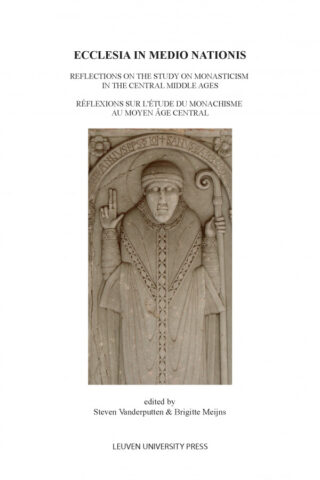
Ecclesia in medio nationis
Reflections on the Study of Monasticism in the Central Middle Ages - Réflexions sur l'étude du monachismeau moyen âge central
Steven Vanderputten (Editor), Brigitte Meijns (Editor),
Series: Mediaevalia Lovaniensia 42
Category: History, History 500-1500
ISBN: 9789058678874
Publication date: December 13, 2011
€45.00 (including 6% VAT)
Buy NowNumber of pages: 215
Size: 240 x 160 x 10 mm

Stock item: 65187
Standard delivery time for print books:
For Belgium: 5 to 8 working days
For EU: 2 to 3 weeks
For other countries: 4 to 5 weeks
Series: Mediaevalia Lovaniensia 42
Category: History, History 500-1500
ISBN: 9789461661111
Publication date: December 13, 2011
€34.00 (including 6% VAT)
Buy NowNumber of pages: 215
The role of monastic institutions in society during the Central Middle Ages has been much debated in medieval studies. Some scholars saw monasticism as the principal motivator of economic, social, intellectual and ‘spiritual’ progress in human society, while others regarded monastic ideology as fundamentally anti-social and oriented towards itself. These debates seem to have lost some of their relevance to the present-day scholar. Today monasticism is studied as a social entity which needed interactions with the outside world, not only to subsist in a physical sense, but also to give a clear sense of purpose to its members. Drawing on recent trends in historical scholarship, this volume seeks to identify some of the major questions that will dominate research into monasticism in the years to come. Contributions deal with the evolution of monasticism itself, its links with aristocracy, the economic relations of religious communities and their physical and ideological boundaries, and the representation of the outside world in monastic manuscripts. Les contributions rassemblées dans ce volume présentent un point de vue à la fois multiple et multidisciplinaire sur l’état de la question dans l’historiographie du monachisme, un domaine de recherche dont la complexité s’avère désormais incontestable. Il s’agit de réflexions portant sur l’évolution du monachisme, ou d’études approfondissant les liens entre le monachisme et l’aristocratie ou les réalités économiques, explorant les liens physiques et idéologiques avec le monde extérieur, sans oublier des analyses portant sur les représentations du monde extérieur dans les manuscrits médiévaux.
This publication is GPRC-labeled (Guaranteed Peer-Reviewed Content).
Contents/Contenu
Steven Vanderputten (Gent) & Brigitte Meijns (Leuven)
Introduction
Isabelle Rosé (Rennes)
Les moines et leur vie communautaire du IXe au XIIe siècle.
Tour d’horizon historiographique
Florian Mazel (Rennes)
Monachisme et aristocratie aux Xe-XIe siècles.
Un regard sur l’historiographie récente
Nicolas Ruffini & Jean-François Nieus (Namur)
Société seigneuriale, réformes ecclésiales: les enjeux documentaires d’une révision historiographique
Alexis Wilkin (Bruxelles)
Communautés religieuses bénédictines et environnement économique, IXe-XIIe siècles. Réflexions sur les tendances historiographiques de l’analyse du temporel monastique
Harald Sellner (Tübingen)
Les communautés religieuses du Moyen Age central et la recherche des réformes monastiques en Allemagne
Gert Melville (Dresden)
Inside and Outside. Some Considerations about Cloistral Boundaries in the Central Middle Ages
Diane Reilly (Bloomington)
The Monastic World View in the Artistic Tradition
Arnoud-Jan Bijsterveld (Tilburg)
Conclusions
It is a great gift of the collection that it gives attention both to monastic spiritual prerogatives and to the untidy worldly realities in which monks took part. Readers might come away from the volume wishing that the several authors had found a corporate synthesis more convincing than that monks suffered from a kind of bipolar disorder. Still, in their effort to reconcile the tendencies of Martha and Mary, the authors survey some very vivid evidence of robust monastic change. These essays offer rich bibliographies, especially in reference to recent scholarship in French. Their insights and provocations should draw attention for a long time.
Michael A. Vargas, sehepunkte, Ausgabe 13 (2013), Nr. 1
Overall, this is a helpful volume and should be welcomed and read by scholars of monasticism and those interested in the interactions of the church and society in the central Middle Ages. The Conventus group that was responsible for this gathering is to be commended for making these articles available and it is with great anticipation that we should await more of their work.
GREG PETERS, Medieval and Spiritual Theology, Biola University, Comitatus 44 (september 2013)
A la fin de cet ouvrage, on ne sait s'il convient de saluer d'abord la haute qualité de ses contributions ou leur évidente et éminente utilité, leur caractère stimulant, les ouvertures qu'elles suggèrent aux chercheurs.
Michel DE WAHA, 'Revue Belge de Philologie et d'Histoire' 2013/4
Frequently Asked Questions
What is "Ecclesia in medio nationis" about?
The role of monastic institutions in society during the Central Middle Ages has been much debated in medieval studies. Some scholars saw monasticism as the principal motivator of economic, social, intellectual and ‘spiritual' progress in human society, while others regarded monastic ideology as fundamentally anti-social and oriented towards itself. These debates seem to have lost some of their relevance to the present-day scholar. Today monasticism is studied as a social entity which needed interactions with the outside world, not only to subsist in a physical sense, but also to give a clear sense of purpose to its members. Drawing on recent trends in historical scholarship, this volume seeks to identify some of the major questions that will dominate research into monasticism in the years to come. Contributions deal with the evolution of monasticism itself, its links with aristocracy, the economic relations of religious communities and their physical and ideological boundaries, and the representation of the outside world in monastic manuscripts. Les contributions rassemblées dans ce volume présentent un point de vue à la fois multiple et multidisciplinaire sur l'état de la question dans l'historiographie du monachisme, un domaine de recherche dont la complexité s'avère désormais incontestable. Il s'agit de réflexions portant sur l'évolution du monachisme, ou d'études approfondissant les liens entre le monachisme et l'aristocratie ou les réalités économiques, explorant les liens physiques et idéologiques avec le monde extérieur, sans oublier des analyses portant sur les représentations du monde extérieur dans les manuscrits médiévaux.
This publication is GPRC-labeled (Guaranteed Peer-Reviewed Content).
Who edited "Ecclesia in medio nationis"?
"Ecclesia in medio nationis" was edited by Steven Vanderputten and Brigitte Meijns.
Steven Vanderputten is Professor of Medieval History at Ghent University. He has published extensively on monasticism and is the spokesman of the international research network Conventus.
Brigitte Meijns is Professor of Medieval History at KU Leuven. She is a specialist of the ecclesiastical history of the Middle Ages and is a member of the international research network Conventus.
Is "Ecclesia in medio nationis" part of a series?
Yes, "Ecclesia in medio nationis" is part of the "Mediaevalia Lovaniensia" series. It's book 42 in the series.

The longstanding, peer-reviewed book series Mediaevalia Lovaniensia. Studies in Medieval History, Society, and Culture publishes high-quality scholarship on the history and culture of the Middle Ages (c. 500–1550). Topics of particular interest to the series include, but are not limited to, social behaviour and power relations in medieval society, processes of identity formation, religious and urban culture, medieval thought and literature, and gender history. The series focuses on Europe and the wider Mediterranean world and is particularly rich in interdisciplinary approaches. By means of monographs and edited volumes, the series explores thematic frontiers and embraces innovative methodological approaches in historical and philological scholarship that is based on an in-depth source-based study.
Mediaevalia Lovaniensia accepts monographs as well as thematically coherent volumes in English. Moreover, it offers scholars the possibility to publish critical editions of primary texts with broader relevance to the understanding of medieval culture and society. The series aspires to publish books that have the potential to become reference works in the field of Medieval Studies.
We encourage early career (postdoctoral) researchers to submit a reworked version of their PhD thesis to this series. Leuven University Press provides authors with two publishing scenarios: traditional (non-Open Access) and the option to publish in Open Access (including language editing).
Editorial Board
Jelle Haemers (KU Leuven)
Jeroen Deploige (Ghent University)
Brigitte Meijns (KU Leuven)
Chanelle Delameillieure (KU Leuven - KULAK)
Baudouin Van den Abeele (UCLouvain)
Proposals
Proposals and enquiries can be sent to one of the editorial board members. Please send a short abstract. Upon approval of the proposal, the full manuscript will be submitted to international blind peer review by two (external) experts. The editors strive towards completing the review of proposals within one month and of complete manuscripts within five months after submission. Manuscripts should preferably be (+/-) 80.000 to 120.000 words in length.
Please make use of the submission form to present your manuscript or proposal to our board.
Authors interested in Open Access can consult the available funding options.
Links & Resources
What is the Table of Contents for "Ecclesia in medio nationis"?
Contents/Contenu
Steven Vanderputten (Gent) & Brigitte Meijns (Leuven)
Introduction
Isabelle Rosé (Rennes)
Les moines et leur vie communautaire du IXe au XIIe siècle.
Tour d'horizon historiographique
Florian Mazel (Rennes)
Monachisme et aristocratie aux Xe-XIe siècles.
Un regard sur l'historiographie récente
Nicolas Ruffini & Jean-François Nieus (Namur)
Société seigneuriale, réformes ecclésiales: les enjeux documentaires d'une révision historiographique
Alexis Wilkin (Bruxelles)
Communautés religieuses bénédictines et environnement économique, IXe-XIIe siècles. Réflexions sur les tendances historiographiques de l'analyse du temporel monastique
Harald Sellner (Tübingen)
Les communautés religieuses du Moyen Age central et la recherche des réformes monastiques en Allemagne
Gert Melville (Dresden)
Inside and Outside. Some Considerations about Cloistral Boundaries in the Central Middle Ages
Diane Reilly (Bloomington)
The Monastic World View in the Artistic Tradition
Arnoud-Jan Bijsterveld (Tilburg)
Conclusions
Related titles

 Orality and Scribal Culture in the High Middle Ages
Timothy B. Noone (Author), Mark J. Clark (Author),
November 2026
 Toekomstdromen
Maarten Van Dijck (Editor), Gerrit Verhoeven (Editor), Hans Cools (Editor),
November 2026
 The Medieval Aristotle
Nena Bobovnik (Editor), Clelia V. Crialesi (Editor), Lisa Devriese (Editor),
August 2026

 Trend en toeval – vierde editie
Bruno Blondé (Author), Isabelle Devos (Author), Jord Hanus (Author), Wouter Ryckbosch (Author),
August 2026

 Political Exile in the Global Twentieth Century
Wolfram Kaiser (Editor), Piotr H. Kosicki (Editor),
April 2026
 Christian Democracy and the Fall of Communism
Michael Gehler (Editor), Piotr H. Kosicki (Editor), Helmut Wohnout (Editor),
April 2026
 Brusselse plaatsnamen
Iadine Degryse (Editor), Benjamin Wayens (Editor), Chantal Kesteloot (Editor), Dennis De Vriese (Editor), Matthijs Degraeve (Editor),
April 2026
 Cartographies of Catastrophes
Laura Demeter (Editor), Carmen M. Enss (Editor), Piotr Kisiel (Editor), Carol Ludwig (Editor),
February 2026
 Thomas Aquinas and Hervaeus Natalis on Concepts and Intentional Objects
Fabrizio Amerini (Author),
February 2026