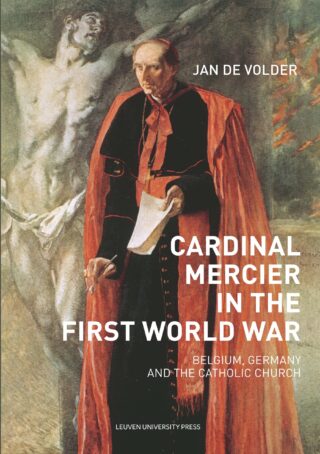
Cardinal Mercier in the First World War
Belgium, Germany and the Catholic Church
Jan De Volder (Author),
Series: KADOC-Studies on Religion, Culture and Society 23
Category: History, History 1800-present, Religion
Language: English
ISBN: 9789462701649
Publication date: October 24, 2018
€49.50 (including 6% VAT)
Buy NowNumber of pages: 264
Size: 230 x 170 x 15 mm
Number of illustrations: 10
Illustrations and other content description:
b&w illustrations

Stock item: 124697
Standard delivery time for print books:
For Belgium: 5 to 8 working days
For EU: 2 to 3 weeks
For other countries: 4 to 5 weeks
Series: KADOC-Studies on Religion, Culture and Society 23
Category: History, History 1800-present, Religion
Language: English
ISBN: 9789461662729
Publication date: October 24, 2018
€37.00 (including 6% VAT)
Buy NowNumber of pages: 264
Number of illustrations: 10
Illustrations and other content description:
b&w illustrations
Church leaders and their contrasting opinions in the face of the Great War
Cardinal Désiré-Joseph Mercier, Archbishop of Malines, was the incarnation of the Belgian resistance against the German occupation during the First World War. With his famous pastoral letter of Christmas 1914 ‘Patriotisme et Endurance’ he reached a wide audience, and gained international influence and respect.
Mercier’s distinct patriotic stance clearly determined his views of national politics, especially of the ‘Flemish question’, and his conflict with the German occupier made him a hero of the Allies. The Germans did not always know how to handle this influential man of the Church. Pope Benedict XV did not always approve of the course of action adopted by the Belgian prelate. Whereas Mercier justified the war effort as a just cause in view of the restoration of Belgium’s independence, the Pope feared that “this useless massacre” meant nothing but the “suicide of civilized Europe”.
Through a critical analysis of the policies of Cardinal Mercier and Pope Benedict XV, this book sheds revealing light on the contrasting positions of Church leaders in the face of the Great War.
This publication is GPRC-labeled (Guaranteed Peer-Reviewed Content).
Introduction
Belgium and the German Invasion of 1914 Belgium, a laboratory for Catholics in a liberal democracy Catholic Party between conservatives and social Catholicism Cardinal Mercier, Belgium’s primate The German invasion A Protestant-Catholic Holy War? The 1914 conclave Pope Benedict XV and the Belgian dilemma
Mercier’s Pastoral Letter “Patriotism and Endurance” Cardinal Mercier and the fall of Antwerp The Cardinal’s choice is maturing Patriotism and Endurance Alternatives were possible
In Conflict with the Occupier The German reaction Meanwhile in the Vatican The nation’s hero
Mercier and Benedict XV A new crisis Banishment to Rome? Letter to the bishops of Germany and Austria Meeting with the pope Triumph in Rome Arm wrestling about the return “At our return from Rome”
Arrests, Deportations, and State Looting Arrests and executions Dismantling of a nation Resistance against the deportations Towards a public papal condemnation? Vatican pressure
The Flemish Question Flamenpolitik A Flemish university in Ghent The Belgian administration split Roman questions regarding Mercier’s stance Roman Realpolitik
Holy War or Holy Peace A just war? First search for a negotiated solution Towards a compromise peace in 1916? Pope Benedict’s peace proposal “The bitterest hour of our life” The end of the war
The Allies’ Hero of a Diminished Belgium Towards a solution for the Roman question? Belgium after the armistice Triumphal tour of the United States and Canada
Conclusion
Annex: Patriotism and Endurance – Christmas 1914 Bibliography Index of Persons Colophon
Uit deze studie blijkt vrij duidelijk dat de plaats van Mercier in de internationale diplomatie tijdens de Eerste Wereldoorlog zeker niet deze was van een klein figurantje. [...] Dit uiterst goed gedocumenteerd boek (met personenregister) laat een aantal tot op heden niet ontsloten bronnen tot hun volle recht komen (Vaticaan, aartsbisdom Mechelen, archief van het Koninklijk Paleis, Rijksarchief, uitgebreide literatuurlijst). Maar niet in het minst schetst het een naar onze bescheiden mening objectief en her en der verrassend beeld van een van de grootste figuren in de Belgische geschiedenis.
Alex Vanneste, Volkskunde, 2019, 2
De verschillende vragen over het leven en werk van Mercier tonen echter bovenal dat De Volder in zijn opzet is geslaagd: het boek heeft een eerste aanzet gegeven om de complexe figuur van Mercier verder te onderzoeken.Kasper Swerts, Contemporanea, Jaargang XXXVIII — Jaar 2019 — Nummer 4, https://www.contemporanea.be/nl/article/20194-recensies-swerts-over-de-volder
De internationale betekenis van deze Belgische kerkvorst verantwoordt de publicatie van een synthese in het Engels zodat dit vernieuwende onderzoek - onder meer in de Vaticaanse archieven - een ruimer internationaal bereik kan verwerven. Mercier was immers niet enkel belangrijk voor het bezette Belgische grond- gebied maar ook voor de internationale scene.Luc Vandeweyer, Belgisch Tijdschrift voor Nieuwste Geschiedenis 2019 2-3
In het korte bestek van een recensie kan nauwelijks recht worden gedaan aan drie kwaliteiten die het boek heeft. De Volder is grondig in de gedetailleerdheid waarmee hij de gebeurtenissen beschrijft. Tegelijk plaatst De Volder de gebeurtenissen soepel en effectief in hun context, niet alleen die van de grotere lijnen van het Duitse en Vaticaanse beleid, maar ook van de Belgische economische en politieke context van voor en tijdens de oorlog, en van de gevolgen van de bezetting voor het Belgische volk. En niet in de laatste plaats: het boek is voortreffelijk geschreven. Lodewijk Winkeler, BMGN — Low
Countries Historical Review | Volume 135 (2020)
Ungeachtet dieser kleineren Anmerkungen bietet Jan De Volders Buch einem internationalen Publikum einen anregenden Einblick in die diplomatische Strategie der Katholischen Kirche während des Ersten Weltkriegs und leistet einen wichtigen Beitrag zur Historisierung einer Symbolfigur belgischer Geschichte.Moritz A. Sorg, Historische Zeitschrift // BAND 310 / 2020, https://doi.org/10.1515/hzhz-2020-1065
Door een kritische analyse van het beleid van kardinaal Mercier en Paus Benedictus XV. en als vervolg op zijn “Kardinaal Verzet, Mercier, de Kerk en de oorlog van 14-18”, werpt dit boek van Jan De Volder dan ook een onthullend licht op de contrasterende standpunten van de kerkleiders tijdens de “rape of Belgium”, tijdens de Grote Oorlog, nl. de Pruisische kerk-staat-verhouding, tegenover de Belgisch-liberale, fundamentele godsdienstvrijheid. [...] Zeker lezen.Stretto,
november 2020
Die Studie ist hervorragend dokumentiert und führt zu abgeklärten Ergebnissen, die keine einseitige Parteinahme beinhalten. [...] Das vom Autor Gebotene bietet nichtsdestowenigereine brillante und gut belegte Übersicht zu dem gewählten Thema.Manfred Hauke, Rottenburger Jahrbuch fuer Kirchengeschichte (RJKG), 39/2020
Overall, this book ably fulfils the agenda set out in its title. (...) For the good job done Jan De Volder deserves our belated thanks. - Gearóid Barry, First World War Studies, 1–2. https://doi.org/10.1080/19475020.2024.2404302
Historicus Jan De Volder publiceerde een geactualiseerde versie van zijn studie over de rol van kardinaal Désiré-Joseph Mercier (1851-1926) in de Eerste Wereldoorlog. Het boek vervolledigt ons beeld van een nu wat vergeten, destijds wereldberoemde kerkvorst, op de grens tussen politiek en religie, tussen oorlog en vrede.Ludo Meyvis, Campuskrant, 21 november 2018
Frequently Asked Questions
What is "Cardinal Mercier in the First World War" about?
Church leaders and their contrasting opinions in the face of the Great War
Cardinal Désiré-Joseph Mercier, Archbishop of Malines, was the incarnation of the Belgian resistance against the German occupation during the First World War. With his famous pastoral letter of Christmas 1914 ‘Patriotisme et Endurance’ he reached a wide audience, and gained international influence and respect.
Mercier’s distinct patriotic stance clearly determined his views of national politics, especially of the 'Flemish question', and his conflict with the German occupier made him a hero of the Allies. The Germans did not always know how to handle this influential man of the Church. Pope Benedict XV did not always approve of the course of action adopted by the Belgian prelate. Whereas Mercier justified the war effort as a just cause in view of the restoration of Belgium's independence, the Pope feared that "this useless massacre" meant nothing but the "suicide of civilized Europe”.
Through a critical analysis of the policies of Cardinal Mercier and Pope Benedict XV, this book sheds revealing light on the contrasting positions of Church leaders in the face of the Great War.
This publication is GPRC-labeled (Guaranteed Peer-Reviewed Content).
Who wrote "Cardinal Mercier in the First World War"?
"Cardinal Mercier in the First World War" was written by Jan De Volder.
Jan De Volder is a Belgian historian. Currently, he occupies the Cusanus Chair ‘Religion, Conflict and Peace’ of the Faculty of Theology and Religious Studies of the University of Louvain (KU Leuven). He has a special interest in church and religion during World Wars I and II.
Is "Cardinal Mercier in the First World War" part of a series?
Yes, "Cardinal Mercier in the First World War" is part of the "KADOC-Studies on Religion, Culture and Society" series. It's book 23 in the series.


The longstanding peer-reviewed book series KADOC Studies in Religion, Culture and Society is devoted to a deeper understanding of the role of religion(s) in society in Europe and the world since 1750. By means of monographs and edited volumes, the series explores thematic frontiers and embraces innovative methodological approaches in historical, sociological and anthropological scholarship on religion, culture and society. The series particularly welcomes manuscripts adopting interreligious and transnational perspectives. Taken together, KADOC Studies in Religion, Culture and Society and its companion series KADOC Artes represent a diptych featuring the immaterial and material legacies of religions in Europe and the world from the 18th century onwards.
KADOC Studies in Religion, Culture and Society is managed by an independent Editorial Board. Books are published in English. Open Access publishing is encouraged. Financial support will be examined on a case-by-case basis and in consultation with the author.
KADOC, the Interfaculty Documentation and Research Centre on Religion, Culture and Society at KU Leuven, is an internationally oriented interdisciplinary research center as well as a heritage institution recognized by the Flemish Government with particularly rich and diverse documentary holdings.
Editorial board
Elena Arigita Maza (Universidad de Granada)
Florian Bock (Ruhr Universität Bochum)
Timothy Brittain‐Catlin (University of Cambridge)
James Chappel (Duke University)
Kim Christiaens (KADOC-KU Leuven)
Kathleen James-Chakraborty (University College Dublin)
James Kennedy (Utrecht University)
Franziska Metzger (PH Luzern)
Patrick Pasture (MoSa‐KU Leuven) - chairman
Isabelle Saint‐Martin (EPHE Paris)
Thijl Sunier (VU Amsterdam)
Árpád von Klimó (Catholic University of America)
Veerle De Laet (Leuven University Press)
Peter Heyrman (KADOC-KU Leuven) - secretary
Proposals
Proposals and enquiries can be sent to Peter Heyrman. The series welcomes monographs and edited volumes. Book proposals may relate to, for example, the political impact of religion, the dynamics between religion and welfare, and missionary history. All proposals and manuscripts are subject to double blind peer review involving at least one external reviewer (proposals) or at least two (manuscripts). The editors strive towards completing the review of proposals within two months and of complete manuscripts within five months after submission.
Please make use of the submission form to present your manuscript or proposal to our board.
Authors interested in Open Access can consult the available funding options.
Links & Resources
What is the Table of Contents for "Cardinal Mercier in the First World War"?
Introduction
Belgium and the German Invasion of 1914 Belgium, a laboratory for Catholics in a liberal democracy Catholic Party between conservatives and social Catholicism Cardinal Mercier, Belgium’s primate The German invasion A Protestant-Catholic Holy War? The 1914 conclave Pope Benedict XV and the Belgian dilemma
Mercier’s Pastoral Letter “Patriotism and Endurance” Cardinal Mercier and the fall of Antwerp The Cardinal’s choice is maturing Patriotism and Endurance Alternatives were possible
In Conflict with the Occupier The German reaction Meanwhile in the Vatican The nation’s hero
Mercier and Benedict XV A new crisis Banishment to Rome? Letter to the bishops of Germany and Austria Meeting with the pope Triumph in Rome Arm wrestling about the return “At our return from Rome”
Arrests, Deportations, and State Looting Arrests and executions Dismantling of a nation Resistance against the deportations Towards a public papal condemnation? Vatican pressure
The Flemish Question Flamenpolitik A Flemish university in Ghent The Belgian administration split Roman questions regarding Mercier’s stance Roman Realpolitik
Holy War or Holy Peace A just war? First search for a negotiated solution Towards a compromise peace in 1916? Pope Benedict’s peace proposal “The bitterest hour of our life” The end of the war
The Allies’ Hero of a Diminished Belgium Towards a solution for the Roman question? Belgium after the armistice Triumphal tour of the United States and Canada
Conclusion
Annex: Patriotism and Endurance – Christmas 1914 Bibliography Index of Persons Colophon
What is the DOI for "Cardinal Mercier in the First World War"?
The Digital Object Identifier (DOI) for "Cardinal Mercier in the First World War" is 10.11116/9789461662729.
Related titles
 Margarete Schütte-Lihotzky and the Architecture of Collective Dissidence, 1918–1989
S.E. Eisterer (Author),
April 2027
 The Romero Memory
Judith Gruber (Editor), Jonas Van Mulder (Editor), Stephan Parmentier (Editor), Veerle Draulans (Editor), Joren Janssens (Editor), Jacques Haers (Editor), Kim Christiaens (Editor),
December 2026

 Toekomstdromen
Maarten Van Dijck (Editor), Gerrit Verhoeven (Editor), Hans Cools (Editor),
November 2026
 German–Rapanui Entanglements
Cristián Moreno Pakarati (Editor), Diego Muñoz (Editor), Philipp Schorch (Editor),
August 2026
 Trend en toeval – vierde editie
Bruno Blondé (Author), Isabelle Devos (Author), Jord Hanus (Author), Wouter Ryckbosch (Author),
August 2026
 Cinema in Post-War Belgium
Gertjan Willems (Editor), Bjorn Gabriels (Editor), Bénédicte Rochet (Editor),
May 2026
 Performing Magnetism
Eleonora Paklons (Editor), Kristof Smeyers (Editor), Kurt Vanhoutte (Editor), Hannah Welslau (Editor),
May 2026
 Political Exile in the Global Twentieth Century
Wolfram Kaiser (Editor), Piotr H. Kosicki (Editor),
April 2026
 Christian Democracy and the Fall of Communism
Michael Gehler (Editor), Piotr H. Kosicki (Editor), Helmut Wohnout (Editor),
April 2026
 Brusselse plaatsnamen
Iadine Degryse (Editor), Benjamin Wayens (Editor), Chantal Kesteloot (Editor), Dennis De Vriese (Editor), Matthijs Degraeve (Editor),
April 2026

 Cartographies of Catastrophes
Laura Demeter (Editor), Carmen M. Enss (Editor), Piotr Kisiel (Editor), Carol Ludwig (Editor),
February 2026