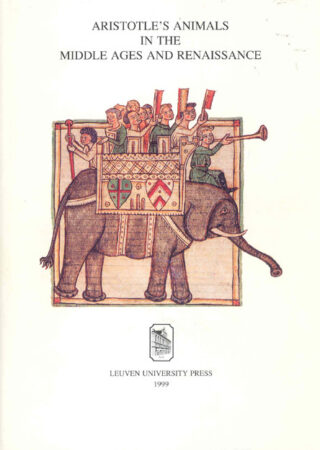
Aristotle’s Animals in the Middle Ages and Renaissance
Guy Guldentops (Author), Carlos Steel (Author),
Aristotle’s zoological writings with their wealth of detailed investigations on diverse species of animals have fascinated medieval and Renaissance culture. This volume explores how these texts have been read in various traditions (Arabic, Hebrew, Latin), and how they have been incorporated in different genres (in philosophical and scientific treatises, in florilegia and encyclopedias, in theological symbolism, in moral allegories, and in manuscript illustrations).
This multidisciplinary and multilinguistic approach highlights substantial aspects of Aristotle’s animals.
Carlos Steel
Animaux de la Bible et animaux d’Aristote. Thomas d’Aquin sur Béhémoth l’éléphant
Aafke M.I.van Oppenraay
Michael Scot’s Arabic-Latin Translation of Aristotle’s Books on Animals. Some Remarks concerning the Relation between the Translation and its Arabic and Greek Sources
Mauro Monta
The Zoological Writings in the Hebrew Tradition. The Hebrew Approach to Aristotle’s Zoological Writings and to their Ancient and Medieval Commentators in the Middle Ages
Pieter Beullens
A 13-th Century Florilegium from Aristotle’s Book on Animals: Auctoritates extracte de libro Aristotilis de naturis animalium
Remke Kruk
On Animals: Excerpts of Aristotle and Ibn Sînâ in Marwazî’s Tabâ’i’ al-Hayawân
Isabelle Draelants
La transmission du De animalibus d’Aristote dans le De floribus rerum naturalium d’Arnoldus Saxo
Henryk Anzulewicz
Die aristotelische Biologie in den Frühwerken des Albertus Magnus
Miguel de Asua
Medicine and Philosophy in Peter of Spain’s Commentary on De animalibus
Silvia Nagel
Testi con due redazioni attribuite ad un medesimo autore: il caso del De animalibus di Pietro Ispano
Christian Hünemörder
Der Text des Michael Scotus um die Mitte des 13. Jahrhunderts und Thomas Cantimpratensis III
Theodor Wolfram Köhler
Die wissenschaftstheoretische und inhaltliche Bedeutung der Rezeption von De animalibus für den philosophisch-anthropologischen Diskurs im 13. Jahrhundert
Guy Guldentops
The Sagacity of the Bees. An Aristotelian Topos in Thirteenth-Century Philosophy
Stefano Perfetti
Three Different Ways of Interpreting Aristotle’s De Partibus animalium: Pietro Pomponazzi, Niccolo Leonico Tomeo and Agostino Nifo
Jan Papy
The Attitude towards Aristotelian Biological Thought in the Louvain Medical Treatises during the Sixteenth and Early Seventeenth Century: the Case of Embryology
Baudouin van den Abeele
Une version moralisée du De animalibus d’Aristote (XIVe siècle)
Michel Camille
Bestiary or Biology? Aristotle’s Animals in Oxford, merton College, MS 271
Allan Gotthelf
From Aristotle to Darwin. Closing Words
Frequently Asked Questions
What is "Aristotle’s Animals in the Middle Ages and Renaissance" about?
Aristotle's zoological writings with their wealth of detailed investigations on diverse species of animals have fascinated medieval and Renaissance culture. This volume explores how these texts have been read in various traditions (Arabic, Hebrew, Latin), and how they have been incorporated in different genres (in philosophical and scientific treatises, in florilegia and encyclopedias, in theological symbolism, in moral allegories, and in manuscript illustrations).
This multidisciplinary and multilinguistic approach highlights substantial aspects of Aristotle's animals.
Who wrote "Aristotle’s Animals in the Middle Ages and Renaissance"?
"Aristotle’s Animals in the Middle Ages and Renaissance" was written by Guy Guldentops and Carlos Steel.
Carlos Steel is emeritus professor of ancient and medieval philosophy at KU Leuven and director of the “Aristoteles Latinus” project.
Is "Aristotle’s Animals in the Middle Ages and Renaissance" part of a series?
Yes, "Aristotle’s Animals in the Middle Ages and Renaissance" is part of the "Mediaevalia Lovaniensia" series. It's book 27 in the series.

The longstanding, peer-reviewed book series Mediaevalia Lovaniensia. Studies in Medieval History, Society, and Culture publishes high-quality scholarship on the history and culture of the Middle Ages (c. 500–1550). Topics of particular interest to the series include, but are not limited to, social behaviour and power relations in medieval society, processes of identity formation, religious and urban culture, medieval thought and literature, and gender history. The series focuses on Europe and the wider Mediterranean world and is particularly rich in interdisciplinary approaches. By means of monographs and edited volumes, the series explores thematic frontiers and embraces innovative methodological approaches in historical and philological scholarship that is based on an in-depth source-based study.
Mediaevalia Lovaniensia accepts monographs as well as thematically coherent volumes in English. Moreover, it offers scholars the possibility to publish critical editions of primary texts with broader relevance to the understanding of medieval culture and society. The series aspires to publish books that have the potential to become reference works in the field of Medieval Studies.
We encourage early career (postdoctoral) researchers to submit a reworked version of their PhD thesis to this series. Leuven University Press provides authors with two publishing scenarios: traditional (non-Open Access) and the option to publish in Open Access (including language editing).
Editorial Board
Jelle Haemers (KU Leuven)
Jeroen Deploige (Ghent University)
Brigitte Meijns (KU Leuven)
Chanelle Delameillieure (KU Leuven - KULAK)
Baudouin Van den Abeele (UCLouvain)
Proposals
Proposals and enquiries can be sent to one of the editorial board members. Please send a short abstract. Upon approval of the proposal, the full manuscript will be submitted to international blind peer review by two (external) experts. The editors strive towards completing the review of proposals within one month and of complete manuscripts within five months after submission. Manuscripts should preferably be (+/-) 80.000 to 120.000 words in length.
Please make use of the submission form to present your manuscript or proposal to our board.
Authors interested in Open Access can consult the available funding options.
Links & Resources
What is the Table of Contents for "Aristotle’s Animals in the Middle Ages and Renaissance"?
Carlos Steel
Animaux de la Bible et animaux d'Aristote. Thomas d'Aquin sur Béhémoth l'éléphant
Aafke M.I.van Oppenraay
Michael Scot's Arabic-Latin Translation of Aristotle's Books on Animals. Some Remarks concerning the Relation between the Translation and its Arabic and Greek Sources
Mauro Monta
The Zoological Writings in the Hebrew Tradition. The Hebrew Approach to Aristotle's Zoological Writings and to their Ancient and Medieval Commentators in the Middle Ages
Pieter Beullens
A 13-th Century Florilegium from Aristotle's Book on Animals: Auctoritates extracte de libro Aristotilis de naturis animalium
Remke Kruk
On Animals: Excerpts of Aristotle and Ibn Sînâ in Marwazî's Tabâ'i' al-Hayawân
Isabelle Draelants
La transmission du De animalibus d'Aristote dans le De floribus rerum naturalium d'Arnoldus Saxo
Henryk Anzulewicz
Die aristotelische Biologie in den Frühwerken des Albertus Magnus
Miguel de Asua
Medicine and Philosophy in Peter of Spain's Commentary on De animalibus
Silvia Nagel
Testi con due redazioni attribuite ad un medesimo autore: il caso del De animalibus di Pietro Ispano
Christian Hünemörder
Der Text des Michael Scotus um die Mitte des 13. Jahrhunderts und Thomas Cantimpratensis III
Theodor Wolfram Köhler
Die wissenschaftstheoretische und inhaltliche Bedeutung der Rezeption von De animalibus für den philosophisch-anthropologischen Diskurs im 13. Jahrhundert
Guy Guldentops
The Sagacity of the Bees. An Aristotelian Topos in Thirteenth-Century Philosophy
Stefano Perfetti
Three Different Ways of Interpreting Aristotle's De Partibus animalium: Pietro Pomponazzi, Niccolo Leonico Tomeo and Agostino Nifo
Jan Papy
The Attitude towards Aristotelian Biological Thought in the Louvain Medical Treatises during the Sixteenth and Early Seventeenth Century: the Case of Embryology
Baudouin van den Abeele
Une version moralisée du De animalibus d'Aristote (XIVe siècle)
Michel Camille
Bestiary or Biology? Aristotle's Animals in Oxford, merton College, MS 271
Allan Gotthelf
From Aristotle to Darwin. Closing Words
Related titles

 Orality and Scribal Culture in the High Middle Ages
Timothy B. Noone (Author), Mark J. Clark (Author),
November 2026
 Toekomstdromen
Maarten Van Dijck (Editor), Gerrit Verhoeven (Editor), Hans Cools (Editor),
November 2026
 The Medieval Aristotle
Nena Bobovnik (Editor), Clelia V. Crialesi (Editor), Lisa Devriese (Editor),
August 2026

 Trend en toeval – vierde editie
Bruno Blondé (Author), Isabelle Devos (Author), Jord Hanus (Author), Wouter Ryckbosch (Author),
August 2026

 Political Exile in the Global Twentieth Century
Wolfram Kaiser (Editor), Piotr H. Kosicki (Editor),
April 2026
 Christian Democracy and the Fall of Communism
Michael Gehler (Editor), Piotr H. Kosicki (Editor), Helmut Wohnout (Editor),
April 2026
 Brusselse plaatsnamen
Iadine Degryse (Editor), Benjamin Wayens (Editor), Chantal Kesteloot (Editor), Dennis De Vriese (Editor), Matthijs Degraeve (Editor),
April 2026

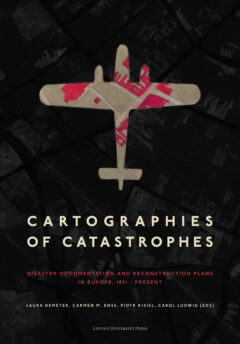 Cartographies of Catastrophes
Laura Demeter (Editor), Carmen M. Enss (Editor), Piotr Kisiel (Editor), Carol Ludwig (Editor),
February 2026
 Thomas Aquinas and Hervaeus Natalis on Concepts and Intentional Objects
Fabrizio Amerini (Author),
February 2026