

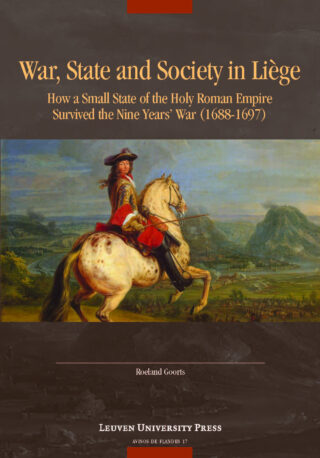
War, State, and Society in Liège
How a Small State of the Holy Roman Empire survived the Nine Year's War (1688-1697)
Roeland Goorts (Author),
Series: Avisos de Flandes 17
Category: History, History 1500-1800
Language: English
ISBN: 9789462701311
Publication date: March 11, 2019
€65.00 (including 6% VAT)
Buy NowNumber of pages: 418
Size: 244 x 170 x 20 mm
Number of illustrations: 53
Illustrations and other content description:
b&w images

Stock item: 127235
Standard delivery time for print books:
For Belgium: 5 to 8 working days
For EU: 2 to 3 weeks
For other countries: 4 to 5 weeks
Series: Avisos de Flandes 17
Category: History, History 1500-1800
Language: English
ISBN: 9789461662712
Publication date: March 11, 2019
€49.00 (including 6% VAT)
Buy NowNumber of pages: 418
Number of illustrations: 53
Illustrations and other content description:
b&w images
War, State and Society in Liège is a fascinating case study of the consequences of war in the Prince-Bishopric of Liège and touches upon wider issues in early modern history, such as small power diplomacy in the seventeenth century and during the Nine Years’ War.
Small power diplomacy in seventeenth century Europe
War, State and Society in Liège is a fascinating case study of the consequences of war in the Prince-Bishopric of Liège and touches upon wider issues in early modern history, such as small power diplomacy in the seventeenth century and during the Nine Years’ War.
For centuries, the small semi-independent Holy Roman Principality of Liège succeeded in preserving a non-belligerent role in European conflicts. During the Nine Years’ War (1688–1697), however, Liège’s leaders had to abolish the practice of neutrality. For the first time in its early modern history, the Prince-Bishopric had to raise a regular army, reconstruct ruined defence structures, and supply army contributions in both money and material.
The issues under discussion in War, State and Society in Liège offer the reader insight into how Liège politically protected its powerful institutions and how the local elite tried to influence the interplay between domestic and external diplomatic relationships.
This publication is GPRC-labeled (Guaranteed Peer-Reviewed Content).
List of figures, maps, illustrations and tables List of archival abbreviations 1Acknowledgements Note on the nomenclature of the Nine Years’ War
Chapter I Introduction to the Nine Years’ War Chapter II The balance of power in the Principality of Liège Chapter III The finances of the Prince-Bishopric during the Nine Years’ War Chapter IV The army of Liège Chapter V The urban sites and their defences Chapter VI Foreign relations Chapter VII “Den kleinen Krieg” in the Prince-Bishopric Chapter VIII The economic and social effects Chapter IX Conclusion on the Nine Years’ War in the Princedom Appendices Bibliography Index
Goorts provides a wealth of relevant empirical material on the internal politics and fiscal-military organization of the Prince-Bishopric of Liège that will prove valuable for historians working in this field.Bram van Besouw, BMGN - Low Countries Historical Review, 135(2). DOI: http://doi.org/10.18352/bmgn-lchr.10805
Goorts’s War, State and Society in Liège is an important addition to our understanding of warfare during the early modern period, particularly in the age of Louis XIV, and of small states directly affected by such conflicts. While often portrayed as wars of maneuver and siege, Goorts’s investigation of Liège during the Nine Years’ War illustrates the complexities of late seventeenth-century warfare and the implications for those states caught in war’s path. War, State and Society in Liège sheds new light not only on Louis XIV’s wars, but on how small states coped with its challenges.John M. Stapleton, Jr., Journal of Military History, vol. 84, no. 4 (October 2020)
Much of the real value of Goorts’s work lies in the amount of detail he is able to provide on the workings of the state, the network of local communities within the territory, and the economy, and on the impact of war on all three. He is able to trace the careers and fortunes of any number of minor characters who would normally never make it into more broadly focused works; he shows much of the human cost of war in individual localities. Taken as a whole, his work is a valuable addition to the scholarship on war and society in the early modern period.
James R. Smither, Renaissance Quarterly , Volume 74 , Issue 2 , Summer 2021 , pp. 633 - 634 , DOI: https://doi.org/10.1017/rqx.2021.44
Par la masse d’informations qu’il apporte, le livre rendra d’indéniables services aux spécialistes d’histoire militaire et diplomatique. Ses faiblesses rhétoriques n’obèrent pas son apport à l’histoire de la neutralité. Nous disposons ici, grâce au travail de R. Goorts, d’un éclairage essentiel sur l’histoire de l’espace mosan pris dans la tourmente des conflits entre la France, le Saint-Empire et les Provinces-Unies à la fin du XVIIe siècle.Thierry ALLAIN, Revue d'histoire moderne & contemporaine 69-1, janvier-mars 2022
Nevertheless, this book will undoubtedly spur researchers to more in-depth investigation, analysis, and comparison with other ecclesiastical and imperial, comparatively less neutral and more militarized, states. Michael Depreter, Early Modern Low Countries 6 (2022) 1, DOI 10.51750/emlc.12179
Frequently Asked Questions
What is "War, State, and Society in Liège" about?
Small power diplomacy in seventeenth century Europe
War, State and Society in Liège is a fascinating case study of the consequences of war in the Prince-Bishopric of Liège and touches upon wider issues in early modern history, such as small power diplomacy in the seventeenth century and during the Nine Years’ War.
For centuries, the small semi-independent Holy Roman Principality of Liège succeeded in preserving a non-belligerent role in European conflicts. During the Nine Years’ War (1688–1697), however, Liège’s leaders had to abolish the practice of neutrality. For the first time in its early modern history, the Prince-Bishopric had to raise a regular army, reconstruct ruined defence structures, and supply army contributions in both money and material.
The issues under discussion in War, State and Society in Liège offer the reader insight into how Liège politically protected its powerful institutions and how the local elite tried to influence the interplay between domestic and external diplomatic relationships.
This publication is GPRC-labeled (Guaranteed Peer-Reviewed Content).
Who wrote "War, State, and Society in Liège"?
"War, State, and Society in Liège" was written by Roeland Goorts.
Roeland Goorts, PhD, studied at the KU Leuven and the University of Reading. His research focuses on medieval and early modern military history, especially in the Prince-Bishopric of Liège.
Is "War, State, and Society in Liège" part of a series?
Yes, "War, State, and Society in Liège" is part of the "Avisos de Flandes" series. It's book 17 in the series.

Series editor
Werner Thomas, KU Leuven
Proposals
To submit a proposal please send a preliminary abstract (1-2 pp.) and a short bio to series editor Werner Thomas. The evaluation process takes an average of four weeks. Upon approval of the abstract, the full manuscript will be submitted to international peer review. Two peer reviewers will be asked for expert advice, three in case of conflicting reports.
Please make use of the submission form to present the full manuscript to our board.
Authors interested in Open Access can consult the available funding options.
Links & Resources
What is the Table of Contents for "War, State, and Society in Liège"?
List of figures, maps, illustrations and tables List of archival abbreviations 1Acknowledgements Note on the nomenclature of the Nine Years’ War
Chapter I Introduction to the Nine Years’ War Chapter II The balance of power in the Principality of Liège Chapter III The finances of the Prince-Bishopric during the Nine Years’ War Chapter IV The army of Liège Chapter V The urban sites and their defences Chapter VI Foreign relations Chapter VII “Den kleinen Krieg” in the Prince-Bishopric Chapter VIII The economic and social effects Chapter IX Conclusion on the Nine Years’ War in the Princedom Appendices Bibliography Index
What is the DOI for "War, State, and Society in Liège"?
The Digital Object Identifier (DOI) for "War, State, and Society in Liège" is 10.11116/9789461662712.
Related titles
 Toekomstdromen
Maarten Van Dijck (Editor), Gerrit Verhoeven (Editor), Hans Cools (Editor),
November 2026
 Trend en toeval – vierde editie
Bruno Blondé (Author), Isabelle Devos (Author), Jord Hanus (Author), Wouter Ryckbosch (Author),
August 2026
 Political Exile in the Global Twentieth Century
Wolfram Kaiser (Editor), Piotr H. Kosicki (Editor),
April 2026

 Christian Democracy and the Fall of Communism
Michael Gehler (Editor), Piotr H. Kosicki (Editor), Helmut Wohnout (Editor),
April 2026
 Brusselse plaatsnamen
Iadine Degryse (Editor), Benjamin Wayens (Editor), Chantal Kesteloot (Editor), Dennis De Vriese (Editor), Matthijs Degraeve (Editor),
April 2026
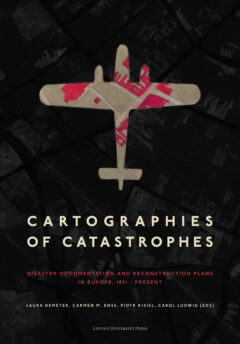 Cartographies of Catastrophes
Laura Demeter (Editor), Carmen M. Enss (Editor), Piotr Kisiel (Editor), Carol Ludwig (Editor),
February 2026
 Denken en dialogeren over identiteit
Karel Van Nieuwenhuyse (Author), Bauke Verbergt (Author), Greet Vermeiren (Author), Ellen Claes (Author),
October 2025
 Vroegmoderne dieren in de Nederlanden
Judith Brouwer (Editor), djoeke van Netten (Editor),
November 2025