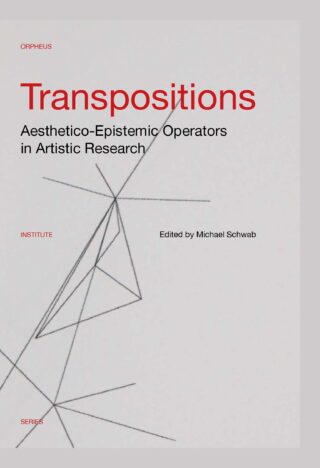

Transpositions
Aesthetico-Epistemic Operators in Artistic Research
Michael Schwab (Editor),

Series: Orpheus Institute Series
Category: Artistic Practice, Music
Language: English
ISBN: 9789462701410
Publication date: July 27, 2018
€45.00 (including 6% VAT)
Buy NowNumber of pages: 336
Size: 285 x 190 x 25 mm
Number of illustrations: 23
Illustrations and other content description:
b&w illustrations

Stock item: 123187
Standard delivery time for print books:
For Belgium: 5 to 8 working days
For EU: 2 to 3 weeks
For other countries: 4 to 5 weeks
Series: Orpheus Institute Series
Category: Artistic Practice, Music
Language: English
ISBN: 9789461662538
Publication date: July 10, 2018
Download Free PDFNumber of pages: 336
Number of illustrations: 23
Illustrations and other content description:
b&w illustrations
Under the heading transposition, seventeen artists, musicians, and theorists explain how one thing may turn into another in a spatio-temporal play of identity and difference that has the power to expand into the unknown.
New modes of epistemic relationships in artistic researchResearch leads to new insights rupturing the existent fabric of knowledge. Situated in the still evolving field of artistic research, this book investigates a fundamental quality of this process. Building on the lessons of deconstruction, artistic research invents new modes of epistemic relationships that include aesthetic dimensions.
Under the heading transposition, seventeen artists, musicians, and theorists explain how one thing may turn into another in a spatio-temporal play of identity and difference that has the power to expand into the unknown. By connecting materially concrete positions in a way familiar to artists, this book shows how moves can be made between established positions and completely new ground. In doing so, research changes from a process that expands knowledge to one that creatively reinvents it.
Ebook available in Open Access.
This publication is GPRC-labeled (Guaranteed Peer-Reviewed Content).
Contributors: Annette Arlander (University of the Arts Helsinki), Paulo de Assis (Orpheus Institute, Ghent), Rosi Braidotti (Utrecht University), Leif Dahlberg (Royal Institute of Technology Stockholm), Lucia D’Errico (Orpheus Institute, Ghent), Mika Elo (University of the Arts Helsinki), Laura González (Royal Conservatoire of Scotland), Esa Kirkkopelto (University of the Arts Helsinki), Yve Lomax (Royal College of Art, London), Cecile Malaspina (CNRS-Université Paris 1/Université Paris 7), Tor-Finn Malum Fitje (independent artist, Oslo), Dieter Mersch (Zurich University of the Arts), David Pirrò (University of Music and Performing Arts Graz), Hans-Jörg Rheinberger (Max Planck Institute for the History of Science, Berlin), Hanns Holger Rutz (University of Music and Performing Arts Graz), Michael Schwab (Orpheus Institute, Ghent/University of Applied Arts Vienna), Birk Weiberg (Zurich University of the Arts)
Introduction Michael Schwab Transformations Rosi Braidotti Abandoning Art in the Name of Art: Transpositional Logic in Artistic Research Esa Kirkkopelto Calling the Dragon, Holding Hands with Junipers: Transpositions in Practice Annette Arlander Aberrant Likenesses: The Transposition of Resemblances in the Performance of Written Music Lucia D’Errico Work of Art as Analyst as Work of Art Laura González Annlee; or, Transposition as Artistic Device Leif Dahlberg Transposing the Unseen: The Metaphors of Modern Physics Tor-Finn Malum Fitje Staging Collisions: On Behaviour David Pirrò Algorithms under Reconfiguration Hanns Holger Rutz
Speculations on Transpositional Photography Birk Weiberg
Transpositionality and Artistic Research Michael Schwab Transpositions: From Traces through Data to Models and Simulations Hans-Jörg Rheinberger
Transposition Cecile Malaspina
Transduction and Ensembles of Transducers: Relaying Flows of Intensities Paulo de Assis
Alchemistic Transpositions: On Artistic Practices of Transmutation and Transition Dieter Mersch
Ineffable Dispositions Mika Elo
Without Remainder or Residue: Example, Making Use, Transposition Yve Lomax
Frequently Asked Questions
What is "Transpositions" about?
New modes of epistemic relationships in artistic researchResearch leads to new insights rupturing the existent fabric of knowledge. Situated in the still evolving field of artistic research, this book investigates a fundamental quality of this process. Building on the lessons of deconstruction, artistic research invents new modes of epistemic relationships that include aesthetic dimensions.
Under the heading transposition, seventeen artists, musicians, and theorists explain how one thing may turn into another in a spatio-temporal play of identity and difference that has the power to expand into the unknown. By connecting materially concrete positions in a way familiar to artists, this book shows how moves can be made between established positions and completely new ground. In doing so, research changes from a process that expands knowledge to one that creatively reinvents it.
Ebook available in Open Access.
This publication is GPRC-labeled (Guaranteed Peer-Reviewed Content).
Contributors: Annette Arlander (University of the Arts Helsinki), Paulo de Assis (Orpheus Institute, Ghent), Rosi Braidotti (Utrecht University), Leif Dahlberg (Royal Institute of Technology Stockholm), Lucia D’Errico (Orpheus Institute, Ghent), Mika Elo (University of the Arts Helsinki), Laura González (Royal Conservatoire of Scotland), Esa Kirkkopelto (University of the Arts Helsinki), Yve Lomax (Royal College of Art, London), Cecile Malaspina (CNRS-Université Paris 1/Université Paris 7), Tor-Finn Malum Fitje (independent artist, Oslo), Dieter Mersch (Zurich University of the Arts), David Pirrò (University of Music and Performing Arts Graz), Hans-Jörg Rheinberger (Max Planck Institute for the History of Science, Berlin), Hanns Holger Rutz (University of Music and Performing Arts Graz), Michael Schwab (Orpheus Institute, Ghent/University of Applied Arts Vienna), Birk Weiberg (Zurich University of the Arts)
Who wrote "Transpositions"?
"Transpositions" was written by Michael Schwab, Annette Arlander, Paulo de Assis, Rosi Braidotti, Leif Dahlberg, Lucia D'Errico, Mika Elo, Laura Gonzalez, Esa Kirkkopelto, Yve Lomax, Cecile Malaspina, Tor-Fin Malum Fitje, Dieter Mersch, David Pirró, Hans-Jörg Rheinberger, Hanns Holger Rutz and Birk Weiberg.
Michael Schwab is the editor-in-chief of the Journal for Artistic Research (JAR).
Paulo de Assis is artist researcher (pianist, composer, music philosopher) and research fellow at the Orpheus Institute.
Lucia D’Errico is a musician and artistic researcher. She is research fellow at the Orpheus Institute Ghent.
Is "Transpositions" part of a series?
Yes, "Transpositions" is part of the "Orpheus Institute Series" series.

Throughout the Orpheus Institute’s various activities there is a clear focus on the development of a new research discipline in the arts, one that addresses questions and topics that are at the heart of musical practice, building on the unique expertise and perspectives of musicians and in constant dialogue with more established research disciplines.
Within this context, the Orpheus Institute launched an international Research Centre in 2007 that acts as a stable constituent within an ever-growing field of enquiry. The Orpheus Research Centre is a place where musical artists can fruitfully conduct individual and collaborative research on issues that are of concern to all involved in artistic practice. It is important that at the centre of the international Orpheus Institute network is a place, a building, a community. As the concepts and methodologies of artistic research in music have evolved, work at Orpheus Institute has found new structures. Since 2012, research has been consolidated into a number of groups focused on specific areas, each led by a principal investigator of substantial international reputation as a practicing musician. The work of Orpheus Institute is disseminated through events, publications and musical performances, and through its active animation of discussion within the sector.
This series of peer-reviewed publications —launched in 2013— encompasses monographs by Research Fellows and associates of the Orpheus Institute, compilations of lectures, texts, and performances from seminars and study days, and edited volumes on topics arising from work at the institute. Research can be presented in digital media as well as printed texts. As a whole, the series is meant to enhance and advance discourse in the field of artistic research in music and to generate future work in this emerging and vital area of study.

Editorial board
William Brooks (Chair, Series Editor), Peter Dejans, Jonathan Impett, Kathleen Coessens, Paulo de Assis, Heike Vermeire, Ed Crooks, Laura Cull, Aurelie Daems
Proposals
Proposals and enquiries can be sent to the series editor William Brooks.
Please make use of the submission form to present your manuscript or proposal to our board.
Authors interested in Open Access can consult the available funding options.
Links & Resources
Is "Transpositions" available Open Access?
Yes, "Transpositions" is published Open Access. It is available under a BY-NC license.
What is the Table of Contents for "Transpositions"?
Introduction Michael Schwab Transformations Rosi Braidotti Abandoning Art in the Name of Art: Transpositional Logic in Artistic Research Esa Kirkkopelto Calling the Dragon, Holding Hands with Junipers: Transpositions in Practice Annette Arlander Aberrant Likenesses: The Transposition of Resemblances in the Performance of Written Music Lucia D’Errico Work of Art as Analyst as Work of Art Laura González Annlee; or, Transposition as Artistic Device Leif Dahlberg Transposing the Unseen: The Metaphors of Modern Physics Tor-Finn Malum Fitje Staging Collisions: On Behaviour David Pirrò Algorithms under Reconfiguration Hanns Holger Rutz
Speculations on Transpositional Photography Birk Weiberg
Transpositionality and Artistic Research Michael Schwab Transpositions: From Traces through Data to Models and Simulations Hans-Jörg Rheinberger
Transposition Cecile Malaspina
Transduction and Ensembles of Transducers: Relaying Flows of Intensities Paulo de Assis
Alchemistic Transpositions: On Artistic Practices of Transmutation and Transition Dieter Mersch
Ineffable Dispositions Mika Elo
Without Remainder or Residue: Example, Making Use, Transposition Yve Lomax
What is the DOI for "Transpositions"?
The Digital Object Identifier (DOI) for "Transpositions" is 10.11116/9789461662538.
Related titles
 The Book of Requiems, 1815–1900
John Koslovsky (Editor), Steven Vande Moortele (Editor),
December 2026
 Collective Trauma and Future Fantasies
Raika Khorshidian (Editor), Birgit Mersmann (Editor), Cathrine Bublatzky (Editor), Julia Stenzel (Editor),
November 2026

 Violence and Trauma in Contemporary Performance
Sofie de Smet (Editor), Marieke Breyne (Editor), Pedzisai Maedza (Editor), Christel Stalpaert (Editor),
May 2025
 Music Theory and Analysis Volume 12 Issue 1, 2025 (Journal Subscription)
John Koslovsky (Editor), Markus Neuwirth (Editor), Derek Remeš (Editor),
May 2025