Reference work for musicologists, music theorists, performers, and music lovers
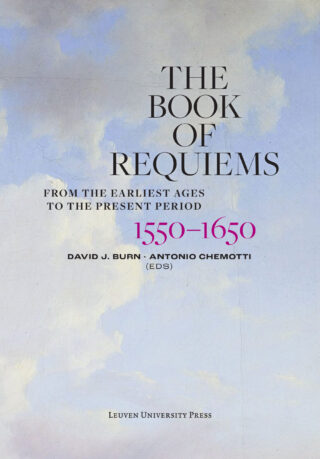
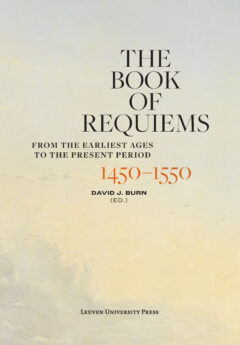
Few western musical repertories speak more to the imagination than the Requiem mass for the dead. Yet, surprisingly, despite the significance of Requiem settings for our musical culture, the literature concerning them is sparse. The Book of Requiems presents essays on the most important works in this tradition, from the origins of the genre up to the present day. Each chapter is devoted to a specific Requiem, and offers both historical information and a detailed work-discussion. Conceived as a multi-volume essay collection by leading experts, The Book of Requiems is an authoritative reference publication intended as a first port of call for musicologists, music theorists, and performers both professional and student.
The present volume, the second in the series, treats settings composed between c. 1550 and c. 1650, a period in which the Requiem becomes a defining feature of the soundscape of Catholic death rituals.
Contributors: Pieter Bergé (University of Leuven), Franz Körndle (University of Augsburg), Christian Thomas Leitmeir (University of Oxford), Alison Sanders McFarland (Louisiana State University), Bernadette Nelson (CESEM-FCSH, Nova University, Lisbon), Owen Rees (University of Oxford), Stephen Rice (director of The Brabant Ensemble), Katelijne Schiltz (University of Regensburg)
Tables
Musical Examples
Introduction
Pieter Bergé, David J. Burn, and Antonio Chemotti
Jacobus Clemens non Papa (c. 1515–55/56): Missa pro defunctis
Stephen Rice
Cristóbal de Morales (c. 1500–53): Missa pro defunctis for four voices and Missa pro defunctis for five voices
Alison Sanders McFarland
Philippe de Monte (1521–1603): Missa pro defunctis
Katelijne Schiltz
Francisco Guerrero (1527/28–99): Missa pro defunctis
Owen Rees
Jacobus de Kerle (1531/32–91): Missa pro defunctis
Christian Thomas Leitmeir
Tomás Luis de Victoria (c. 1548–1611): Missa pro defunctis for four voices and Missa pro defunctis for six voices
Owen Rees
Orlando di Lasso (1530/32–94): Missa pro defunctis for four voices and Missa pro defunctis for six voices
Franz Körndle
Giovanni Pierluigi da Palestrina (1525/26–94): Missa pro defunctis for five voices
Christian Thomas Leitmeir
Duarte Lobo (c. 1565–1646): Missa pro defunctis for six voices and Missa pro defunctis for eight voices
Owen Rees
Mateo Romero (1575/76–1647): Missa de requiem
Antonio Chemotti
Manuel Cardoso (c. 1566–1650): Missa pro defunctis for six voices and Missa pro defunctis for four voices
Bernadette Nelson
Filipe de Magalhães (c. 1565–1652): Missa pro defunctis for six voices
Bernadette Nelson
Catalogue of Early Polyphonic Requiems
Antonio Chemotti
Primary Sources Cited
Bibliography
Contributors
'The Book of Requiems' will become a primary reference tool on this fascinating genre and serve as a crucial aid to researchers, performers, and students of various disciplines. The editors of the second volume in the series have made a highly insightful decision to group together works from ca. 1550 to ca. 1650; this cuts across stylistic changes and reveals the most intense period of creation of Requiem settings and many shared compositional approaches across the traditional style periods. Organizing the volume in this way also allows important focus on many changes brought by Trent since some works exist in both pre-Tridentine versions reflecting local liturgical use and those based on the Reformed liturgy. Although significant in various regions of Europe, the Requiem as a genre witnessed what could be considered its most important flowering during this era in the Iberian sphere as is demonstrated by the works selected by the editors to be featured. I congratulate them on their wonderful achievement. - Grayson Wagstaff, The Catholic University of America
In ieder geval is dit een reeks om in de gaten te houden (...) de sterke punten doen mij uitzien naar de volgende delen. - Emanuel Overbeeke, OpusKlassiek, oktober 2023, www.opusklassiek.nl/boeken/burn_requiems2.htm
The contributions included in The Book of Requiems (1550-1650) offer several notable advantages: they provide a comprehensive overview of Requiem production during the sixteenth and seventeenth centuries through clear and detailed analyses. These contributions engage fully with the results of recent musicological research and present intriguing critical readings (or re-readings) of both wellknown and lesser-known works. The analytical approach chat guides the entire series remains highly productive in the study of Requiem history. It allows for an examination of the distinctive features of the Masses, considering their evolution over time and across regions, while also identifying commonalities, connections, borrowings and their absences. - Simone Caputo, Muzyka 2024/4
Frequently Asked Questions
What is "The Book of Requiems, 1550-1650" about?
Reference work for musicologists, music theorists, performers, and music lovers
Few western musical repertories speak more to the imagination than the Requiem mass for the dead. Yet, surprisingly, despite the significance of Requiem settings for our musical culture, the literature concerning them is sparse. The Book of Requiems presents essays on the most important works in this tradition, from the origins of the genre up to the present day. Each chapter is devoted to a specific Requiem, and offers both historical information and a detailed work-discussion. Conceived as a multi-volume essay collection by leading experts, The Book of Requiems is an authoritative reference publication intended as a first port of call for musicologists, music theorists, and performers both professional and student.
The present volume, the second in the series, treats settings composed between c. 1550 and c. 1650, a period in which the Requiem becomes a defining feature of the soundscape of Catholic death rituals.
Contributors: Pieter Bergé (University of Leuven), Franz Körndle (University of Augsburg), Christian Thomas Leitmeir (University of Oxford), Alison Sanders McFarland (Louisiana State University), Bernadette Nelson (CESEM-FCSH, Nova University, Lisbon), Owen Rees (University of Oxford), Stephen Rice (director of The Brabant Ensemble), Katelijne Schiltz (University of Regensburg)
Who edited "The Book of Requiems, 1550-1650"?
"The Book of Requiems, 1550-1650" was edited by David J. Burn and Antonio Chemotti.
David J. Burn is professor of musicology and head of the Early Music Research Group at KU Leuven.
Antonio Chemotti is assistant professor of musicology at KU Leuven in association with the Alamire Foundation and research affiliate at the Royal Library of Belgium.
Is "The Book of Requiems, 1550-1650" part of a series?
Yes, "The Book of Requiems, 1550-1650" is part of the "The Book of Requiems" series. It's book 2 in the series.
The Book of Requiems is a multi‑volume set structured according to chronological period, as follows:
- Volume I: 1450–1550
- Volume II: 1550–1650
- Volume III: 1650–1720
- Volume IV: 1720–1815
- Volume V: 1815–1900
- Volume VI: 1900–present
This collection of essays by leading specialists constitutes an authoritative reference work. It is intended as a primary point of entry for musicologists, music theorists, and performers at both professional and advanced student levels.
The Book of Requiems will become a primary reference tool on this fascinating genre and serve as a crucial aid to researchers, performers, and students of various disciplines. — Grayson Wagstaff, The Catholic University of America
What is the Table of Contents for "The Book of Requiems, 1550-1650"?
Tables
Musical Examples
Introduction
Pieter Bergé, David J. Burn, and Antonio Chemotti
Jacobus Clemens non Papa (c. 1515–55/56): Missa pro defunctis
Stephen Rice
Cristóbal de Morales (c. 1500–53): Missa pro defunctis for four voices and Missa pro defunctis for five voices
Alison Sanders McFarland
Philippe de Monte (1521–1603): Missa pro defunctis
Katelijne Schiltz
Francisco Guerrero (1527/28–99): Missa pro defunctis
Owen Rees
Jacobus de Kerle (1531/32–91): Missa pro defunctis
Christian Thomas Leitmeir
Tomás Luis de Victoria (c. 1548–1611): Missa pro defunctis for four voices and Missa pro defunctis for six voices
Owen Rees
Orlando di Lasso (1530/32–94): Missa pro defunctis for four voices and Missa pro defunctis for six voices
Franz Körndle
Giovanni Pierluigi da Palestrina (1525/26–94): Missa pro defunctis for five voices
Christian Thomas Leitmeir
Duarte Lobo (c. 1565–1646): Missa pro defunctis for six voices and Missa pro defunctis for eight voices
Owen Rees
Mateo Romero (1575/76–1647): Missa de requiem
Antonio Chemotti
Manuel Cardoso (c. 1566–1650): Missa pro defunctis for six voices and Missa pro defunctis for four voices
Bernadette Nelson
Filipe de Magalhães (c. 1565–1652): Missa pro defunctis for six voices
Bernadette Nelson
Catalogue of Early Polyphonic Requiems
Antonio Chemotti
Primary Sources Cited
Bibliography
Contributors
What is the DOI for "The Book of Requiems, 1550-1650"?
The Digital Object Identifier (DOI) for "The Book of Requiems, 1550-1650" is 10.11116/9789461665133.
Related titles
 Franz Schreker. Der Schmied von Gent
Pieter Bergé (Editor), Steven Vande Moortele (Author), Martijn Vincken (Author),
February 2027
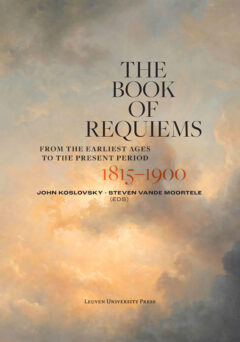 The Book of Requiems, 1815–1900
John Koslovsky (Editor), Steven Vande Moortele (Editor),
December 2026
 Music Theory and Analysis Volume 12 Issue 1, 2025 (Journal Subscription)
John Koslovsky (Editor), Markus Neuwirth (Editor), Derek Remeš (Editor),
May 2025
 Musiceren is topsport
Bert De Cuyper (Author), Griet Baert (Author), Linde Verjans (Author),
December 2021
 Theory into practice
Nicholas Cook (Author), Peter Johnson (Author), Hans Zender (Author),
October 2021