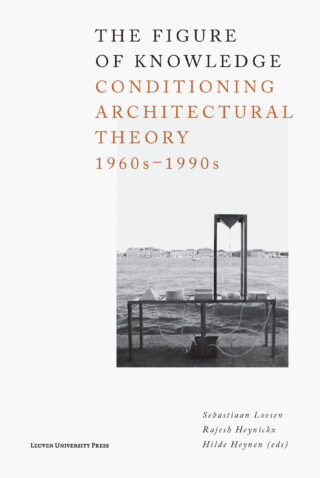

The Figure of Knowledge
Conditioning Architectural Theory, 1960s - 1990s
Sebastiaan Loosen (Editor), Rajesh Heynickx (Editor), Hilde Heynen (Editor),

Category: Architecture and Urban Planning
Language: English
ISBN: 9789462702240
Publication date: September 30, 2020
€31.50 (including 6% VAT)
Buy NowNumber of pages: 321
Size: 234 x 156 x 17 mm

Funded by: KU Leuven Fund for Fair Open Access
Stock item: 137673
Standard delivery time for print books:
For Belgium: 5 to 8 working days
For EU: 2 to 3 weeks
For other countries: 4 to 5 weeks
Category: Architecture and Urban Planning
Language: English
ISBN: 9789461663238
Publication date: September 30, 2020
Download Free EpubNumber of pages: 321
Funded by: KU Leuven Fund for Fair Open Access
Category: Architecture and Urban Planning
Language: English
ISBN: 9789461663221
Publication date: September 30, 2020
Download Free PDFNumber of pages: 321
Funded by: KU Leuven Fund for Fair Open Access
Critical historiography of architectural theory
It is a major challenge to write the history of post-WWII architectural theory without boiling it down to a few defining paradigms. An impressive anthologising effort during the 1990s charted architectural theory mostly via the various theoretical frameworks employed, such as critical theory, critical regionalism, deconstructivism, and pragmatism.
Yet the intellectual contours of what constitutes architectural theory have been constantly in flux. It is therefore paramount to ask what kind of knowledge has become important in the recent history of architectural theory and how the resulting figure of knowledge sets the conditions for the actual arguments made.
The contributions in this volume focus on institutional, geographical, rhetorical, and other conditioning factors. They thus screen the unspoken rules of engagement that postwar architectural theory ascribed to.
Contributors: Matthew Allen (University of Toronto), Karen Burns (University of Melbourne), Ole W. Fischer (University of Utah), Philip Goad (University of Melbourne), Hilde Heynen (KU Leuven), Rajesh Heynickx (KU Leuven), Paul Holmquist (Louisiana State University), Sandra Kaji-O’Grady (University of Queensland), Peter Lang (Royal Institute of Art, Stockholm), André Loeckx (KU Leuven), Sebastiaan Loosen (KU Leuven), Louis Martin (Université du Québec à Montréal), Joan Ockman (University of Pennsylvania), Carmen Popescu (ENSAB, Rennes), Ricardo Ruivo (Architectural Association, London), Andrew Toland (University of Technology Sydney).
Ebook available in Open Access.
This publication is GPRC-labeled (Guaranteed Peer-Reviewed Content).
Listen to an interview with Sebastiaan Loosen, Rajesh Heynickx, and Hilde Heynen at New Books Network: https://newbooksnetwork.com/the-figure-of-knowledge
INTRODUCTION
The Shifting Contours of Postwar Architectural Theory
Sebastiaan Loosen, Rajesh Heynickx, and Hilde Heynen
SECTION 1: Modernism and its Discontents
Meaning and Effect: Revisiting Semiotics in Architecture
André Loeckx and Hilde Heynen
A Voice from the Margins: Robin Boyd and 1960s Architecture Culture
Philip Goad
Contaminations: Art, Architecture, and the Critical Vision of Lara-Vinca Masini
Peter Lang
Architecture Becomes Programming: Invisible Technicians, Printouts, and Situated Theories in the 1960s
Matthew Allen
Troubled Dialogues: Intellectuality at a Crossroads at the Carrefour de l’Europe in Brussels
Sebastiaan Loosen
SECTION 2: Projects of Theory
Institutionalized Critique? On the Re(birth) of Architectural Theory after Modernism: ETH and MIT Compared
Ole W. Fischer
Thinking Architecture, its Theory and History: A Case Study about Melvin Charney
Louis Martin
Dirtying the Real: Liane Lefaivre and the Architectural Stalemate with Emerging Realities
Andrew Toland
Between Making and Acting: The Inherent Ambivalence of Arendtian Architectural Theory
Paul Holmquist
Critical Regionalism: A not so Critical Theory
Carmen Popescu
SECTION 3: The Misuses of History
The Historiographical Invention of the Soviet Avant-Garde: Cultural Politics and the Return of the Lost Project
Ricardo Ruivo
Effete, Effeminate, Feminist: Feminizing Architecture Theory
Sandra Kaji-O’Grady
Anthologizing Post-Structuralism: Architecture Ecriture, Gender, and Subjectivity
Karen Burns
Consequences of Pragmatism: A Retrospect on “The Pragmatist Imagination”
Joan Ockman
CODA
A Discipline in the Making
Hilde Heynen
Sebastiaan Loosen
Sebastiaan Loosen is a postdoctoral researcher at the KTH Stockholm.
Rajesh Heynickx
Rajesh Heynickx is gewoon hoogleraar aan de Faculteit Architectuur en voorzitter van het Departement Architectuur van de KU Leuven.
Rajesh Heynickx is intellectual historian at KU Leuven, Faculty of Architecture.
Hilde Heynen
Hilde Heynen is professor emerita of architectural theory at KU Leuven.
“le livre offre une vision précise et ample, à la fois érudite et accessible, de l’histoire intellectuelle de l’architecture de ces décennies de bascule, dont les années 1960 constituent le point d’orgue, qui virent les architectes partir à la reconquête de leur statut d’intellectuel. […] ‘The Figure of Knowledge: Conditioning Architectural Theory, 1960s-1990s’ montre, si besoin était, qu’il est possible, pour peu d’agir avec méthode, d’écrire l’histoire d’une matière aussi intangible que la pensée architecturale.“
Eléonore Marantz, Critique d’art, URL: http://journals.openedition.org/critiquedart/86655 ; DOI: https://doi.org/10.4000/critiquedart.86655
Combined, 'The Figure of Knowledge' and 'Choosing Architecture' make visible the state of architecture theory today. Even though architecture theory is no longer advanced by polemical manifestos, it remains present in other forms. Either in conversations or design reviews, readings or anthologies, architecture theory continues to reveal and reflect on architecture’s entanglement with historical, societal, cultural and economic concerns. Thinking about architecture remains crucial. - Sergio M. Figueiredo, Archined, 17.05.21, https://www.archined.nl/2021/05/architecture-theory-today-of-theorists-and-theoreticians/
Frequently Asked Questions
What is "The Figure of Knowledge" about?
Critical historiography of architectural theory
It is a major challenge to write the history of post-WWII architectural theory without boiling it down to a few defining paradigms. An impressive anthologising effort during the 1990s charted architectural theory mostly via the various theoretical frameworks employed, such as critical theory, critical regionalism, deconstructivism, and pragmatism.
Yet the intellectual contours of what constitutes architectural theory have been constantly in flux. It is therefore paramount to ask what kind of knowledge has become important in the recent history of architectural theory and how the resulting figure of knowledge sets the conditions for the actual arguments made.
The contributions in this volume focus on institutional, geographical, rhetorical, and other conditioning factors. They thus screen the unspoken rules of engagement that postwar architectural theory ascribed to.
Contributors: Matthew Allen (University of Toronto), Karen Burns (University of Melbourne), Ole W. Fischer (University of Utah), Philip Goad (University of Melbourne), Hilde Heynen (KU Leuven), Rajesh Heynickx (KU Leuven), Paul Holmquist (Louisiana State University), Sandra Kaji-O’Grady (University of Queensland), Peter Lang (Royal Institute of Art, Stockholm), André Loeckx (KU Leuven), Sebastiaan Loosen (KU Leuven), Louis Martin (Université du Québec à Montréal), Joan Ockman (University of Pennsylvania), Carmen Popescu (ENSAB, Rennes), Ricardo Ruivo (Architectural Association, London), Andrew Toland (University of Technology Sydney).
Ebook available in Open Access.
This publication is GPRC-labeled (Guaranteed Peer-Reviewed Content).
Listen to an interview with Sebastiaan Loosen, Rajesh Heynickx, and Hilde Heynen at New Books Network: https://newbooksnetwork.com/the-figure-of-knowledge
Who edited "The Figure of Knowledge"?
"The Figure of Knowledge" was edited by Sebastiaan Loosen, Rajesh Heynickx and Hilde Heynen.
Sebastiaan Loosen is a postdoctoral researcher at the KTH Stockholm.
Rajesh Heynickx is gewoon hoogleraar aan de Faculteit Architectuur en voorzitter van het Departement Architectuur van de KU Leuven.
Rajesh Heynickx is intellectual historian at KU Leuven, Faculty of Architecture.
Hilde Heynen is professor emerita of architectural theory at KU Leuven.
Is "The Figure of Knowledge" available Open Access?
Yes, "The Figure of Knowledge" is published Open Access. It is available under a BY-NC-ND license.
Who funded the publication of "The Figure of Knowledge"?
Publication of "The Figure of Knowledge" was funded by KU Leuven Fund for Fair Open Access
.
What is the Table of Contents for "The Figure of Knowledge"?
INTRODUCTION
The Shifting Contours of Postwar Architectural Theory
Sebastiaan Loosen, Rajesh Heynickx, and Hilde Heynen
SECTION 1: Modernism and its Discontents
Meaning and Effect: Revisiting Semiotics in Architecture
André Loeckx and Hilde Heynen
A Voice from the Margins: Robin Boyd and 1960s Architecture Culture
Philip Goad
Contaminations: Art, Architecture, and the Critical Vision of Lara-Vinca Masini
Peter Lang
Architecture Becomes Programming: Invisible Technicians, Printouts, and Situated Theories in the 1960s
Matthew Allen
Troubled Dialogues: Intellectuality at a Crossroads at the Carrefour de l’Europe in Brussels
Sebastiaan Loosen
SECTION 2: Projects of Theory
Institutionalized Critique? On the Re(birth) of Architectural Theory after Modernism: ETH and MIT Compared
Ole W. Fischer
Thinking Architecture, its Theory and History: A Case Study about Melvin Charney
Louis Martin
Dirtying the Real: Liane Lefaivre and the Architectural Stalemate with Emerging Realities
Andrew Toland
Between Making and Acting: The Inherent Ambivalence of Arendtian Architectural Theory
Paul Holmquist
Critical Regionalism: A not so Critical Theory
Carmen Popescu
SECTION 3: The Misuses of History
The Historiographical Invention of the Soviet Avant-Garde: Cultural Politics and the Return of the Lost Project
Ricardo Ruivo
Effete, Effeminate, Feminist: Feminizing Architecture Theory
Sandra Kaji-O’Grady
Anthologizing Post-Structuralism: Architecture Ecriture, Gender, and Subjectivity
Karen Burns
Consequences of Pragmatism: A Retrospect on “The Pragmatist Imagination”
Joan Ockman
CODA
A Discipline in the Making
Hilde Heynen
Related titles
 Margarete Schütte-Lihotzky and the Architecture of Collective Dissidence, 1918–1989
S.E. Eisterer (Author),
April 2027
 Infrastructuring Arrival
Karel Arnaut (Editor), Luce Beeckmans (Editor), Bruno Meeus (Editor),
November 2026
 Cartographies of Catastrophes
Laura Demeter (Editor), Carmen M. Enss (Editor), Piotr Kisiel (Editor), Carol Ludwig (Editor),
February 2026

 Architecture & Feminist Critical Theory
Hilde Heynen (Author), Lucía C. Pérez-Moreno (Editor),
November 2025
 Integration Otherwise Inspiration Kit
Luce Beeckmans (Author), Dounia Salamé (Author), Martina Bovo (Author), Mary Hogan (Author),
June 2025
 Bronnengids Interieurontwerp België, 1945-2000
Benoît Vandevoort (Editor), Sam Vanhee (Editor), Fredie Floré (Editor), Els De Vos (Editor), Tine Poot (Editor),
April 2025
 Laurent-Benoît Dewez (1731–1812), Architect in the Age of Enlightenment
Dirk Van de Vijver (Author),
February 2025
 Between Conventional and Experimental
Regine Hess (Editor), Inbal Ben-Asher Gitler (Editor), Tzafrir Fainholtz (Editor), Yael Allweil (Editor),
December 2024
 Architectures of Resistance
Angeliki Sioli (Editor), Nishat Awan (Editor), Kristopher Palagi (Editor),
August 2024