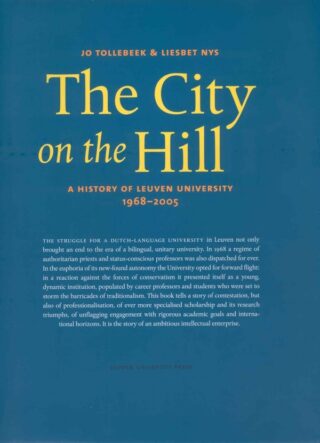
The City on the Hill
A history of Leuven University 1968-2005
Liesbet Nys (Author), Jo Tollebeek (Author),
The struggle for a Dutch-language university in Leuven not only brought an end to the era of a bilingual, unitary university. In 1968 a regime of authoritarian priests and status-conscious professors was also dispatched for ever. In the euphoria of its new-found autonomy the University opted for forward flight: in a reaction against the forces of conservatism it presented itself as a young, dynamic institution, populated by career professors and students who were set to storm the barricades of traditionalism. This book tells a story of contestation, but also of professionalisation, of ever more specialised scholarship and its research triumphs, of unflagging engagement with rigorous academic goals and international horizons. It is the story of an ambitious enterprise.
ACKNOWLEDGEMENTS
FOREWORD
AGENDA
Challenges for a new university
The third founder
Tradition as a foundation
The problems of the day
‘The most difficult hypothesis’
Common theme
HOMO NOVUS
A portrait of Pieter de Somer
1. NEITHER PRINCE NOR CHURCH
The battle for independence
‘Leuven Flemish’
Not a clerical university
The letter of the law
For another policy
New associations
2. STRUCTURES
The organisation of the scholarly world
An energetic start
The power of academics
‘Malaise’
Renovation in style
Principles
3. STUDENT POLITICS
Contestation and participation
‘Young caravans’
Red Leuven
Sea change
‘Civil servants’
After the caravans
4. THE PROFESSIONAL RANKS
Living in different times
Five generation
Colonials and canons
Pioneers and pragmatists
Threats
An open world
5. MODELS
The transfer of knowledge
A Gesamthochschule?
Slimming down
Streamlining
Continued learning, lifelong learning
The triumph of didactics
THE ORATOR
A portrait of Roger Dillemans
6. CALLING AND PROFESSION
On engagement, ethos and meaning
Identity
Changing commitment
A mission
Values and scholarship
A special radiance
7. WORLDLY MATTERS
Serving the community
In the public eye
Healing and curing
Academic ‘outreach’
Contract research, patents and spin-offs
8. THE GENDER OF THE UNIVERSITY
The feminisation debate
A freer lifestyle?
Circumspection
‘Woman power’
Many agendas
9. THE STUDENT RANKS
From Leuven to Barcelona
A student life for everyone
Class and style
Mobility
Privatisation
10. GEOGRAPHY
Building the University
Three cores
Planning
The architects of the new-build University
The prestige of restoration
ENTREPRENEUR
A portrait of André Oosterlinck
11. DIRECTING
The bureaucratisation of research and teaching
A study bureau
Coordination
Rationalisation
Quality as policy
The battle against the Moloch
12. SPECIALISATION
Disciplines without a centre
‘Big science’
In the frontline
Different science
Like cousins
Conversations
13. THE ‘MIDDLE RANKS’
Blue and white coats
The residue of the past
Multiformity
Upwards
Group interests
‘The dying swan’
14. STRIKING POWER
Income, expenditure and allocation formulas
Equivalence
Savings
Flemish money
A whirlwind
Distorted relationship
15. MISE-EN-SCàˆNE
The self-image of an institution
Commemoration
Academic rituals
Heritage and culture
Image creation
The enlarged community
SUMMING UP
The togati of the future
Years of passion
Years of disillusionment
Years of repentance and insurance
A broader horizon
SOURCES AND LITERATURE
Origins of knowledge
Archive material
Images and interviews
Published sources
Literature
ORIGINS OF THE ILLUSTRATIONS
INDEX OF NAMES
AUTHOR’S NOTE
Frequently Asked Questions
What is "The City on the Hill" about?
The struggle for a Dutch-language university in Leuven not only brought an end to the era of a bilingual, unitary university. In 1968 a regime of authoritarian priests and status-conscious professors was also dispatched for ever. In the euphoria of its new-found autonomy the University opted for forward flight: in a reaction against the forces of conservatism it presented itself as a young, dynamic institution, populated by career professors and students who were set to storm the barricades of traditionalism. This book tells a story of contestation, but also of professionalisation, of ever more specialised scholarship and its research triumphs, of unflagging engagement with rigorous academic goals and international horizons. It is the story of an ambitious enterprise.
Who wrote "The City on the Hill"?
"The City on the Hill" was written by Liesbet Nys and Jo Tollebeek.
Liesbet Nys is postdoctoral researcher at the Research Group, Cultural History since 1750 at KU Leuven.
Jo Tollebeek is professor of Cultural History at KU Leuven.
Is "The City on the Hill" part of a series?
Yes, "The City on the Hill" is part of the "Lovaniensia - 600 Years KU Leuven" series. It's book 28 in the series.
What is the Table of Contents for "The City on the Hill"?
ACKNOWLEDGEMENTS
FOREWORD
AGENDA
Challenges for a new university
The third founder
Tradition as a foundation
The problems of the day
'The most difficult hypothesis'
Common theme
HOMO NOVUS
A portrait of Pieter de Somer
1. NEITHER PRINCE NOR CHURCH
The battle for independence
'Leuven Flemish'
Not a clerical university
The letter of the law
For another policy
New associations
2. STRUCTURES
The organisation of the scholarly world
An energetic start
The power of academics
'Malaise'
Renovation in style
Principles
3. STUDENT POLITICS
Contestation and participation
'Young caravans'
Red Leuven
Sea change
'Civil servants'
After the caravans
4. THE PROFESSIONAL RANKS
Living in different times
Five generation
Colonials and canons
Pioneers and pragmatists
Threats
An open world
5. MODELS
The transfer of knowledge
A Gesamthochschule?
Slimming down
Streamlining
Continued learning, lifelong learning
The triumph of didactics
THE ORATOR
A portrait of Roger Dillemans
6. CALLING AND PROFESSION
On engagement, ethos and meaning
Identity
Changing commitment
A mission
Values and scholarship
A special radiance
7. WORLDLY MATTERS
Serving the community
In the public eye
Healing and curing
Academic 'outreach'
Contract research, patents and spin-offs
8. THE GENDER OF THE UNIVERSITY
The feminisation debate
A freer lifestyle?
Circumspection
'Woman power'
Many agendas
9. THE STUDENT RANKS
From Leuven to Barcelona
A student life for everyone
Class and style
Mobility
Privatisation
10. GEOGRAPHY
Building the University
Three cores
Planning
The architects of the new-build University
The prestige of restoration
ENTREPRENEUR
A portrait of André Oosterlinck
11. DIRECTING
The bureaucratisation of research and teaching
A study bureau
Coordination
Rationalisation
Quality as policy
The battle against the Moloch
12. SPECIALISATION
Disciplines without a centre
'Big science'
In the frontline
Different science
Like cousins
Conversations
13. THE 'MIDDLE RANKS'
Blue and white coats
The residue of the past
Multiformity
Upwards
Group interests
'The dying swan'
14. STRIKING POWER
Income, expenditure and allocation formulas
Equivalence
Savings
Flemish money
A whirlwind
Distorted relationship
15. MISE-EN-SCàˆNE
The self-image of an institution
Commemoration
Academic rituals
Heritage and culture
Image creation
The enlarged community
SUMMING UP
The togati of the future
Years of passion
Years of disillusionment
Years of repentance and insurance
A broader horizon
SOURCES AND LITERATURE
Origins of knowledge
Archive material
Images and interviews
Published sources
Literature
ORIGINS OF THE ILLUSTRATIONS
INDEX OF NAMES
AUTHOR'S NOTE
Related titles
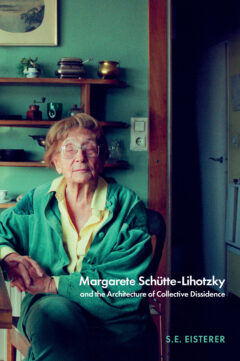 Margarete Schütte-Lihotzky and the Architecture of Collective Dissidence, 1918–1989
S.E. Eisterer (Author),
April 2027
 Toekomstdromen
Maarten Van Dijck (Editor), Gerrit Verhoeven (Editor), Hans Cools (Editor),
November 2026
 German–Rapanui Entanglements
Cristián Moreno Pakarati (Editor), Diego Muñoz (Editor), Philipp Schorch (Editor),
August 2026

 Trend en toeval – vierde editie
Bruno Blondé (Author), Isabelle Devos (Author), Jord Hanus (Author), Wouter Ryckbosch (Author),
August 2026
 Cinema in Post-War Belgium
Gertjan Willems (Editor), Bjorn Gabriels (Editor), Bénédicte Rochet (Editor),
May 2026
 Performing Magnetism
Eleonora Paklons (Editor), Kristof Smeyers (Editor), Kurt Vanhoutte (Editor), Hannah Welslau (Editor),
May 2026
 Political Exile in the Global Twentieth Century
Wolfram Kaiser (Editor), Piotr H. Kosicki (Editor),
April 2026
 Christian Democracy and the Fall of Communism
Michael Gehler (Editor), Piotr H. Kosicki (Editor), Helmut Wohnout (Editor),
April 2026
 Brusselse plaatsnamen
Iadine Degryse (Editor), Benjamin Wayens (Editor), Chantal Kesteloot (Editor), Dennis De Vriese (Editor), Matthijs Degraeve (Editor),
April 2026
 Cartographies of Catastrophes
Laura Demeter (Editor), Carmen M. Enss (Editor), Piotr Kisiel (Editor), Carol Ludwig (Editor),
February 2026