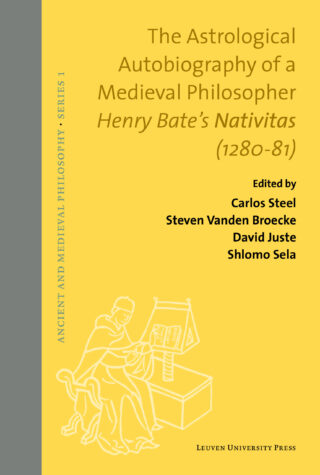
The Astrological Autobiography of a Medieval Philosopher
Henry Bate's Nativitas (1280-81)
Steven Vanden Broecke (Editor), Carlos Steel (Editor), David Juste (Editor), Shlomo Sela (Editor),
Series: Ancient and Medieval Philosophy - Series 1 17
Category: History, History 1500-1800, Philosophy
ISBN: 9789462701557
Publication date: November 27, 2018
€87.00 (including 6% VAT)
Buy NowNumber of pages: 304
Size: 234 x 156 x 20 mm

Stock item: 125311
Standard delivery time for print books:
For Belgium: 5 to 8 working days
For EU: 2 to 3 weeks
For other countries: 4 to 5 weeks
Series: Ancient and Medieval Philosophy - Series 1 17
Category: History, History 1500-1800, Philosophy
ISBN: 9789461662699
Publication date: November 27, 2018
€74.00 (including 6% VAT)
Buy NowNumber of pages: 304
Critical edition of the earliest known astrological autobiography
The present book reveals the riches of the earliest known astrological autobiography, authored by Henry Bate of Mechelen (1246–after 1310). Exploiting all resources of contemporary astrological science, Bate conducts in his Nativitas a profound self-analysis, revealing the peculiarities of his character and personality at a crucial moment of his life (1280). The result is an extraordinarily detailed and penetrating attempt to decode the fate of one’s own life and its idiosyncrasies. The Astrological Autobiography of a Medieval Philosopher offers the first critical edition of Bate’s Nativitas. An extensive introduction presents Bate’s life and work and sheds new light on the reception and use of Greek, Latin, Arabic, and Hebrew texts among scholars in Paris at the end of the 13th century. The book thus provides a major new resource for scholars working on medieval science, autobiography, and notions of personhood and individuality.
This publication is GPRC-labeled (Guaranteed Peer-Reviewed Content).
Preface
Table of Contents
Abbreviations
Introduction
Chapter 1: Manuscripts and text tradition of the Nativitas
1.1. Manuscripts (David Juste)
1.2. Text tradition (Carlos Steel)
1.2.1. Th e two traditions of the Nativitas
1.2.1.1. Errors in P V (and their copies Par L) against S
1.2.1.2. Errors in S against PV (and their copies)
1.2.1.3. Par a copy from V
1.2.1.4. P and L copies of a common model
1.2.1.5. Another witness of β: Munich, BSB, Clm 3857
1.2.1.6. Three copies of the introduction of the Nativitas
1.2.2. Two different versions of the revolution of the 35th year
1.2.2.1 Th e α version
1.2.2.2. Th e S version
1.2.2.3. Why are there two versions of the revolutions for the 35th year?
1.2.2.4. Is S a direct copy of Bate’s autograph?
1.2.3. Title
1.2.4. Conclusion: a short text history
1.2.5. Stemma codicum
1.3. Editorial principles (Carlos Steel)
Chapter 2: A portrait of Henry Bate (Carlos Steel and Steven Vanden Broecke)
2.1. Introduction
2.2. Bate’s biography
2.2.1. Family background
2.2.2. Studies in Paris
2.2.3. Return to the Low Countries: courtly connections, astrology, and an ecclesiastical career
2.2.4. After the Nativitas
2.3. Bate’s self-portrait
Chapter 3: Bate’s astrological and astronomical works (David Juste)
3.1. Original works
3.1.1. Magistralis compositio astrolabii (1274)
3.1.2. [Equatorium planetarum] (date unknown)
3.1.3. Tables of Mechelen — Tabule Machlinienses (fi rst version before 1280)
3.1.4. Nativitas (1280-81)
3.1.5. De diebus creticis periodorumque causis (after 1281, perhaps 1292)
3.1.6. Commentary on Albumasar’s De magnis coniunctionibus (lost)
[3.1.7.] †Tractatus in quo ostenduntur defectus tabularum Alfonsi
3.2. Translations
3.2.1. Alkindi, Liber de iudiciis revolutionum annorum mundi (1278)
3.2.2. Abraham Avenezra, De mundo vel seculo I [Sefer ha-ʿolam I] (1281)
3.2.3. Abraham Avenezra, De luminaribus [Sefer ha-meʾorot] (1292)
3.2.4. Abraham Avenezra, Introductorius ad astronomiam [Reshit ḥokhmah] (1292)
3.2.5. Abraham Avenezra, Liber rationum I [Sefer ha-ṭeʿamim I] (1292)
3.2.6. Abraham Avenezra, Liber rationum II [Sefer ha-ṭeʿamim II] (1292)
3.2.7. Abraham Avenezra, Liber introductionis ad iudicia astrologie [Mishpeṭei ha-mazzalot] (1292)
[3.2.8] †De fortitudine planetarum
Chapter 4: Bate’s Nativitas: the earliest known astrological autobiography (Steven Vanden Broecke)
4.1. Purpose
4.2. ‘Autobiography’ and astrological meaning-making in the Nativitas
4.2.1. Astrological judgment and self-guidance
4.2.2. Particularity and notions of selfhood
4.2.3. The inhabitable birth chart
4.3. Precedents and reception
4.4. Structure and synopsis of the Nativitas
Chapter 5: Bate’s Nativitas in context (David Juste)
5.1. The Nativitas in the history of astrology
5.2. Bate’s astrological sources
5.3. Bate and the University of Paris
5.3.1. Introduction
5.3.2. Peter of Limoges
5.3.3. Other scholars and opportunities
5.3.4. William of Saint-Cloud
5.4. Appendix: Bate’s astrological sources
Chapter 6: Bate and Abraham Ibn Ezra (Shlomo Sela)
6.1. Introduction
6.2. The Triple Abraham
6.3. Abraham Avenezra
6.4. Abraham Princeps
6.5. Abraham Compilator
Chapter 7: Basic elements of Bate’s astrological technique (Steven Vanden Broecke)
7.1. The four astrological charts of the Nativitas
7.2. Rectifying the nativity
7.3. Hyleg, alcochoden, and empirical verifi cation of the rectified nativity
7.4. A template for analysis: the twelve houses
7.5. Bate’s procedure of astrological self-analysis: the example of the first house
7.5.1. Complexion and shape of the body
7.5.2. Qualities of the soul
7.5.2.1. Jupiter
7.5.2.2. Mercury
7.5.2.3. Interpreting the decans
7.6. Solar revolutions of the nativity
Index of manuscripts
Bibliography to the introduction
Nativitas Magistri Henrici Baten
Conspectus siglorum
Abbreviationes
Textus
Appendix i. Versio altera in codice Segoviensi 84
Appendix ii. Digressio in Libro Rationum
Index fontium ab editoribus allegatorum
Editiones et manuscripta fontium ab editoribus allegata
It would require an undue amount of space to list all of the aspects that make this edition of Bate’s Nativitasan arresting source for anyone interested in medieval intellectual and cultural history. Most importantly, perhaps, the book subtly undermines facile clichés about the nature of medieval astrology and in their place gives us a glimpse of the inner workings of the art, revealing an occasionally stunning degree of complexity and psychological depth.
C. Philipp E. Nothaft, Journal for the History of Astronomy, Volume 50 Issue 2, May 2019, https://doi.org/10.1177/0021828619834390
This is the first complete Latin edition of Bate's Nativitas, and it is an impressive scholarly achievement whose depths can only be hinted at in this review. Not only have the editors produced the definitive edition of Bate's text, they have also written what amounts to a separate monograph to contextualize it.Justin Lake, Bryn Mawr
Classical Review 2019.09.58
'The Astrological Autobiography of a Medieval Philosopher' offers the first critical edition of Bate’s 'Nativitas'. An extensive introduction presents Bate’s life and work and sheds new light on the reception and use of Greek, Latin, Arabic, and Hebrew texts among scholars in Paris at the end of the 13th century. The book thus provides a major new resource for scholars working on medieval science, autobiography, and notions of personhood and individuality.Studi Medievali 2019, II
Die insgesamt äußerst sorgfältige Edition macht damit einen Text verfügbar, der eine Vielzahl von Einblicken in die Welt des späten 13. Jahrhunderts eröffnet. Auch jenseits der Forschung zur Geschichte der Astrologie ist dem Werk daher uneingeschränkt eine breite Rezeption zu wünschen.
Klaus Oschema, The Medieval Review 20.04.06
Bate’s rich treatise touches on more themes than the editorial team could begin to address; I flagged several passages to which I wish to return in my own work on astrology and prophecy. For all of these reasons, 'The Astrological Autobiography of a Medieval Philosopher' is a real gift, for which scholars will long remain in the editors’ debt. Laura Ackerman Smoller, Isis—Volume 111,
Number 3, September 2020
Cette publication de la Nativitas, l’autobiographie astrologique du savant et philosophe Henri Bate de Malines (1246 – après 1310), un texte unique en son genre, représente un événement attendu depuis près d’un siècle avec la publication, en 1924, d’un article du grand historien des sciences Aleksander Birkenmajer, qui résumait sa thèse sur Henri Bate, restée inédite. Le présent volume, issu de la collaboration entre quatre chercheurs de renom, vient donc combler un vide important, dont on comprend très bien qu’il ait duré si longtemps, considérant l’extrême difficulté de la matière.
Jean-Patrice Boudet, Mittellateinisches Jahrbuch 56,1 (2021)
Das Buch ist ein schönes Beispiel dafür, was in Kooperation erreichbar ist – es handelt sich um eine mustergültige Edition, die man sich für so manchen astrologischen Quellentext wünschen würde. Günther Oestmann, Deutsches Archiv für Erforschung des Mittelalters, 77. Jahrgang, Heft 1, 2021
Frequently Asked Questions
What is "The Astrological Autobiography of a Medieval Philosopher" about?
Critical edition of the earliest known astrological autobiography
The present book reveals the riches of the earliest known astrological autobiography, authored by Henry Bate of Mechelen (1246–after 1310). Exploiting all resources of contemporary astrological science, Bate conducts in his Nativitas a profound self-analysis, revealing the peculiarities of his character and personality at a crucial moment of his life (1280). The result is an extraordinarily detailed and penetrating attempt to decode the fate of one’s own life and its idiosyncrasies. The Astrological Autobiography of a Medieval Philosopher offers the first critical edition of Bate’s Nativitas. An extensive introduction presents Bate’s life and work and sheds new light on the reception and use of Greek, Latin, Arabic, and Hebrew texts among scholars in Paris at the end of the 13th century. The book thus provides a major new resource for scholars working on medieval science, autobiography, and notions of personhood and individuality.
This publication is GPRC-labeled (Guaranteed Peer-Reviewed Content).
Who edited "The Astrological Autobiography of a Medieval Philosopher"?
"The Astrological Autobiography of a Medieval Philosopher" was edited by Steven Vanden Broecke, Carlos Steel, David Juste and Shlomo Sela.
Steven Vanden Broecke is associate professor in the History Department of Ghent University.
Carlos Steel is emeritus professor of ancient and medieval philosophy at KU Leuven and director of the “Aristoteles Latinus” project.
David Juste is research leader of the project Ptolemaeus Arabus et Latinus at the Bavarian Academy of Sciences and Humanities (Munich).
Shlomo Sela is emeritus professor at the department of Jewish Thought at Bar-Ilan University (Tel Aviv).
Is "The Astrological Autobiography of a Medieval Philosopher" part of a series?
Yes, "The Astrological Autobiography of a Medieval Philosopher" is part of the "Ancient and Medieval Philosophy - Series 1" series. It's book 17 in the series.
Ancient and Medieval Philosophy - Series 1 presents state-of-the-art research on the history of Western thought from its origins to the beginnings of modernity.
In association with The De Wulf-Mansion Centre.


About the Series
The series' focus lies primarily on the continuity and thematic transitions between ancient, medieval and renaissance thought, but also includes volumes on specific topics related to any of those periods. ‘Philosophy' is understood broadly to include metaphysics, ethics, natural philosophy, epistemology and philosophy of mind, and philosophical theology. Since the series is particularly devoted to making available Latin and Greek source texts, we welcome critical text editions as well as contributions that are based on philological scrutiny of those texts, without losing sight of their philosophical importance.
Ancient and Medieval Philosophy - Series 1 aims to publish at least two volumes a year and accepts monographs as well as thematically coherent edited volumes in English (without excluding the possibility of French, German, or Italian contributions to edited volumes). Manuscripts should be 80.000 to 120.000 words in length.
Readership
Researchers and graduate students in ancient, medieval and renaissance philosophy, in classics and in history.
Editorial Coordinator
Russell Friedman, KU Leuven, Belgium
Editorial Board
Pieter Beullens, KU Leuven, Belgium
Lisa Devriese, KU Leuven, Belgium
Pieter d'Hoine, KU Leuven, Belgium
Jan Opsomer, KU Leuven, Belgium
Jenny Pelletier, KU Leuven, Belgium
Andrea Robiglio, KU Leuven, Belgium
Carlos Steel, KU Leuven, Belgium
Gerd Van Riel, KU Leuven, Belgium
Advisory Board
Brad Inwood, Yale Universityo, USA
Jill Kraye, The Warburg Institute, London, United Kingdom
John Marenbon, University of Cambridge, United Kingdom
Lodi Nauta, University of Groningen, The Netherlands
Timothy Noone (†) , The Catholic University of America, USA
Robert Pasnau, University of Colorado at Boulder, USA
Martin Pickavé, University of Toronto, Canada,
Pasquale Porro, Università degli Studi di Milano, Italy
Geert Roskam, KU Leuven, Belgium
Proposals
Proposals and enquiries can be sent to editorial coordinator Russell L. Friedman. Please send a preliminary abstract (3-4 pp.) and a short bio. Upon approval of this abstract, the full manuscript will be submitted to international peer review.
Please make use of the submission form to present the full manuscript to our board.
Authors interested in Open Access can consult the available funding options.
Links & Resources
What is the Table of Contents for "The Astrological Autobiography of a Medieval Philosopher"?
Preface
Table of Contents
Abbreviations
Introduction
Chapter 1: Manuscripts and text tradition of the Nativitas
1.1. Manuscripts (David Juste)
1.2. Text tradition (Carlos Steel)
1.2.1. Th e two traditions of the Nativitas
1.2.1.1. Errors in P V (and their copies Par L) against S
1.2.1.2. Errors in S against PV (and their copies)
1.2.1.3. Par a copy from V
1.2.1.4. P and L copies of a common model
1.2.1.5. Another witness of β: Munich, BSB, Clm 3857
1.2.1.6. Three copies of the introduction of the Nativitas
1.2.2. Two different versions of the revolution of the 35th year
1.2.2.1 Th e α version
1.2.2.2. Th e S version
1.2.2.3. Why are there two versions of the revolutions for the 35th year?
1.2.2.4. Is S a direct copy of Bate’s autograph?
1.2.3. Title
1.2.4. Conclusion: a short text history
1.2.5. Stemma codicum
1.3. Editorial principles (Carlos Steel)
Chapter 2: A portrait of Henry Bate (Carlos Steel and Steven Vanden Broecke)
2.1. Introduction
2.2. Bate’s biography
2.2.1. Family background
2.2.2. Studies in Paris
2.2.3. Return to the Low Countries: courtly connections, astrology, and an ecclesiastical career
2.2.4. After the Nativitas
2.3. Bate’s self-portrait
Chapter 3: Bate’s astrological and astronomical works (David Juste)
3.1. Original works
3.1.1. Magistralis compositio astrolabii (1274)
3.1.2. [Equatorium planetarum] (date unknown)
3.1.3. Tables of Mechelen — Tabule Machlinienses (fi rst version before 1280)
3.1.4. Nativitas (1280-81)
3.1.5. De diebus creticis periodorumque causis (after 1281, perhaps 1292)
3.1.6. Commentary on Albumasar’s De magnis coniunctionibus (lost)
[3.1.7.] †Tractatus in quo ostenduntur defectus tabularum Alfonsi
3.2. Translations
3.2.1. Alkindi, Liber de iudiciis revolutionum annorum mundi (1278)
3.2.2. Abraham Avenezra, De mundo vel seculo I [Sefer ha-ʿolam I] (1281)
3.2.3. Abraham Avenezra, De luminaribus [Sefer ha-meʾorot] (1292)
3.2.4. Abraham Avenezra, Introductorius ad astronomiam [Reshit ḥokhmah] (1292)
3.2.5. Abraham Avenezra, Liber rationum I [Sefer ha-ṭeʿamim I] (1292)
3.2.6. Abraham Avenezra, Liber rationum II [Sefer ha-ṭeʿamim II] (1292)
3.2.7. Abraham Avenezra, Liber introductionis ad iudicia astrologie [Mishpeṭei ha-mazzalot] (1292)
[3.2.8] †De fortitudine planetarum
Chapter 4: Bate’s Nativitas: the earliest known astrological autobiography (Steven Vanden Broecke)
4.1. Purpose
4.2. ‘Autobiography’ and astrological meaning-making in the Nativitas
4.2.1. Astrological judgment and self-guidance
4.2.2. Particularity and notions of selfhood
4.2.3. The inhabitable birth chart
4.3. Precedents and reception
4.4. Structure and synopsis of the Nativitas
Chapter 5: Bate’s Nativitas in context (David Juste)
5.1. The Nativitas in the history of astrology
5.2. Bate’s astrological sources
5.3. Bate and the University of Paris
5.3.1. Introduction
5.3.2. Peter of Limoges
5.3.3. Other scholars and opportunities
5.3.4. William of Saint-Cloud
5.4. Appendix: Bate’s astrological sources
Chapter 6: Bate and Abraham Ibn Ezra (Shlomo Sela)
6.1. Introduction
6.2. The Triple Abraham
6.3. Abraham Avenezra
6.4. Abraham Princeps
6.5. Abraham Compilator
Chapter 7: Basic elements of Bate’s astrological technique (Steven Vanden Broecke)
7.1. The four astrological charts of the Nativitas
7.2. Rectifying the nativity
7.3. Hyleg, alcochoden, and empirical verifi cation of the rectified nativity
7.4. A template for analysis: the twelve houses
7.5. Bate’s procedure of astrological self-analysis: the example of the first house
7.5.1. Complexion and shape of the body
7.5.2. Qualities of the soul
7.5.2.1. Jupiter
7.5.2.2. Mercury
7.5.2.3. Interpreting the decans
7.6. Solar revolutions of the nativity
Index of manuscripts
Bibliography to the introduction
Nativitas Magistri Henrici Baten
Conspectus siglorum
Abbreviationes
Textus
Appendix i. Versio altera in codice Segoviensi 84
Appendix ii. Digressio in Libro Rationum
Index fontium ab editoribus allegatorum
Editiones et manuscripta fontium ab editoribus allegata
Related titles

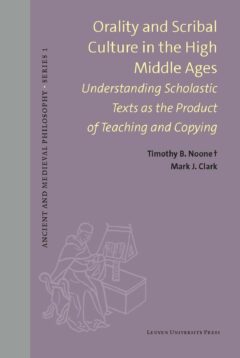 Orality and Scribal Culture in the High Middle Ages
Timothy B. Noone (Author), Mark J. Clark (Author),
November 2026
 Toekomstdromen
Maarten Van Dijck (Editor), Gerrit Verhoeven (Editor), Hans Cools (Editor),
November 2026
 Summa (Quaestiones ordinariae) art. LXXIII – LXXV
Henry of Ghent (Author), Gordon Wilson (Editor), Juan Carlos Flores (Editor),
September 2026
 The Medieval Aristotle
Nena Bobovnik (Editor), Clelia V. Crialesi (Editor), Lisa Devriese (Editor),
August 2026

 Trend en toeval – vierde editie
Bruno Blondé (Author), Isabelle Devos (Author), Jord Hanus (Author), Wouter Ryckbosch (Author),
August 2026


 Political Exile in the Global Twentieth Century
Wolfram Kaiser (Editor), Piotr H. Kosicki (Editor),
April 2026
 Christian Democracy and the Fall of Communism
Michael Gehler (Editor), Piotr H. Kosicki (Editor), Helmut Wohnout (Editor),
April 2026
 Brusselse plaatsnamen
Iadine Degryse (Editor), Benjamin Wayens (Editor), Chantal Kesteloot (Editor), Dennis De Vriese (Editor), Matthijs Degraeve (Editor),
April 2026

 Cartographies of Catastrophes
Laura Demeter (Editor), Carmen M. Enss (Editor), Piotr Kisiel (Editor), Carol Ludwig (Editor),
February 2026

 Thomas Aquinas and Hervaeus Natalis on Concepts and Intentional Objects
Fabrizio Amerini (Author),
February 2026