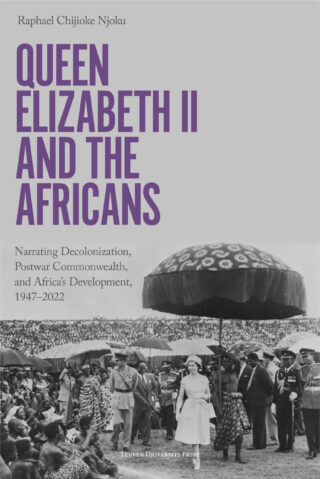
Queen Elizabeth II and the Africans
Narrating Decolonization, Postwar Commonwealth, and Africa’s Development, 1947 – 2022
Raphael Chijioke Njoku (Author),
Category: African Studies, History, History 1800-present, Postcolonial Studies
Language: English
ISBN: 9789462704343
Publication date: September 5, 2024
€28.00 (including 6% VAT)
Buy NowNumber of pages: 270
Size: 234 x 156 x 14 mm
Number of illustrations: 10
Illustrations and other content description:
black & white illustrations

Stock item: 161448
Standard delivery time for print books:
For Belgium: 5 to 8 working days
For EU: 2 to 3 weeks
For other countries: 4 to 5 weeks
Category: African Studies, History, History 1800-present, Postcolonial Studies
Language: English
ISBN: 9789461665812
Publication date: October 15, 2024
€24.00 (including 6% VAT)
Buy NowNumber of pages: 270
Number of illustrations: 10
Illustrations and other content description:
black & white illustrations
Category: African Studies, History, History 1800-present, Postcolonial Studies
Language: English
ISBN: 9789461665805
Publication date: September 5, 2024
€24.00 (including 6% VAT)
Buy NowNumber of pages: 270
Number of illustrations: 10
Illustrations and other content description:
black & white illustrations
First book-length study by an African writer that incorporates the trials and triumphs of Queen Elizabeth II, tracing her contributions to African affairs
The road to Queen Elizabeth II’s implementation of African reforms was rough, especially in the first two decades following her ascension to the throne. In this book, Raphael Chijioke Njoku examines Queen Elizabeth II’s role in the African decolonization trajectories and the postcolonial state’s quest for genuine political and economic liberation since 1947. By locating Elizabeth at the center of Anglophone Africa’s independence agitations, the account harnesses the African interests to tease out the monarch’s dilemma of complying with Whitehall’s decolonization schemes while building an inclusive and unified Commonwealth in which Africans could play a vital role. Njoku argues that to gratify British lawmakers in her complex and marginal place within the British parliamentary system of conservative versus reformist, Elizabeth’s contribution fell short of African nationalists’ expectations on account of her silence and inaction during the African decolonization raptures. Yet ultimately, the author concludes, she helped build an inclusive and unified organization in which Africans could assert and appropriate political and economic autarky.
This publication is GPRC-labeled (Guaranteed Peer-Reviewed Content).
This book will be made open access within three years of publication thanks to Path to Open, a program developed in partnership between JSTOR, the American Council of Learned Societies (ACLS), University of Michigan Press, and The University of North Carolina Press to bring about equitable access and impact for the entire scholarly community, including authors, researchers, libraries, and university presses around the world. Learn more at https://about.jstor.org/path-to-open/
Listen to an interview with Raphael Chijioke Njoku at New Books Network: https://newbooksnetwork.com/queen-elizabeth-ii-and-the-africans
Preface
Abbreviations
Introduction
Chapter 1—The House of Windsor: African Subjects and the Princess-Queen
Chapter 2—Deconstructing the 1947 Cape Town Speech : Decolonization Rhetoric and the Commonwealth
Chapter 3—The Cold War: African “Radicals” and Her Royal Stateliness, 1953–1961
Chapter 4—Her Majesty’s Africa Tour-De-Force : Feasting with the Obedient, the Noble, and the Nonconformist, 1961–1989
Chapter 5—Majestic Milestones: The Commonwealth and Africa’s Development
Chapter 6—King Charles III and Africa’s Commonwealth Future
Conclusion
Notes
Bibliography
Index
Njoku provides a vivid and sweeping account of Queen Elizabeth II’s involvement in British relations with Africa during the era of decolonization and the Cold War and beyond. – Tim Stapleton, University of Calgary
Like an opera, this book masterfully brings various aspects of British imperialism, colonial discourses, and African assertions of personhood into harmony. It is an essential read for all interested in empire and the politics of decolonization in British colonial Africa. – Chima Korieh, Marquette University
Das Buch überzeugt einerseits durch eine breite Quellenbasis (mit unter anderem Archivalien aus acht Ländern), eine langfristige Perspektive von 1947 bis heute und die gelungene Integration afrikanischer Perspektiven wie Erinnerungskulturen. Positiv hervorzuheben ist zudem, dass geschlechtergeschichtliche Gesichtspunkte reflektiert werden und Elizabeth II. als weibliche Herrscherfigur sichtbar wird. - Falko Schnicke, Historische Zeitschrift, vol. 322, no. 1, pp. 253-255. https://doi.org/10.1515/hzhz-2026-1055
'Queen Elizabeth II and the Africans' will be of considerable value to scholars of British foreign policy, decolonization, African history, and the Cold War. It also has the potential to act as a useful introductory text for students of history and international history who are new to these topics owing to the breadth of material it covers and thoughtful insight it offers. - H-SAfrica, H-Net Reviews. September, 2025. URL: https://www.h-net.org/reviews/showrev.php?id=62261
This is a timely, original intervention that will be valuable to scholars, teachers, graduate students, and everyone interested in the politics of empire, decolonisation, and the Cold War in Africa. - Waliu Ismaila, The Journal of Imperial and Commonwealth History, https://doi.org/10.1080/03086534.2026.2709785
In sum, the book makes immense contributions to the advancement of African history by centering the place of Queen Elizabeth II in the entire gamut of Afro-British relations during decolonization, postwar commonwealth, and Africa’s development, 1947–2022. The book enriches the debate on the role of the British monarchy in Afro-British relations. - Danladi Abah, African Studies Review, 2025, 1–3, https://doi.org/10.1017/asr.2025.10169
Njoku’s book was deeply researched, strongly argued, thoughtfully organized, and properly hinged on the Game theory. - Kingsley C. Ezeuwa, Ikenga Journal, Vol 25, No 3, september 2024, https://www.ikengajournal.com.ng/admin/img/paper/25_3-13.pdf
Frequently Asked Questions
What is "Queen Elizabeth II and the Africans" about?
First book-length study by an African writer that incorporates the trials and triumphs of Queen Elizabeth II, tracing her contributions to African affairs
The road to Queen Elizabeth II’s implementation of African reforms was rough, especially in the first two decades following her ascension to the throne. In this book, Raphael Chijioke Njoku examines Queen Elizabeth II's role in the African decolonization trajectories and the postcolonial state's quest for genuine political and economic liberation since 1947. By locating Elizabeth at the center of Anglophone Africa's independence agitations, the account harnesses the African interests to tease out the monarch's dilemma of complying with Whitehall's decolonization schemes while building an inclusive and unified Commonwealth in which Africans could play a vital role. Njoku argues that to gratify British lawmakers in her complex and marginal place within the British parliamentary system of conservative versus reformist, Elizabeth’s contribution fell short of African nationalists’ expectations on account of her silence and inaction during the African decolonization raptures. Yet ultimately, the author concludes, she helped build an inclusive and unified organization in which Africans could assert and appropriate political and economic autarky.
This publication is GPRC-labeled (Guaranteed Peer-Reviewed Content).
This book will be made open access within three years of publication thanks to Path to Open, a program developed in partnership between JSTOR, the American Council of Learned Societies (ACLS), University of Michigan Press, and The University of North Carolina Press to bring about equitable access and impact for the entire scholarly community, including authors, researchers, libraries, and university presses around the world. Learn more at https://about.jstor.org/path-to-open/
Listen to an interview with Raphael Chijioke Njoku at New Books Network: https://newbooksnetwork.com/queen-elizabeth-ii-and-the-africans
Who wrote "Queen Elizabeth II and the Africans"?
"Queen Elizabeth II and the Africans" was written by Raphael Chijioke Njoku.
Raphael Chijioke Njoku, PhD, is an African history and global studies professor at Idaho State University.
What is the Table of Contents for "Queen Elizabeth II and the Africans"?
Preface
Abbreviations
Introduction
Chapter 1—The House of Windsor: African Subjects and the Princess-Queen
Chapter 2—Deconstructing the 1947 Cape Town Speech : Decolonization Rhetoric and the Commonwealth
Chapter 3—The Cold War: African “Radicals” and Her Royal Stateliness, 1953–1961
Chapter 4—Her Majesty’s Africa Tour-De-Force : Feasting with the Obedient, the Noble, and the Nonconformist, 1961–1989
Chapter 5—Majestic Milestones: The Commonwealth and Africa’s Development
Chapter 6—King Charles III and Africa’s Commonwealth Future
Conclusion
Notes
Bibliography
Index
What is the DOI for "Queen Elizabeth II and the Africans"?
The Digital Object Identifier (DOI) for "Queen Elizabeth II and the Africans" is 10.11116/9789461665805.
Related titles
 Margarete Schütte-Lihotzky and the Architecture of Collective Dissidence, 1918–1989
S.E. Eisterer (Author),
April 2027

 Toekomstdromen
Maarten Van Dijck (Editor), Gerrit Verhoeven (Editor), Hans Cools (Editor),
November 2026
 A City in Practice
Aude Tournaye (Editor), Filip De Boeck (Editor), Picha Collective (Editor),
September 2026

 German–Rapanui Entanglements
Cristián Moreno Pakarati (Editor), Diego Muñoz (Editor), Philipp Schorch (Editor),
August 2026
 Trend en toeval – vierde editie
Bruno Blondé (Author), Isabelle Devos (Author), Jord Hanus (Author), Wouter Ryckbosch (Author),
August 2026
 Cinema in Post-War Belgium
Gertjan Willems (Editor), Bjorn Gabriels (Editor), Bénédicte Rochet (Editor),
May 2026

 Performing Magnetism
Eleonora Paklons (Editor), Kristof Smeyers (Editor), Kurt Vanhoutte (Editor), Hannah Welslau (Editor),
May 2026
 Christian Democracy and the Fall of Communism
Michael Gehler (Editor), Piotr H. Kosicki (Editor), Helmut Wohnout (Editor),
April 2026
 Jean Katambayi Mukendi
Johannes Muselaers (Editor), Stéphane Symons (Editor), Anne-Claire Schmitz (Editor), Emma Enderby (Editor),
April 2026
 Political Exile in the Global Twentieth Century
Wolfram Kaiser (Editor), Piotr H. Kosicki (Editor),
April 2026
 Brusselse plaatsnamen
Iadine Degryse (Editor), Benjamin Wayens (Editor), Chantal Kesteloot (Editor), Dennis De Vriese (Editor), Matthijs Degraeve (Editor),
April 2026