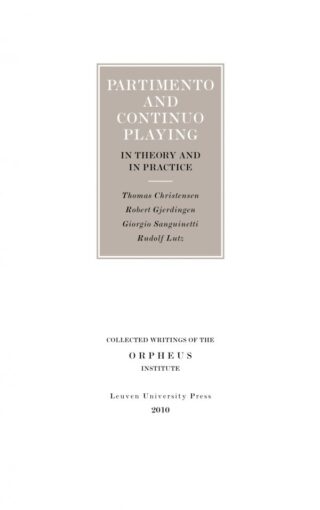
This volume is a collection of essays based on lectures given at the International Orpheus Academy for Music Theory on ‘Music and Theory: Thoroughbass in Practice, Theory, and Improvisation’. Hence the point of departure was not ‘Music Theory’ as such, but the interaction between music theory, music history, performance practice, aesthetics, and related sciences. This multidisciplinary approach, with the accent on the interplay between music performance and music theory, is reflected in the contributions to this book.
Thomas Christensen, in his contribution, shows how the development of tonal harmonic theory went hand in hand with the practice of thoroughbass. Both Robert Gjerdingen and Giorgio Sanguinetti focus on the Neapolitan tradition of partimento. Gjerdingen addresses the relation between the realization of partimenti and contrapuntal thinking, illustrated by examples of contrapuntal imitation and combination in partimenti, leading to the ‘partimentofugue’. Sanguinetti elaborates on the history of this partimentofugue from the early 18th until the late 19th century. Rudolf Lutz, finally, presents his use of partimenti in educational practice, giving examples of how reviving this old practice can give new insights to composers, conductors and musicians.
Preface
Thomas Christensen
Thoroughbass as music theory
Robert Gjerdingen
Partimenti written to impart a knowledge of counterpoint and composition
Giorgio Sanguinetti
Partimento-fugue: the Neapolitan angle
Rudolf Lutz
The playing of Partimento
Personalia
Colophon
Frequently Asked Questions
What is "Partimento and Continuo Playing in Theory and in Practice" about?
This volume is a collection of essays based on lectures given at the International Orpheus Academy for Music Theory on ‘Music and Theory: Thoroughbass in Practice, Theory, and Improvisation'. Hence the point of departure was not ‘Music Theory' as such, but the interaction between music theory, music history, performance practice, aesthetics, and related sciences. This multidisciplinary approach, with the accent on the interplay between music performance and music theory, is reflected in the contributions to this book.
Thomas Christensen, in his contribution, shows how the development of tonal harmonic theory went hand in hand with the practice of thoroughbass. Both Robert Gjerdingen and Giorgio Sanguinetti focus on the Neapolitan tradition of partimento. Gjerdingen addresses the relation between the realization of partimenti and contrapuntal thinking, illustrated by examples of contrapuntal imitation and combination in partimenti, leading to the ‘partimentofugue'. Sanguinetti elaborates on the history of this partimentofugue from the early 18th until the late 19th century. Rudolf Lutz, finally, presents his use of partimenti in educational practice, giving examples of how reviving this old practice can give new insights to composers, conductors and musicians.
Who wrote "Partimento and Continuo Playing in Theory and in Practice"?
"Partimento and Continuo Playing in Theory and in Practice" was written by Thomas Christensen, Robert Gjerdingen, Giorgio Sanguinetti and Rudolf Lutz.
Thomas Christensen is Professor of Music and the Humanities at the University of Chicago.
Robert Gjerdingen is Professor of Music Theory and Cognition at Northwestern University.
Giorgio Sanguinetti is Associate Professor at the University of Rome 'Tor Vergata'.
Rudolf Lutz is Lecturer at the University of Music in Basel, the Schola Cantorum Basiliensis, and Artistic Director of the J.S. Bach Foundation in St. Gallen.
Who edited "Partimento and Continuo Playing in Theory and in Practice"?
"Partimento and Continuo Playing in Theory and in Practice" was edited by Dirk Moelants.
Dirk Moelants is a viola da gamba player and musicologist working as a Lecturer at the University of Amsterdam and as guest Professor at Ghent University.
Is "Partimento and Continuo Playing in Theory and in Practice" part of a series?
Yes, "Partimento and Continuo Playing in Theory and in Practice" is part of the "Geschriften van het Orpheus Instituut/Collected Writings of the Orpheus Institute" series. It's book 9 in the series.
In association with

The publications in the series "Collected Writings of the Orpheus Institute" contain musical testimonies and music-theoretical reflections with a strong emphasis on musical practice.
Editorial Board
Peter Dejans, Luk Vaes
What is the Table of Contents for "Partimento and Continuo Playing in Theory and in Practice"?
Preface
Thomas Christensen
Thoroughbass as music theory
Robert Gjerdingen
Partimenti written to impart a knowledge of counterpoint and composition
Giorgio Sanguinetti
Partimento-fugue: the Neapolitan angle
Rudolf Lutz
The playing of Partimento
Personalia
Colophon
What is the DOI for "Partimento and Continuo Playing in Theory and in Practice"?
The Digital Object Identifier (DOI) for "Partimento and Continuo Playing in Theory and in Practice" is 10.11116/9789461660947.
Related titles
 Franz Schreker. Der Schmied von Gent
Pieter Bergé (Editor), Steven Vande Moortele (Author), Martijn Vincken (Author),
February 2027
 The Book of Requiems, 1815–1900
John Koslovsky (Editor), Steven Vande Moortele (Editor),
December 2026
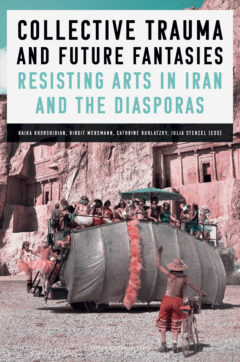 Collective Trauma and Future Fantasies
Raika Khorshidian (Editor), Birgit Mersmann (Editor), Cathrine Bublatzky (Editor), Julia Stenzel (Editor),
November 2026

 Violence and Trauma in Contemporary Performance
Sofie de Smet (Editor), Marieke Breyne (Editor), Pedzisai Maedza (Editor), Christel Stalpaert (Editor),
May 2025
 Music Theory and Analysis Volume 12 Issue 1, 2025 (Journal Subscription)
John Koslovsky (Editor), Markus Neuwirth (Editor), Derek Remeš (Editor),
May 2025