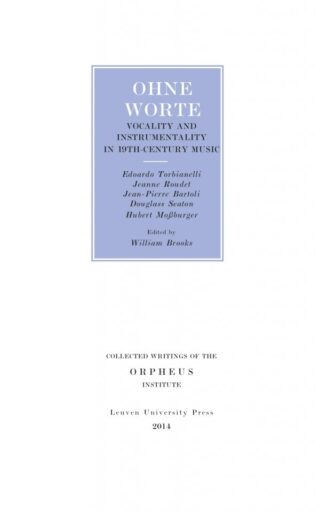
Ohne Worte
Vocality and Instrumentality in 19th-Century Music
William Brooks (Editor),
Series: Geschriften van het Orpheus Instituut/Collected Writings of the Orpheus Institute 12
Category: Artistic Practice, Music
Language: English
ISBN: 9789058679987
Publication date: November 12, 2014
€34.50 (including 6% VAT)
Buy NowSize: 240 x 150 x mm

Stock item: 92807
Standard delivery time for print books:
For Belgium: 5 to 8 working days
For EU: 2 to 3 weeks
For other countries: 4 to 5 weeks
Series: Geschriften van het Orpheus Instituut/Collected Writings of the Orpheus Institute 12
Category: Artistic Practice, Music
Language: English
ISBN: 9789461661616
Publication date: November 12, 2014
€26.00 (including 6% VAT)
Buy Now
The musical thought and practice of canonical composers
What can music tell us—without words? Can it depict scenes, narrate stories, elucidate beliefs? And can it be an instrument through which we access the inner lives not only of musicians from the past but of ourselves, today?
In Ohne Worte five scholars and performers probe these and related questions to illuminate both the experience and performance of nineteenth-century music. Drawing on a rich range of sources, they reveal the musical thought and practice of canonical composers like Berlioz, Mendelssohn, and Schumann. Their work challenges us to reconsider our musical practices and the voices manifested in them, and it encourages the creation of an art that is both historical and transcendental.
This publication is GPRC-labeled (Guaranteed Peer-Reviewed Content).
Contributors
Jean-Pierre Bartoli (Université Paris–Sorbonne), Hubert Moßburger (Staatlichen Hochschule für Musik und Darstellende Kunst Stuttgart), Jeanne Roudet (Université Paris–Sorbonne), Douglass Seaton (Florida State University School of Music), Edoardo Torbianelli (Hochschule der Künste Bern)
Preface
— Edoardo Torbianelli
Playing with Images: Character and Emotion in the Age
of Romanticism
— Hubert MoàŸburger
“Inner Voices” and “Deep Combinations”: Robert
Schumann’s Approach to Romantic Polyphony
— Jeanne Roudet
Frédéric Chopin, Clara Schuman, and the Singing Piano
School
— Jean-Pierre Bartoli
Vocal Patterns in the Themes of Berlioz’s Instrumental
Music
— Douglass Seaton
Plot and Narrative in Mendelssohn’s Chamber Music for
Strings and Piano
— Hubert MoàŸburger
Robert Schumann’s Poetic Paraphrases: Analytical
Implications
Personalia
Colophon
Frequently Asked Questions
What is "Ohne Worte" about?
The musical thought and practice of canonical composers
What can music tell us—without words? Can it depict scenes, narrate stories, elucidate beliefs? And can it be an instrument through which we access the inner lives not only of musicians from the past but of ourselves, today?
In Ohne Worte five scholars and performers probe these and related questions to illuminate both the experience and performance of nineteenth-century music. Drawing on a rich range of sources, they reveal the musical thought and practice of canonical composers like Berlioz, Mendelssohn, and Schumann. Their work challenges us to reconsider our musical practices and the voices manifested in them, and it encourages the creation of an art that is both historical and transcendental.
This publication is GPRC-labeled (Guaranteed Peer-Reviewed Content).
Contributors
Jean-Pierre Bartoli (Université Paris–Sorbonne), Hubert Moßburger (Staatlichen Hochschule für Musik und Darstellende Kunst Stuttgart), Jeanne Roudet (Université Paris–Sorbonne), Douglass Seaton (Florida State University School of Music), Edoardo Torbianelli (Hochschule der Künste Bern)
Who wrote "Ohne Worte"?
"Ohne Worte" was written by Edoardo Torbianelli, Jeanne Roudet, Jean-Pierre Bartoli, Douglass Seaton and Hubert Mossburger.
Who edited "Ohne Worte"?
"Ohne Worte" was edited by William Brooks.
William Brooks is professor of music at the University of York, emeritus professor at the University of Illinois, scholar-in-residence at the Newberry Library, and senior research fellow at the Orpheus Institute.
Is "Ohne Worte" part of a series?
Yes, "Ohne Worte" is part of the "Geschriften van het Orpheus Instituut/Collected Writings of the Orpheus Institute" series. It's book 12 in the series.
In association with

The publications in the series "Collected Writings of the Orpheus Institute" contain musical testimonies and music-theoretical reflections with a strong emphasis on musical practice.
Editorial Board
Peter Dejans, Luk Vaes
What is the Table of Contents for "Ohne Worte"?
Preface
— Edoardo Torbianelli
Playing with Images: Character and Emotion in the Age
of Romanticism
— Hubert MoàŸburger
“Inner Voices” and “Deep Combinations”: Robert
Schumann's Approach to Romantic Polyphony
— Jeanne Roudet
Frédéric Chopin, Clara Schuman, and the Singing Piano
School
— Jean-Pierre Bartoli
Vocal Patterns in the Themes of Berlioz's Instrumental
Music
— Douglass Seaton
Plot and Narrative in Mendelssohn's Chamber Music for
Strings and Piano
— Hubert MoàŸburger
Robert Schumann's Poetic Paraphrases: Analytical
Implications
Personalia
Colophon
What is the DOI for "Ohne Worte"?
The Digital Object Identifier (DOI) for "Ohne Worte" is 10.11116/9789461661616.
Related titles
 Franz Schreker. Der Schmied von Gent
Pieter Bergé (Editor), Steven Vande Moortele (Author), Martijn Vincken (Author),
February 2027
 The Book of Requiems, 1815–1900
John Koslovsky (Editor), Steven Vande Moortele (Editor),
December 2026
 Collective Trauma and Future Fantasies
Raika Khorshidian (Editor), Birgit Mersmann (Editor), Cathrine Bublatzky (Editor), Julia Stenzel (Editor),
November 2026

 Violence and Trauma in Contemporary Performance
Sofie de Smet (Editor), Marieke Breyne (Editor), Pedzisai Maedza (Editor), Christel Stalpaert (Editor),
May 2025
 Music Theory and Analysis Volume 12 Issue 1, 2025 (Journal Subscription)
John Koslovsky (Editor), Markus Neuwirth (Editor), Derek Remeš (Editor),
May 2025