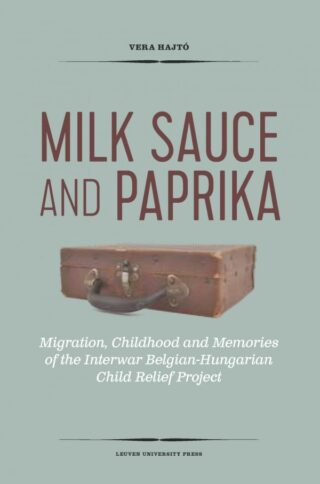
Milk Sauce and Paprika
Migration, Childhood and Memories of the Interwar Belgian-Hungarian Child Relief Project
Vera Hajto (Author),
Category: Diversity and Equity Studies, History, History 1800-present, Migration Studies
Language: English
ISBN: 9789462700789
Publication date: September 15, 2016
€55.00 (including 6% VAT)
Buy NowNumber of pages: 298
Size: 240 x 160 x mm

Stock item: 111008
Standard delivery time for print books:
For Belgium: 5 to 8 working days
For EU: 2 to 3 weeks
For other countries: 4 to 5 weeks
Category: Diversity and Equity Studies, History, History 1800-present, Migration Studies
Language: English
ISBN: 9789461662071
Publication date: September 15, 2016
€41.00 (including 6% VAT)
Buy NowNumber of pages: 298
The compelling story of Hungarian children living with Belgian families during the interwar period
Children who migrated without their families were noteworthy participants of interwar European migration history. Milk Sauce and Paprika tells the story of Hungarian children who were sent to Belgium in the framework of a humanitarian project between 1923 and 1927.
Based on a wide variety of sources such as official documents, contemporary newspapers, photographs, family correspondences, biographies and interviews, this book examines the history of the Belgian-Hungarian child relief project and describes its social and cultural impacts on the families involved in both countries.
This compelling story of one of the first mass European child migration movements offers new insights in the dynamics of national and religious communities. Furthermore, it sheds light on intimate family life and contemporary habits and values regarding parenting and co-parenting in the interwar period. Cutting across national and cultural borders, this monograph connects individual and collective memory with the experiences of childhood and migration.
This publication is GPRC-labeled (Guaranteed Peer-Reviewed Content).
Acknowledgements
Introduction
Migration and Childhood
States, Organisations, Families and Children: Levels of Analysis
Concepts: ‘Holiday’ -; ‘Migration’ -; ‘Foster’
About Childhood: Archives, Ego-documents and Oral History
Part I
States, Institutions, and the Welfare of Children
Chapter 1. Nations and Actors
International Relief Projects for Children and Pacifistic Objectives
Economy, Politics and Social Circumstances -; Belgium and Hungary
Introducing the Actors: the State, the Organisers and the Catholic Church
Chapter 2. Practising Propaganda and Negotiating Collective Identities: “Catholic people of the Kempen! Think about the Hungarian children”
In the Newspapers
During Festivities
From the Travel Reports
‘Are the Children Suffering from Hunger in Hungary?’: Mission Statement in the Form of a Polemic
Concluding Remarks to Part I
Part II
The Family Network -; The Best Interests of the Child
Chapter 1. The Hungarian Nation and the Best Interests of its Families and its Children
“Walking Red Tulips”: They are the Future of the Hungarian Nation
Fairy Tales, Mythical Figures and the Relief Project
Fairy Tale Gone Bad?
Practising Social Control
Chapter 2. About the Families
Staying with Families
What Kinds of Families?
Assistance to the Families
The Question of ‘Adoption’
Chapter 3. Representation and Bonding of Families
Photographing the Family -; Photographing the Hungarian Child
Exchanging Letters -; Creating Families
Concluding Remarks to Part II
Part III
Children -; Migrants -; Identities: Between ‘Motherland’ and ‘Home’
Chapter 1. The Returned Ones
Exchanging Letters -; Retaining Attachment
‘Anna uit Hongarije’
Chapter 2. Staying in Belgium -; Family and Friends
Letters from Home and Migrant Children
Girlfriends in Sisterhood
Hungarians around Us -; the Beginning of an Organisation
Collective Remembrance -; Bonheiden 2007
Remembering Individually
Concluding Remarks to Part III
Conclusion
Structure and Agency in Migration and Childhood
Memory that Defines
Life after the Relief Project
Appendices
Appendix 1. Confessional distribution of the Hungarian population around 1930
Appendix 2. Statistics of the Hungarian children who participated in the international relief project in the different countries
Appendix 3. Quantitative data on the relief project based on the lists of names of the Hungarian children (1923-1927)
Appendix 4. Estimation of number of children that remained in Belgium after the relief project
Notes
Illustration credits
Sources
Bibliography
Index
Vera Hajtó kijkt tegelijkertijd met de bril van een antropologe, sociologe en historica. Met haar originele probleemstelling positioneert ze zich op de intersectie van verschillende onderzoekdisciplines, waardoor haar bijdrage zonder twijfel, zeker in de Belgische context, pionierswerk mag worden genoemd. Hoe dieper in het boek, hoe meer de individuele getuigenissen centraal komen te staan en de geschiedkundige insteek enigszins naar de achtergrond verdwijnt. De auteur weet trefzeker de groeiende verstrengeling van kinderwelzijn en natievorming aan te wijzen [...]
We kunnen met klem stellen dat Vera Hajtó door middel van haar uitgebreide set aan analytische en linguïstische skills en haar originele positie in het ruimere onderzoeksveld de typische valkuilen van een gevalstudie met succes weet te vermijden.
Chiara Candaele, Contemporanea, Jaargang XXXIX, 2017, Nummer 1
'Milk Sauce and Paprika' is een diepgravend, meerlagig boek, dat voortvloeit uit het doctoraatsonderzoek van Vera Hajto. Het boek is uitermate interessant voor al wie als student of onderzoeker met migratiegeschiedenis bezig is.
Leen Beyers, Volkskunde, 2017, 2
The stories of double belonging in the memories of the by now ninety-year-old Hungarian child migrants—inhabiting two lives, two families—linger long after the reader finishes the book. Hajtó offers us a glimpse into the ways the politicization of children and childhood in the wake of 1918 inscribed itself onto the bodies of real, living people. Ilse Josepha Lazaroms, The Journal of the History of Childhood and Youth, Volume 11, Number 3, Fall 2018, pp. 457-459, DOI: https://doi.org/10.1353/hcy.2018.0056
Frequently Asked Questions
What is "Milk Sauce and Paprika" about?
The compelling story of Hungarian children living with Belgian families during the interwar period
Children who migrated without their families were noteworthy participants of interwar European migration history. Milk Sauce and Paprika tells the story of Hungarian children who were sent to Belgium in the framework of a humanitarian project between 1923 and 1927.
Based on a wide variety of sources such as official documents, contemporary newspapers, photographs, family correspondences, biographies and interviews, this book examines the history of the Belgian-Hungarian child relief project and describes its social and cultural impacts on the families involved in both countries.
This compelling story of one of the first mass European child migration movements offers new insights in the dynamics of national and religious communities. Furthermore, it sheds light on intimate family life and contemporary habits and values regarding parenting and co-parenting in the interwar period. Cutting across national and cultural borders, this monograph connects individual and collective memory with the experiences of childhood and migration.
This publication is GPRC-labeled (Guaranteed Peer-Reviewed Content).
Who wrote "Milk Sauce and Paprika"?
"Milk Sauce and Paprika" was written by Vera Hajto.
What is the Table of Contents for "Milk Sauce and Paprika"?
Acknowledgements
Introduction
Migration and Childhood
States, Organisations, Families and Children: Levels of Analysis
Concepts: 'Holiday' -; 'Migration' -; 'Foster'
About Childhood: Archives, Ego-documents and Oral History
Part I
States, Institutions, and the Welfare of Children
Chapter 1. Nations and Actors
International Relief Projects for Children and Pacifistic Objectives
Economy, Politics and Social Circumstances -; Belgium and Hungary
Introducing the Actors: the State, the Organisers and the Catholic Church
Chapter 2. Practising Propaganda and Negotiating Collective Identities: “Catholic people of the Kempen! Think about the Hungarian children”
In the Newspapers
During Festivities
From the Travel Reports
'Are the Children Suffering from Hunger in Hungary?': Mission Statement in the Form of a Polemic
Concluding Remarks to Part I
Part II
The Family Network -; The Best Interests of the Child
Chapter 1. The Hungarian Nation and the Best Interests of its Families and its Children
“Walking Red Tulips”: They are the Future of the Hungarian Nation
Fairy Tales, Mythical Figures and the Relief Project
Fairy Tale Gone Bad?
Practising Social Control
Chapter 2. About the Families
Staying with Families
What Kinds of Families?
Assistance to the Families
The Question of 'Adoption'
Chapter 3. Representation and Bonding of Families
Photographing the Family -; Photographing the Hungarian Child
Exchanging Letters -; Creating Families
Concluding Remarks to Part II
Part III
Children -; Migrants -; Identities: Between 'Motherland' and 'Home'
Chapter 1. The Returned Ones
Exchanging Letters -; Retaining Attachment
'Anna uit Hongarije'
Chapter 2. Staying in Belgium -; Family and Friends
Letters from Home and Migrant Children
Girlfriends in Sisterhood
Hungarians around Us -; the Beginning of an Organisation
Collective Remembrance -; Bonheiden 2007
Remembering Individually
Concluding Remarks to Part III
Conclusion
Structure and Agency in Migration and Childhood
Memory that Defines
Life after the Relief Project
Appendices
Appendix 1. Confessional distribution of the Hungarian population around 1930
Appendix 2. Statistics of the Hungarian children who participated in the international relief project in the different countries
Appendix 3. Quantitative data on the relief project based on the lists of names of the Hungarian children (1923-1927)
Appendix 4. Estimation of number of children that remained in Belgium after the relief project
Notes
Illustration credits
Sources
Bibliography
Index
What is the DOI for "Milk Sauce and Paprika"?
The Digital Object Identifier (DOI) for "Milk Sauce and Paprika" is 10.11116/9789461662071.
Related titles
 Margarete Schütte-Lihotzky and the Architecture of Collective Dissidence, 1918–1989
S.E. Eisterer (Author),
April 2027
 Infrastructuring Arrival
Karel Arnaut (Editor), Luce Beeckmans (Editor), Bruno Meeus (Editor),
November 2026

 Toekomstdromen
Maarten Van Dijck (Editor), Gerrit Verhoeven (Editor), Hans Cools (Editor),
November 2026
 Feminists Resisting Gendered Violence
Hemangini Gupta (Editor), Fiona Mackay (Editor), Jan Breckenridge (Editor), Louise Chappell (Editor), Rachna Mehra (Editor), Rukmini Sen (Editor), Mailin Suchting (Editor),
October 2026
 German–Rapanui Entanglements
Cristián Moreno Pakarati (Editor), Diego Muñoz (Editor), Philipp Schorch (Editor),
August 2026
 Trend en toeval – vierde editie
Bruno Blondé (Author), Isabelle Devos (Author), Jord Hanus (Author), Wouter Ryckbosch (Author),
August 2026
 Cinema in Post-War Belgium
Gertjan Willems (Editor), Bjorn Gabriels (Editor), Bénédicte Rochet (Editor),
May 2026
 Performing Magnetism
Eleonora Paklons (Editor), Kristof Smeyers (Editor), Kurt Vanhoutte (Editor), Hannah Welslau (Editor),
May 2026
 Political Exile in the Global Twentieth Century
Wolfram Kaiser (Editor), Piotr H. Kosicki (Editor),
April 2026
 Christian Democracy and the Fall of Communism
Michael Gehler (Editor), Piotr H. Kosicki (Editor), Helmut Wohnout (Editor),
April 2026
 Brusselse plaatsnamen
Iadine Degryse (Editor), Benjamin Wayens (Editor), Chantal Kesteloot (Editor), Dennis De Vriese (Editor), Matthijs Degraeve (Editor),
April 2026
 Nomadic Camera
Burcu Dogramaci (Editor), Winfried Gerling (Editor), Jens Jäger (Editor), Birgit Mersmann (Editor),
March 2026
 Cartographies of Catastrophes
Laura Demeter (Editor), Carmen M. Enss (Editor), Piotr Kisiel (Editor), Carol Ludwig (Editor),
February 2026