

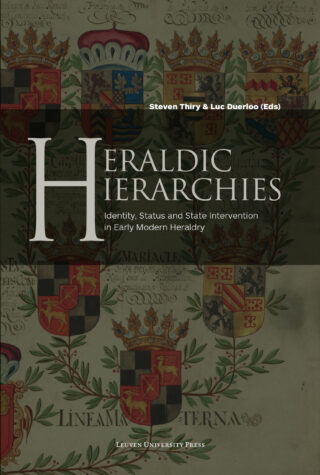
Heraldic Hierarchies
Identity, Status and State Intervention in Early Modern Heraldry
Steven Thiry (Editor), Luc Duerloo (Editor),
Category: History, History 1500-1800
Language: English
ISBN: 9789462702431
Publication date: June 1, 2021
€57.00 (including 6% VAT)
Buy NowNumber of pages: 274
Size: 234 x 156 x 15 mm
Number of illustrations: 50
Illustrations and other content description:
kleur in POD (max 35 pp.)

Stock item: 142197
Standard delivery time for print books:
For Belgium: 5 to 8 working days
For EU: 2 to 3 weeks
For other countries: 4 to 5 weeks
Category: History, History 1500-1800
Language: English
ISBN: 9789461663467
Publication date: June 1, 2021
€48.00 (including 6% VAT)
Buy NowNumber of pages: 274
Number of illustrations: 50
Illustrations and other content description:
kleur in POD (max 35 pp.)
The social use and changing character of armorial display in the early modern period
Early modern heraldry was far from a nostalgic remnant from a feudal past. From the Reformation to the French Revolution, aspiring men seized on these signs to position themselves in a changing society, imbuing heraldic tradition with fresh meaning. Whereas post-medieval developments are all too often described in terms of decadence and stifling formality, recent studies rightly stress the dynamic capacity of bearing arms.
Heraldic Hierarchies aims to correct former misconceptions. Contributing authors rethink the influence of shifting notions of nobility on armorial display and expand this topic to heraldry’s share in shaping and contesting status. Moreover, addressing a common thread, the volume explores how emerging states turned the heraldic experience into an instrument of power and policy. Contributing to debates on social and noble identity, Heraldic Hierarchies uncovers a vital and surprising aspect of the pre-modern hierarchical world.
Contributors: Richard Cust (University of Birmingham), Dominique Delgrange (Lille), Luc Duerloo (University of Antwerp), Joseph McMillan (Alexandria VA), Camille Pollet (Université de Nantes), Antoine Robin (École Pratique des Hautes Études), Simon Rousselot (École Pratique des Hautes Études), Clément Savary (École Pratique des Hautes Études), Hamish Scott (Jesus College, Oxford), Steven Thiry (University of Antwerp), José Manuel Valle Porras (Universidad de Córdoba), Nicolas Vernot (Université de Cergy-Pontoise)
This publication is GPRC-labeled (Guaranteed Peer-Reviewed Content).
Introduction: Identity, Status and State Intervention in Early Modern Heraldry
Steven Thiry and Luc Duerloo
PART 1 — HERALDRY AND NOBLE IDENTITY
‘Degrees of Nobles’:
The Aristocratisation of Europe’s Second Estate, c.1300-1700
Hamish Scott
The ‘Pennon’:
Heraldic Witness to Aristocratic Identities in Early Modern France
Clément Savary
Heraldry as a Nobiliary Sign:
What Treatises of Nobility Bring to a Historiographical Debate
Camille Pollet
Political Disruptions and Mamluk Emblematic Evolutions in the Fifteenth Century
Simon Rousselot
PART 2 — HERALDRY AND THE POLITICS OF STATUS
To Stand Out by Blazon:
Heraldry, Hierarchy and Social Competition during the Early Modern Period
Nicolas Vernot
‘Que en esa forma me lo haga vuestra merced’:
The Clients of the King of Arms Diego de Urbina and the Heraldic Forgeries in his Certifications of Arms (1584-1623)
José Manuel Valle Porras
L’autorité des hérauts d’armes en question à Lille au début du XVIIe siècle : La Remonstrance burlesque au Roy d’armes pour la noblesse lilloise et son contexte
Dominique Delgrange
PART 3 — HERALDRY AND STATE INTERVENTION
The Forge of Honour:
Interpreting Early Modern Policies on Heraldry
Steven Thiry
Emblematic Iconoclasm:
The Case of Charles of Bourbon in 1527
Antoine Robin
Lord Burghley and Displays of Collective Heraldry in Elizabethan England
Richard Cust
American Independence and the Privatisation of Heraldry, 1775-1800
Joseph McMillan
Bibliography
Notes on Contributors
'Heraldic Hierarchies' occupies an important place in the large interdisciplinary literature on state formation in Europe. More precisely, it adds to existing work on the contingent nature of this state formation; it illustrates the complex interaction of state and society in the Early Modern period; and it demonstrates that governments were then seriously concerned about the social distribution of status and its symbolic imagery, including heraldry, the latter of which is today often dismissed, even by some historians, as a pretentious aristocratic pastime. The book also enhances our recognition of the evolution of status as consisting of processes that encompass more than one country. Hopefully this valuable volume will persuade scholars to broaden their research to include the role of heraldry in the social and political processes they are studying. Samuel Clark, European Review of History: Revue européenne d'histoire, 2022, DOI: 10.1080/13507486.2021.2010899
Refreshingly, the present collection is focused on all that was new in what pertained to the nobility and the Crown in their relations with heraldry in the Early Modern period, and it does not even disdain genealogy. Its various contributors engage readily (and capably) with the key issues: the identification of certain families with the princely state, the increasing division of the nobility into fresh and more sharply delineated hierarchies, the expression of these rankings through heraldry, and the roles purportedly played by heralds – now almost all become servants of the Prince – in regulating heraldry.
Nigel Ramsay, Virtus 28 | 2021 | https://doi.org/10.21827/virtus.28.148-151
Frequently Asked Questions
What is "Heraldic Hierarchies" about?
The social use and changing character of armorial display in the early modern period
Early modern heraldry was far from a nostalgic remnant from a feudal past. From the Reformation to the French Revolution, aspiring men seized on these signs to position themselves in a changing society, imbuing heraldic tradition with fresh meaning. Whereas post-medieval developments are all too often described in terms of decadence and stifling formality, recent studies rightly stress the dynamic capacity of bearing arms.
Heraldic Hierarchies aims to correct former misconceptions. Contributing authors rethink the influence of shifting notions of nobility on armorial display and expand this topic to heraldry’s share in shaping and contesting status. Moreover, addressing a common thread, the volume explores how emerging states turned the heraldic experience into an instrument of power and policy. Contributing to debates on social and noble identity, Heraldic Hierarchies uncovers a vital and surprising aspect of the pre-modern hierarchical world.
Contributors: Richard Cust (University of Birmingham), Dominique Delgrange (Lille), Luc Duerloo (University of Antwerp), Joseph McMillan (Alexandria VA), Camille Pollet (Université de Nantes), Antoine Robin (École Pratique des Hautes Études), Simon Rousselot (École Pratique des Hautes Études), Clément Savary (École Pratique des Hautes Études), Hamish Scott (Jesus College, Oxford), Steven Thiry (University of Antwerp), José Manuel Valle Porras (Universidad de Córdoba), Nicolas Vernot (Université de Cergy-Pontoise)
This publication is GPRC-labeled (Guaranteed Peer-Reviewed Content).
Who edited "Heraldic Hierarchies"?
"Heraldic Hierarchies" was edited by Steven Thiry and Luc Duerloo.
Steven Thiry, PhD, is a voluntary member of ‘Power in History: Centre for Political History’ of the University of Antwerp.
Luc Duerloo is professor at the Department of History of the University of Antwerp, where he teaches early modern political and institutional history.
What is the Table of Contents for "Heraldic Hierarchies"?
Introduction: Identity, Status and State Intervention in Early Modern Heraldry
Steven Thiry and Luc Duerloo
PART 1 — HERALDRY AND NOBLE IDENTITY
‘Degrees of Nobles’:
The Aristocratisation of Europe’s Second Estate, c.1300-1700
Hamish Scott
The ‘Pennon’:
Heraldic Witness to Aristocratic Identities in Early Modern France
Clément Savary
Heraldry as a Nobiliary Sign:
What Treatises of Nobility Bring to a Historiographical Debate
Camille Pollet
Political Disruptions and Mamluk Emblematic Evolutions in the Fifteenth Century
Simon Rousselot
PART 2 — HERALDRY AND THE POLITICS OF STATUS
To Stand Out by Blazon:
Heraldry, Hierarchy and Social Competition during the Early Modern Period
Nicolas Vernot
‘Que en esa forma me lo haga vuestra merced’:
The Clients of the King of Arms Diego de Urbina and the Heraldic Forgeries in his Certifications of Arms (1584-1623)
José Manuel Valle Porras
L’autorité des hérauts d’armes en question à Lille au début du XVIIe siècle : La Remonstrance burlesque au Roy d’armes pour la noblesse lilloise et son contexte
Dominique Delgrange
PART 3 — HERALDRY AND STATE INTERVENTION
The Forge of Honour:
Interpreting Early Modern Policies on Heraldry
Steven Thiry
Emblematic Iconoclasm:
The Case of Charles of Bourbon in 1527
Antoine Robin
Lord Burghley and Displays of Collective Heraldry in Elizabethan England
Richard Cust
American Independence and the Privatisation of Heraldry, 1775-1800
Joseph McMillan
Bibliography
Notes on Contributors
Related titles

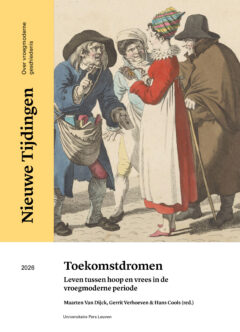 Toekomstdromen
Maarten Van Dijck (Editor), Gerrit Verhoeven (Editor), Hans Cools (Editor),
November 2026
 Trend en toeval – vierde editie
Bruno Blondé (Author), Isabelle Devos (Author), Jord Hanus (Author), Wouter Ryckbosch (Author),
August 2026

 Political Exile in the Global Twentieth Century
Wolfram Kaiser (Editor), Piotr H. Kosicki (Editor),
April 2026

 Christian Democracy and the Fall of Communism
Michael Gehler (Editor), Piotr H. Kosicki (Editor), Helmut Wohnout (Editor),
April 2026
 Brusselse plaatsnamen
Iadine Degryse (Editor), Benjamin Wayens (Editor), Chantal Kesteloot (Editor), Dennis De Vriese (Editor), Matthijs Degraeve (Editor),
April 2026

 Cartographies of Catastrophes
Laura Demeter (Editor), Carmen M. Enss (Editor), Piotr Kisiel (Editor), Carol Ludwig (Editor),
February 2026



 Denken en dialogeren over identiteit
Karel Van Nieuwenhuyse (Author), Bauke Verbergt (Author), Greet Vermeiren (Author), Ellen Claes (Author),
October 2025
 Vroegmoderne dieren in de Nederlanden
Judith Brouwer (Editor), djoeke van Netten (Editor),
November 2025