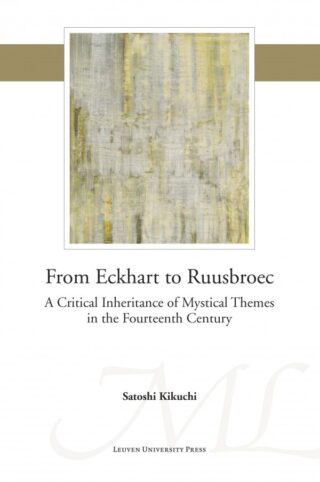
From Eckhart to Ruusbroec
A Critical Inheritance of Mystical Themes in the Fourteenth Century
Satoshi Kikuchi (Author),
Series: Mediaevalia Lovaniensia 44
Category: History, History 500-1500, Philosophy
Language: English
ISBN: 9789058679857
Publication date: September 26, 2014
€51.50 (including 6% VAT)
Buy NowSize: 240 x 160 x mm

Stock item: 93793
Standard delivery time for print books:
For Belgium: 5 to 8 working days
For EU: 2 to 3 weeks
For other countries: 4 to 5 weeks
Series: Mediaevalia Lovaniensia 44
Category: History, History 500-1500, Philosophy
Language: English
ISBN: 9789461661647
Publication date: September 26, 2014
€44.00 (including 6% VAT)
Buy Now
The mystical relationship between Meister Eckhart and Jan van Ruusbroec.
In this thorough textual, historical, and doctrinal study the author seeks to clarify the relationship between two prominent mystics of the fourteenth century: Meister Eckhart, the German Dominican, and Jan van Ruusbroec, the Brabantine Augustinian. Special attention is paid to Ruusbroec’s criticism of mystical tenets circulating in Brabant at that time which were both textually and doctrinally related to Eckhart’s condemned propositions in the papal bull ‘In agro dominico’. This fact implies that Ruusbroec was confronted with the impact of the condemnation of Eckhart’s doctrines on the people in Brabant. Situating Ruusbroec’s life and works within the aftermath of Eckhart’s arrival, the author elucidates Ruusbroec’s position regarding the relevant mystical themes in the later Middle Ages, and follows a process of critical inheritance of mystical tradition from Eckhart to Ruusbroec.
This publication is GPRC-labeled (Guaranteed Peer-Reviewed Content).
CONTENTS Acknowledgements Abbreviations Introduction
PART ONE ECKHART AND RUUSBROEC WITHIN THE HISTORICAL CONTEXT
Chapter One: Toward the Condemnation of Eckhart’s Doctrines 1. An Overview of the Spiritual Milieu in the Later Middle Ages Enthusiasm for the direct relationship between God and humanThe increase of heretical mysticism 2. The Condemnation of Eckhart’s Doctrines A brief summary of the inquisitorial process The content of Eckhart’s condemned doctrines
Chapter Two: The Impact of the Condemnation of Eckhart’s Doctrines in the Fourteenth Century Brabant 1. The Transmission of the News about the Condemnation of Eckhart’s Doctrines 2. The Transmission of Eckhart’s Writings 3. Jan van Leeuwen’s Doctrinal Criticism of Eckhart (1) “Simple nakedness” beyond the practice of virtues (2) The renunciation of the divine Persons (3) Deification into the divine essence and the divine sonship
Chapter Three: Ruusbroec’s Criticism of Mystical Heresies 1. Ruusbroec the Critic 71 2. Key Themes in Ruusbroec’s Criticism of Mystical Heresies and Links to Eckhart’s Condemned Doctrines (1) Heretical doctrines about the praxis of ecclesiastical life(2) Heretical doctrines about God and creation(3) Heretical doctrines about Christology and the mystical union with God 90 Summary of Part One and Connection to Part Two
PART TWO MYSTICAL THEMES IN ECKHART’S THEOLOGY
Chapter Four: Eckhart’s Understanding of the Praxis of Ecclesiastical Life 105 1. Sin and Penitence 2. Interior Disposition toward God To receive God HimselfEmptiness (ledicheit) and spiritual poverty 3. Exterior Works
Chapter Five: Eckhart’s Understanding of God and Creation 1. Unity and Trinity The circumincession of the divine PersonsThe unity of the nature/essence and the unity of the Father A teleological view of the Trinity 2. Relation between God and Creatures Creatures as negation and distinction Creatures as nothing
Chapter Six: Eckhart’s Understanding of the Mystical Union 1. The Transformation of Essence 2. Union with God through Sonship Conformity to Christ’s sonshipThe “birth of God” doctrine God’s self-knowing in the soul 3. Christ’s Humanity Human person and human nature The significance of Christ’s Incarnation
Summary of Part Two and Connection to Part Three PART THREE THE CRITICAL INHERITANCE OF MYSTICAL THEMES IN RUUSBROEC’S THEOLOGY
Chapter Seven: Ruusbroec’s Understanding of the Praxis of Ecclesiastical Life 1. Sin and Penitence 2. The Holy Spirit’s In-working and the Spiritual Poverty 3. Inactivity (ledicheit) in the Essence of God (1) Participation in the triune God (2) Likeness to Christ (3) Inactivity in the created essence and in God’s essence
Chapter Eight: Ruusbroec’s Understanding of God and Creation 1. Unity and Trinity (1) Relation among the divine Persons (2) Relation between unity and trinity 2. Relation Between God and Creatures
Chapter Nine: Ruusbroec’s Understanding of the Mystical Union 1. The Essential Unity of the Spirit with God 2. Union with God in Love 3. Christology Pertaining to the Understanding of the Mystical Union The “birth of God” doctrineThe unique sonship of Christ The supremacy of Christ’s humanity
Summary of Part Three
Conclusion
List of Textual linkages to Eckhart in Ruusbroec’s Writings Die geestelike brulocht (The Spiritual Espousals) Vanden XII beghinen (The Twelve Beguines) Een spieghel der eeuwigher salicheit (A Mirror of Eternal Blessedness) Bibliography Index of names Index of subjects
'In this excellent and engaging study, he has analysed the critical dialogue, focusing on a number of themes that are central to both Eckhart and Ruusbroec's thought, such as the Trinity, creation, Christology, and the ecclesiological dimensions of mystical union. On the basis of primary texts, the reader is able to follow the development of Ruusbroec's critical inheritance of Eckhart. And the aurhor has demonstrated, clearly and with a healthy sense of nuance, the complex and fundamental reflections in both authors.' Rob Faesen, Louvain Studies 39 (2015-16/1) 83-86
Louvain Studies
Frequently Asked Questions
What is "From Eckhart to Ruusbroec" about?
The mystical relationship between Meister Eckhart and Jan van Ruusbroec.
In this thorough textual, historical, and doctrinal study the author seeks to clarify the relationship between two prominent mystics of the fourteenth century: Meister Eckhart, the German Dominican, and Jan van Ruusbroec, the Brabantine Augustinian. Special attention is paid to Ruusbroec’s criticism of mystical tenets circulating in Brabant at that time which were both textually and doctrinally related to Eckhart’s condemned propositions in the papal bull ‘In agro dominico’. This fact implies that Ruusbroec was confronted with the impact of the condemnation of Eckhart’s doctrines on the people in Brabant. Situating Ruusbroec’s life and works within the aftermath of Eckhart’s arrival, the author elucidates Ruusbroec’s position regarding the relevant mystical themes in the later Middle Ages, and follows a process of critical inheritance of mystical tradition from Eckhart to Ruusbroec.
This publication is GPRC-labeled (Guaranteed Peer-Reviewed Content).
Who wrote "From Eckhart to Ruusbroec"?
"From Eckhart to Ruusbroec" was written by Satoshi Kikuchi.
Satoshi Kikuchi is a free research associate of the Faculty of Theology and Religious Studies at the KU Leuven.
Is "From Eckhart to Ruusbroec" part of a series?
Yes, "From Eckhart to Ruusbroec" is part of the "Mediaevalia Lovaniensia" series. It's book 44 in the series.

The longstanding, peer-reviewed book series Mediaevalia Lovaniensia. Studies in Medieval History, Society, and Culture publishes high-quality scholarship on the history and culture of the Middle Ages (c. 500–1550). Topics of particular interest to the series include, but are not limited to, social behaviour and power relations in medieval society, processes of identity formation, religious and urban culture, medieval thought and literature, and gender history. The series focuses on Europe and the wider Mediterranean world and is particularly rich in interdisciplinary approaches. By means of monographs and edited volumes, the series explores thematic frontiers and embraces innovative methodological approaches in historical and philological scholarship that is based on an in-depth source-based study.
Mediaevalia Lovaniensia accepts monographs as well as thematically coherent volumes in English. Moreover, it offers scholars the possibility to publish critical editions of primary texts with broader relevance to the understanding of medieval culture and society. The series aspires to publish books that have the potential to become reference works in the field of Medieval Studies.
We encourage early career (postdoctoral) researchers to submit a reworked version of their PhD thesis to this series. Leuven University Press provides authors with two publishing scenarios: traditional (non-Open Access) and the option to publish in Open Access (including language editing).
Editorial Board
Jelle Haemers (KU Leuven)
Jeroen Deploige (Ghent University)
Brigitte Meijns (KU Leuven)
Chanelle Delameillieure (KU Leuven - KULAK)
Baudouin Van den Abeele (UCLouvain)
Proposals
Proposals and enquiries can be sent to one of the editorial board members. Please send a short abstract. Upon approval of the proposal, the full manuscript will be submitted to international blind peer review by two (external) experts. The editors strive towards completing the review of proposals within one month and of complete manuscripts within five months after submission. Manuscripts should preferably be (+/-) 80.000 to 120.000 words in length.
Please make use of the submission form to present your manuscript or proposal to our board.
Authors interested in Open Access can consult the available funding options.
Links & Resources
What is the Table of Contents for "From Eckhart to Ruusbroec"?
CONTENTS Acknowledgements Abbreviations Introduction
PART ONE ECKHART AND RUUSBROEC WITHIN THE HISTORICAL CONTEXT
Chapter One: Toward the Condemnation of Eckhart’s Doctrines 1. An Overview of the Spiritual Milieu in the Later Middle Ages Enthusiasm for the direct relationship between God and humanThe increase of heretical mysticism 2. The Condemnation of Eckhart’s Doctrines A brief summary of the inquisitorial process The content of Eckhart’s condemned doctrines
Chapter Two: The Impact of the Condemnation of Eckhart’s Doctrines in the Fourteenth Century Brabant 1. The Transmission of the News about the Condemnation of Eckhart’s Doctrines 2. The Transmission of Eckhart’s Writings 3. Jan van Leeuwen’s Doctrinal Criticism of Eckhart (1) “Simple nakedness” beyond the practice of virtues (2) The renunciation of the divine Persons (3) Deification into the divine essence and the divine sonship
Chapter Three: Ruusbroec’s Criticism of Mystical Heresies 1. Ruusbroec the Critic 71 2. Key Themes in Ruusbroec’s Criticism of Mystical Heresies and Links to Eckhart’s Condemned Doctrines (1) Heretical doctrines about the praxis of ecclesiastical life(2) Heretical doctrines about God and creation(3) Heretical doctrines about Christology and the mystical union with God 90 Summary of Part One and Connection to Part Two
PART TWO MYSTICAL THEMES IN ECKHART’S THEOLOGY
Chapter Four: Eckhart’s Understanding of the Praxis of Ecclesiastical Life 105 1. Sin and Penitence 2. Interior Disposition toward God To receive God HimselfEmptiness (ledicheit) and spiritual poverty 3. Exterior Works
Chapter Five: Eckhart’s Understanding of God and Creation 1. Unity and Trinity The circumincession of the divine PersonsThe unity of the nature/essence and the unity of the Father A teleological view of the Trinity 2. Relation between God and Creatures Creatures as negation and distinction Creatures as nothing
Chapter Six: Eckhart’s Understanding of the Mystical Union 1. The Transformation of Essence 2. Union with God through Sonship Conformity to Christ’s sonshipThe “birth of God” doctrine God’s self-knowing in the soul 3. Christ’s Humanity Human person and human nature The significance of Christ’s Incarnation
Summary of Part Two and Connection to Part Three PART THREE THE CRITICAL INHERITANCE OF MYSTICAL THEMES IN RUUSBROEC’S THEOLOGY
Chapter Seven: Ruusbroec’s Understanding of the Praxis of Ecclesiastical Life 1. Sin and Penitence 2. The Holy Spirit’s In-working and the Spiritual Poverty 3. Inactivity (ledicheit) in the Essence of God (1) Participation in the triune God (2) Likeness to Christ (3) Inactivity in the created essence and in God’s essence
Chapter Eight: Ruusbroec’s Understanding of God and Creation 1. Unity and Trinity (1) Relation among the divine Persons (2) Relation between unity and trinity 2. Relation Between God and Creatures
Chapter Nine: Ruusbroec’s Understanding of the Mystical Union 1. The Essential Unity of the Spirit with God 2. Union with God in Love 3. Christology Pertaining to the Understanding of the Mystical Union The “birth of God” doctrineThe unique sonship of Christ The supremacy of Christ’s humanity
Summary of Part Three
Conclusion
List of Textual linkages to Eckhart in Ruusbroec’s Writings Die geestelike brulocht (The Spiritual Espousals) Vanden XII beghinen (The Twelve Beguines) Een spieghel der eeuwigher salicheit (A Mirror of Eternal Blessedness) Bibliography Index of names Index of subjects
Related titles

 Orality and Scribal Culture in the High Middle Ages
Timothy B. Noone (Author), Mark J. Clark (Author),
November 2026
 Toekomstdromen
Maarten Van Dijck (Editor), Gerrit Verhoeven (Editor), Hans Cools (Editor),
November 2026
 Summa (Quaestiones ordinariae) art. LXXIII – LXXV
Henry of Ghent (Author), Gordon Wilson (Editor), Juan Carlos Flores (Editor),
September 2026
 The Medieval Aristotle
Nena Bobovnik (Editor), Clelia V. Crialesi (Editor), Lisa Devriese (Editor),
August 2026

 Trend en toeval – vierde editie
Bruno Blondé (Author), Isabelle Devos (Author), Jord Hanus (Author), Wouter Ryckbosch (Author),
August 2026


 Political Exile in the Global Twentieth Century
Wolfram Kaiser (Editor), Piotr H. Kosicki (Editor),
April 2026
 Christian Democracy and the Fall of Communism
Michael Gehler (Editor), Piotr H. Kosicki (Editor), Helmut Wohnout (Editor),
April 2026
 Brusselse plaatsnamen
Iadine Degryse (Editor), Benjamin Wayens (Editor), Chantal Kesteloot (Editor), Dennis De Vriese (Editor), Matthijs Degraeve (Editor),
April 2026
 Cartographies of Catastrophes
Laura Demeter (Editor), Carmen M. Enss (Editor), Piotr Kisiel (Editor), Carol Ludwig (Editor),
February 2026

 Thomas Aquinas and Hervaeus Natalis on Concepts and Intentional Objects
Fabrizio Amerini (Author),
February 2026