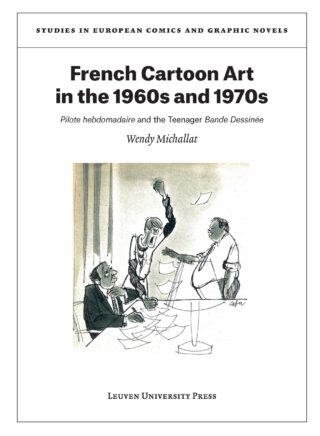
French Cartoon Art in the 1960s and 1970s
"Pilote hebdomadaire" and the Teenager "Bande Dessinée"
Wendy Michallat (Author),
Series: Studies in European Comics and Graphic Novels 6
Category: History, History 1800-present, Literature, Media and Visual Culture
Language: English
ISBN: 9789462701229
Publication date: July 25, 2018
€55.00 (including 6% VAT)
Buy NowNumber of pages: 268
Size: 230 x 170 x 15 mm
Number of illustrations: 9
Illustrations and other content description:
4 b&w, 5 colour illustrations

Stock item: 123229
Standard delivery time for print books:
For Belgium: 5 to 8 working days
For EU: 2 to 3 weeks
For other countries: 4 to 5 weeks
Pilote’s unique position in a new and fast developing youth press market
The French comic magazine Pilote hebdomadaire arrived in a weakening comics market in 1959 largely dominated by syndicated translations of American comics and comics inspired by a Catholic ethos. It tailored its content and tone to an older adolescent reader far removed from that of France’s infant comic. Pilote’s profile set it on a turbulent course subject to the vicissitudes and fickleness of fashion which situated it within an emerging teenager press under pressure to renew and innovate to survive. When it made cartoons its defining characteristic in 1963, Pilote articulated its uniqueness by channelling teenager discourse through them whilst also trying to encourage a zest for education in a modernising and economically buoyant France of exciting new opportunities. Pilote’s cartoon art thus became a dynamic repository for the ideas and attitudes of France’s educated youth which evolved into the radical discourses of the lifestyle and political revolutions of the late 1960s and early 1970s.
This book tells how Pilote hebdomadaire’s unique positioning in a new and fast developing youth press market for teenagers provided the forum and catalyst for the bande dessinée’s stylistic evolution over the course of the 1960s and 1970s.
This publication is GPRC-labeled (Guaranteed Peer-Reviewed Content).
Acknowledgements
Introduction
1. The French Bande Dessinée Market in 1959 and the Pilote Concept
2. Launch and Early Success
3. Pilote in Crisis, 1959-1963
4. The Bande Dessinée Re-launch
5. Prelude to 1968: Challenges and Changes
6. ‘Astérixisation’ and the Impact of the Album Market
7. Post 1968 and the End of Pilote ‘Hebdomadaire’
Final Word
Bibliography
'Although there exist quite some studies on the journal, the study by Wendy Michallat is the very first one to rethink its history in a broader perspective, not just that of comics culture, but that of culture at large. And the result is absolutely breath-taking. First of all because Michallat gives a very detailed yet nuanced and well written overview of the various periods of the magazine, whose history is one of nearly permanent crisis and eternal attempts to relaunch new formats and formulas in a publication niche that was much less profitable than it was often thought. Second, and most importantly, because the author succeeds in doing what other studies fail to do, namely explaining the systematic changes in the magazine’s policy.'Jan Baetens, Cultural
Studies Leuven, 3 August 2018
Despite growing academic interest in bandes dessinées, relatively little has been written about the magazines which publish them. Consequently, Wendy Michallat’s study of the youth weekly Pilote is most welcome: it sheds valuable light not only on bandes dessinées development, but also on the evolution of the French press and on broader trends in society. Ample context is given by the huge range of documents consulted: government policy papers; comments by educators and journalists; letters from readers; interviews with artists, editors, and parents. References to other youth publications, some almost forgotten today, as well as to English-language outlets, provide useful points of comparison.
Matthew Screech, French Studies, Volume 73, Issue 3, July 2019, https://doi.org/10.1093/fs/knz104
On ne peut que recommander ce livre bien documenté et bien écrit à tous ceux qui s’intéressent à l’histoire des BD en France.Edward Ousselin, The French Review, Volume 93, No. 1, October 2019
The book is part of Leuven University Press’s Studies in European Comics and Graphic Novels, an impressive series that offers important contributions to this growing field of study. [...] Her scholarship embodies the best of academic writing in that it satisfies the specialist’s need for documentation and deep analysis, while remaining accessible for students and non-specialist readers.Stephanie Schechner, Studies in 20th & 21st Century Literature: Vol. 43: Iss. 2, Article 20. https://doi.org/10.4148/2334-4415.2084
Cette étude est toutefois aussi intéressante que les cinq précédentes. Elle éclaire des thèmes peu abordés dans d’autres livres sur Pilote (dont les quatre textes cités, publiés avant 1999) et sur les magazines et la BD des années 1960, mais ici montrés à travers une méthodologie claire appuyée sur des exemples visuels bien choisis.
C[h]ris Reyns, Belphégor [Online], 18, 1 | 2020, Online since 14 January 2020, http://journals.openedition.org/belphegor/2136
Frequently Asked Questions
What is "French Cartoon Art in the 1960s and 1970s" about?
Pilote’s unique position in a new and fast developing youth press market
The French comic magazine Pilote hebdomadaire arrived in a weakening comics market in 1959 largely dominated by syndicated translations of American comics and comics inspired by a Catholic ethos. It tailored its content and tone to an older adolescent reader far removed from that of France’s infant comic. Pilote’s profile set it on a turbulent course subject to the vicissitudes and fickleness of fashion which situated it within an emerging teenager press under pressure to renew and innovate to survive. When it made cartoons its defining characteristic in 1963, Pilote articulated its uniqueness by channelling teenager discourse through them whilst also trying to encourage a zest for education in a modernising and economically buoyant France of exciting new opportunities. Pilote’s cartoon art thus became a dynamic repository for the ideas and attitudes of France’s educated youth which evolved into the radical discourses of the lifestyle and political revolutions of the late 1960s and early 1970s.
This book tells how Pilote hebdomadaire’s unique positioning in a new and fast developing youth press market for teenagers provided the forum and catalyst for the bande dessinée’s stylistic evolution over the course of the 1960s and 1970s.
This publication is GPRC-labeled (Guaranteed Peer-Reviewed Content).
Who wrote "French Cartoon Art in the 1960s and 1970s"?
"French Cartoon Art in the 1960s and 1970s" was written by Wendy Michallat.
Wendy Michallat is a lecturer in French at the University of Sheffield in the United Kingdom. She teaches and researches in the field of French cultural history and popular culture.
Is "French Cartoon Art in the 1960s and 1970s" part of a series?
Yes, "French Cartoon Art in the 1960s and 1970s" is part of the "Studies in European Comics and Graphic Novels" series. It's book 6 in the series.
Studies in European Comics and Graphic Novels presents state-of-the-art contributions on comics and graphic novels. The series publishes research on European comics and graphic novels and aims at stimulating scholarship on European BDs. It includes titles from scholars working in different disciplines, such as history, literary criticism, literary theory, art history, and visual studies. Typical themes to be addressed will comprise European graphic novels and comics in historical context; gender and other social identity analysis; theorizations; and detailed case studies or wider surveys. The series publishes monographs and collections for university-level researchers and ambitions to advance knowledge of this still relatively under-discussed subject.

All volumes will be published in English, but the comics and graphic novels under investigation will be of any European language and from any European culture. Like graphic novels and comics, Europe itself is hard to define, and the approach for the series will be open and not overly prescriptive.
Series editors
Jan Baetens, KU Leuven
Hugo Frey, University of Chichester
Maaheen Ahmed, Ghent University
Editorial Board
The editorial board is composed of leading scholars from literature, visual arts, and historical studies:
Bart Beaty (University of Calgary)
Christopher Pizzino (University of Georgia)
Ann Miller (University of Leicester).
Proposals
Proposals and enquiries can be sent to the series editors.
Please make use of the submission form to present your manuscript or proposal to our board.
Authors interested in Open Access can consult the available funding options.
Links & Resources
What is the Table of Contents for "French Cartoon Art in the 1960s and 1970s"?
Acknowledgements
Introduction
1. The French Bande Dessinée Market in 1959 and the Pilote Concept
2. Launch and Early Success
3. Pilote in Crisis, 1959-1963
4. The Bande Dessinée Re-launch
5. Prelude to 1968: Challenges and Changes
6. ‘Astérixisation’ and the Impact of the Album Market
7. Post 1968 and the End of Pilote ‘Hebdomadaire’
Final Word
Bibliography
Related titles

 Margarete Schütte-Lihotzky and the Architecture of Collective Dissidence, 1918–1989
S.E. Eisterer (Author),
April 2027


 Toekomstdromen
Maarten Van Dijck (Editor), Gerrit Verhoeven (Editor), Hans Cools (Editor),
November 2026
 Feminists Resisting Gendered Violence
Hemangini Gupta (Editor), Fiona Mackay (Editor), Jan Breckenridge (Editor), Louise Chappell (Editor), Rachna Mehra (Editor), Rukmini Sen (Editor), Mailin Suchting (Editor),
October 2026


 German–Rapanui Entanglements
Cristián Moreno Pakarati (Editor), Diego Muñoz (Editor), Philipp Schorch (Editor),
August 2026

 Trend en toeval – vierde editie
Bruno Blondé (Author), Isabelle Devos (Author), Jord Hanus (Author), Wouter Ryckbosch (Author),
August 2026
 Affect in Translation and Interpreting
Sofía Monzón (Editor), Lucie Spezzatti (Editor), Elisabeth Goemans (Editor),
May 2026
 Cinema in Post-War Belgium
Gertjan Willems (Editor), Bjorn Gabriels (Editor), Bénédicte Rochet (Editor),
May 2026
 Research Methods in Literary Reception Studies
Jeroen Dera (Editor), Anne Oerlemans (Editor), Frederik Van Dam (Editor),
May 2026


 Performing Magnetism
Eleonora Paklons (Editor), Kristof Smeyers (Editor), Kurt Vanhoutte (Editor), Hannah Welslau (Editor),
May 2026
 Political Exile in the Global Twentieth Century
Wolfram Kaiser (Editor), Piotr H. Kosicki (Editor),
April 2026
 Christian Democracy and the Fall of Communism
Michael Gehler (Editor), Piotr H. Kosicki (Editor), Helmut Wohnout (Editor),
April 2026
 Brusselse plaatsnamen
Iadine Degryse (Editor), Benjamin Wayens (Editor), Chantal Kesteloot (Editor), Dennis De Vriese (Editor), Matthijs Degraeve (Editor),
April 2026