Elachista
La dottrina dei minimi nell'Epicureismo
Francesco Verde (Author),
Series: Ancient and Medieval Philosophy - Series 1 48
Category: Classical Literature, Philosophy
ISBN: 9789058679475
Publication date: September 3, 2013
€99.50 (including 6% VAT)
Buy NowNumber of pages: 460
Size: 240 x 160 x 30 mm

Stock item: 82867
Standard delivery time for print books:
For Belgium: 5 to 8 working days
For EU: 2 to 3 weeks
For other countries: 4 to 5 weeks
Series: Ancient and Medieval Philosophy - Series 1 48
Category: Classical Literature, Philosophy
ISBN: 9789461661364
Publication date: September 3, 2013
€75.00 (including 6% VAT)
Buy NowNumber of pages: 460
The first monograph entirely devoted to the Epicurean doctrine of minimal parts.
The Epicurean doctrine of minimal parts (ta elachista) is a crucial aspect of Epicurus’s philosophy and a genuine turning point compared to the ancient atomism of Leucippus and Democritus. This book consists of three chapters: a philological and theoretical analysis of the primary sources (Epicurus and Lucretius) of the doctrine, a reconstruction of its likely historical background (Xenocrates, Aristotle, Diodorus Cronus), and a close examination of the chiefly geometrical development of this theory within the philosophical school of Epicurus. The critical examination of ancient sources (including several Herculaneum Papyri), combined with a careful analysis of the secondary literature, reveals the very significant role played by minimal parts within the Epicurean science of nature. This is the first monograph entirely devoted to the study of this important doctrine in all its historical and theoretical breadth.
Questo volume esamina la dottrina epicurea dei minimi (ta elachista) che rappresenta un nodo cruciale della filosofia di Epicuro e un autentico punto di svolta rispetto all’atomismo di Leucippo e Democrito. Il libro è organizzato in tre capitoli dedicati rispettivamente: (1) all’analisi filologica e teorica delle fonti primarie (Epicuro e Lucrezio), (2) alla ricostruzione del contesto storico-filosofico a cui la dottrina dei minimi verosimilmente fa riferimento (Senocrate, Aristotele e Diodoro Crono), e, infine, (3) all’approfondimento dello sviluppo della teoria dei minimi in ambito prevalentemente geometrico all’interno della scuola di Epicuro. L’esame critico delle fonti antiche (che riguardano anche alcuni Papiri Ercolanesi), anche attraverso l’attenta analisi della letteratura secondaria, conferma il ruolo decisivo giocato dai minimi nella scienza della natura epicurea. Si tratta della prima monografia interamente consacrata allo studio di questa significativa dottrina in tutta la sua ampiezza storica e teorica.
This publication is GPRC-labeled (Guaranteed Peer-Reviewed Content).
Premessa
Abbreviazioni
Conspectus siglorum
Introduzione
Capitolo I: I testi
I.1 Le testimonianze dirette
I.2 Epicuro, Epistola a Erodoto 56-59
I.2.1 Il limite della grandezza: Ep. Hrdt. 56
I.2.2 L’estremità del corpo limitato: Ep. Hrdt. 57
I.2.3 Il minimo nella sensazione: Ep. Hrdt. 58
I.2.4 Il minimo nell’atomo: Ep. Hrdt. 59
I.3 La trattazione lucreziana
I.3.1 Lucrezio, De rerum natura I 599-634
I.3.2 Lucrezio, De rerum natura II 481-499
I.3.3 Sul significato della trattazione lucreziana
Capitolo II : L a dottrina dei minimi in Epicuro e il suo retroterra storico e teorico
II.1 Minimi sensibili, atomici, spaziali e temporali
II.1.1 Minimi di tempo nell’Epistola a Erodoto
II.2 Il “retroterra” della dottrina dei minimi
II.2.1 Senocrate
II.2.1.1 Epicuro uditore di Senocrate?
II.2.1.2 Senocrate e le linee indivisibili
II.2.1.3 Epicuro e Senocrate
II.2.2 Aristotele
II.2.2.1 Il continuo in Aristotele (Phys. Ε 3)
II.2.2.2 Il continuo in Aristotele (Phys. Ζ)
II.2.2.3 Epicuro e Aristotele
II.2.3 Diodoro Crono
II.2.3.1 Diodoro Crono e gli ἀμεÏῆ
II.2.3.2 Epicuro e Diodoro Crono
II.3 La dottrina dei minimi nell’Epistola a Erodoto e il suo significato
Capitolo III : La dottrina dei minimi nel Giardino
III.1 La questione della “geometria epicurea”
III.1.1 La critica epicurea ai μαθήμαÏ„α: Epicuro e Nausifane di Teo
III.1.2 La geometria nel Giardino: Polieno di Lampsaco e Filonide di Laodicea a mare
III.1.3 Demetrio Lacone e la geometria
III.1.4 Zenone di Sidone e i principi della geometria
III.1.5 Conclusioni
III.2 Le testimonianze di Temistio e di Simplicio (= 278 Us.)
III.2.1 Zenone di Sidone e i minimi nell’opera sulle aporie di Epicuro di Demetrio Lacone (PHerc. 1012)
Conclusioni
English Summary
Appendice I: Epicuro e i triangoli del Timeo
Appendice II : Stratone di Lampsaco e la discontinuità del tempo
Bibliografia
Indici
Indice dei testi antichi
Indice dei nomi
Francesco Verde
Francesco Verde is associate professor of the history of ancient philosophy at Sapienza University of Rome. His main research areas are Epicureanism, Aristotelianism of the Hellenistic age, and Academic Scepticism.
Mais il est entendu, en réalité, que le problème des elachista ne constitue en rien un détail de l'histoire de l'épicurisme, c'est même un apport essentiel de l'ouvrage de Francesco Verde que d'établir son importance de manière définitive.
Celui-ci n'en constitue pas moins pour le chercheur et même simplement pour le lecteur intéressé à l'histoire de la philosophie et de la science de l'Antiquité une ressource exceptionnelle.
Alain GIGANDET, Université Paris Est Créteil-Paris 12, Philosophie antique (14, 2014).
Starting from the canonical texts about Epicurean minima the author looks beyond the canonical texts and manages to create an inclusive perspective for the foundation and the developments of this doctrine. Combining courage with prudence, Verde gives a thourough examination of the texts in their historical, philosophical, philological and also papyrological (as in the final appendix about the triangles in Plato's Timaeus) aspects, capturing and showing the essence of a complex but fascinating aspect of Epicurean thought.
Antonello Orlando, University of Turin, Mnemosyne 68 (2015) 344-347
The book is closely argued, fully documented, and accompanied by two appendices, a bibliography, two indices and an English summary. It seems to be a monograph worthy of study by anyone working on the core notions of Epicurean natural science or mathematics.
Christopher Gill, Phronesis 60 (2015) 253-265
La clarté de l'analyse, l'ampleur de la documentation bibliographique, la rigueur avec laquelle les instruments de travail sont présentés (appendices et indices) font de cet ensemble, accompagné d'un résumé en anglais, un véritable ouvrage de référence.
Pierre-Marie Morel, Revue de Philosophie Ancienne, XXXII (2), 2014
La ricostruzione proposta da Verde di una delle dottrine pi๠oscure e fondamentali della fisiologia epicurea risulta in tal modo solida e convincente sia da una prospettiva storica sia da una prospettiva teorico-esegetica. Per quanti siano interessati a studiare la teoria dei minimi e pi๠in generale ad acquisire una metodologia di ricerca nell'ambito del pensiero epicureo quest'opera costituisce uno strumento di lavoro eccellente e imprescindibile. Francesca Masi, Elenchos (XXXVII 1-2 (2016) pp. 263-274
Frequently Asked Questions
What is "Elachista" about?
The first monograph entirely devoted to the Epicurean doctrine of minimal parts.
The Epicurean doctrine of minimal parts (ta elachista) is a crucial aspect of Epicurus's philosophy and a genuine turning point compared to the ancient atomism of Leucippus and Democritus. This book consists of three chapters: a philological and theoretical analysis of the primary sources (Epicurus and Lucretius) of the doctrine, a reconstruction of its likely historical background (Xenocrates, Aristotle, Diodorus Cronus), and a close examination of the chiefly geometrical development of this theory within the philosophical school of Epicurus. The critical examination of ancient sources (including several Herculaneum Papyri), combined with a careful analysis of the secondary literature, reveals the very significant role played by minimal parts within the Epicurean science of nature. This is the first monograph entirely devoted to the study of this important doctrine in all its historical and theoretical breadth.
Questo volume esamina la dottrina epicurea dei minimi (ta elachista) che rappresenta un nodo cruciale della filosofia di Epicuro e un autentico punto di svolta rispetto all'atomismo di Leucippo e Democrito. Il libro è organizzato in tre capitoli dedicati rispettivamente: (1) all'analisi filologica e teorica delle fonti primarie (Epicuro e Lucrezio), (2) alla ricostruzione del contesto storico-filosofico a cui la dottrina dei minimi verosimilmente fa riferimento (Senocrate, Aristotele e Diodoro Crono), e, infine, (3) all'approfondimento dello sviluppo della teoria dei minimi in ambito prevalentemente geometrico all'interno della scuola di Epicuro. L'esame critico delle fonti antiche (che riguardano anche alcuni Papiri Ercolanesi), anche attraverso l'attenta analisi della letteratura secondaria, conferma il ruolo decisivo giocato dai minimi nella scienza della natura epicurea. Si tratta della prima monografia interamente consacrata allo studio di questa significativa dottrina in tutta la sua ampiezza storica e teorica.
This publication is GPRC-labeled (Guaranteed Peer-Reviewed Content).
Who wrote "Elachista"?
"Elachista" was written by Francesco Verde.
Francesco Verde is associate professor of the history of ancient philosophy at Sapienza University of Rome. His main research areas are Epicureanism, Aristotelianism of the Hellenistic age, and Academic Scepticism.
Is "Elachista" part of a series?
Yes, "Elachista" is part of the "Ancient and Medieval Philosophy - Series 1" series. It's book 48 in the series.
Ancient and Medieval Philosophy - Series 1 presents state-of-the-art research on the history of Western thought from its origins to the beginnings of modernity.
In association with The De Wulf-Mansion Centre.


About the Series
The series' focus lies primarily on the continuity and thematic transitions between ancient, medieval and renaissance thought, but also includes volumes on specific topics related to any of those periods. ‘Philosophy' is understood broadly to include metaphysics, ethics, natural philosophy, epistemology and philosophy of mind, and philosophical theology. Since the series is particularly devoted to making available Latin and Greek source texts, we welcome critical text editions as well as contributions that are based on philological scrutiny of those texts, without losing sight of their philosophical importance.
Ancient and Medieval Philosophy - Series 1 aims to publish at least two volumes a year and accepts monographs as well as thematically coherent edited volumes in English (without excluding the possibility of French, German, or Italian contributions to edited volumes). Manuscripts should be 80.000 to 120.000 words in length.
Readership
Researchers and graduate students in ancient, medieval and renaissance philosophy, in classics and in history.
Editorial Coordinator
Russell Friedman, KU Leuven, Belgium
Editorial Board
Pieter Beullens, KU Leuven, Belgium
Lisa Devriese, KU Leuven, Belgium
Pieter d'Hoine, KU Leuven, Belgium
Jan Opsomer, KU Leuven, Belgium
Jenny Pelletier, KU Leuven, Belgium
Andrea Robiglio, KU Leuven, Belgium
Carlos Steel, KU Leuven, Belgium
Gerd Van Riel, KU Leuven, Belgium
Advisory Board
Brad Inwood, Yale Universityo, USA
Jill Kraye, The Warburg Institute, London, United Kingdom
John Marenbon, University of Cambridge, United Kingdom
Lodi Nauta, University of Groningen, The Netherlands
Timothy Noone (†) , The Catholic University of America, USA
Robert Pasnau, University of Colorado at Boulder, USA
Martin Pickavé, University of Toronto, Canada,
Pasquale Porro, Università degli Studi di Milano, Italy
Geert Roskam, KU Leuven, Belgium
Proposals
Proposals and enquiries can be sent to editorial coordinator Russell L. Friedman. Please send a preliminary abstract (3-4 pp.) and a short bio. Upon approval of this abstract, the full manuscript will be submitted to international peer review.
Please make use of the submission form to present the full manuscript to our board.
Authors interested in Open Access can consult the available funding options.
Links & Resources
What is the Table of Contents for "Elachista"?
Premessa
Abbreviazioni
Conspectus siglorum
Introduzione
Capitolo I: I testi
I.1 Le testimonianze dirette
I.2 Epicuro, Epistola a Erodoto 56-59
I.2.1 Il limite della grandezza: Ep. Hrdt. 56
I.2.2 L'estremità del corpo limitato: Ep. Hrdt. 57
I.2.3 Il minimo nella sensazione: Ep. Hrdt. 58
I.2.4 Il minimo nell'atomo: Ep. Hrdt. 59
I.3 La trattazione lucreziana
I.3.1 Lucrezio, De rerum natura I 599-634
I.3.2 Lucrezio, De rerum natura II 481-499
I.3.3 Sul significato della trattazione lucreziana
Capitolo II : L a dottrina dei minimi in Epicuro e il suo retroterra storico e teorico
II.1 Minimi sensibili, atomici, spaziali e temporali
II.1.1 Minimi di tempo nell'Epistola a Erodoto
II.2 Il “retroterra” della dottrina dei minimi
II.2.1 Senocrate
II.2.1.1 Epicuro uditore di Senocrate?
II.2.1.2 Senocrate e le linee indivisibili
II.2.1.3 Epicuro e Senocrate
II.2.2 Aristotele
II.2.2.1 Il continuo in Aristotele (Phys. Ε 3)
II.2.2.2 Il continuo in Aristotele (Phys. Ζ)
II.2.2.3 Epicuro e Aristotele
II.2.3 Diodoro Crono
II.2.3.1 Diodoro Crono e gli ἀμεÏῆ
II.2.3.2 Epicuro e Diodoro Crono
II.3 La dottrina dei minimi nell'Epistola a Erodoto e il suo significato
Capitolo III : La dottrina dei minimi nel Giardino
III.1 La questione della “geometria epicurea”
III.1.1 La critica epicurea ai μαθήμαÏ„α: Epicuro e Nausifane di Teo
III.1.2 La geometria nel Giardino: Polieno di Lampsaco e Filonide di Laodicea a mare
III.1.3 Demetrio Lacone e la geometria
III.1.4 Zenone di Sidone e i principi della geometria
III.1.5 Conclusioni
III.2 Le testimonianze di Temistio e di Simplicio (= 278 Us.)
III.2.1 Zenone di Sidone e i minimi nell'opera sulle aporie di Epicuro di Demetrio Lacone (PHerc. 1012)
Conclusioni
English Summary
Appendice I: Epicuro e i triangoli del Timeo
Appendice II : Stratone di Lampsaco e la discontinuità del tempo
Bibliografia
Indici
Indice dei testi antichi
Indice dei nomi
What is the DOI for "Elachista"?
The Digital Object Identifier (DOI) for "Elachista" is 10.11116/9789461661364.
Related titles

 Orality and Scribal Culture in the High Middle Ages
Timothy B. Noone (Author), Mark J. Clark (Author),
November 2026
 Summa (Quaestiones ordinariae) art. LXXIII – LXXV
Henry of Ghent (Author), Gordon Wilson (Editor), Juan Carlos Flores (Editor),
September 2026
 The Medieval Aristotle
Nena Bobovnik (Editor), Clelia V. Crialesi (Editor), Lisa Devriese (Editor),
August 2026

 Thomas Aquinas and Hervaeus Natalis on Concepts and Intentional Objects
Fabrizio Amerini (Author),
February 2026
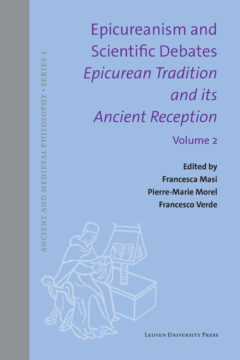 Epicureanism and Scientific Debates. Epicurean Tradition and its Ancient Reception
Francesca Masi (Editor), Pierre-Marie Morel (Editor), Francesco Verde (Editor),
January 2025

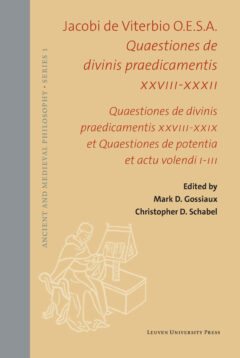 Quaestiones de divinis praedicamentis XXVIII-XXXII
James of Viterbo (Author), Mark D. Gossiaux (Editor), Christopher D. Schabel (Editor),
June 2024
 Summa (Quaestiones ordinariae) art. LXIII-LXVII
Henry of Ghent (Author), Gordon Wilson (Editor), Girard Etzkorn (Editor), Bernd Goehring (Editor), Linda N. Etzkorn (Assisted by),
February 2024
 Epicureanism and Scientific Debates. Antiquity and Late Reception
Francesca Masi (Editor), Pierre-Marie Morel (Editor), Francesco Verde (Editor),
August 2023
 Questiones super I-VII libros Politicorum
Peter of Auvergne (Author), Marco Toste (Editor),
December 2022