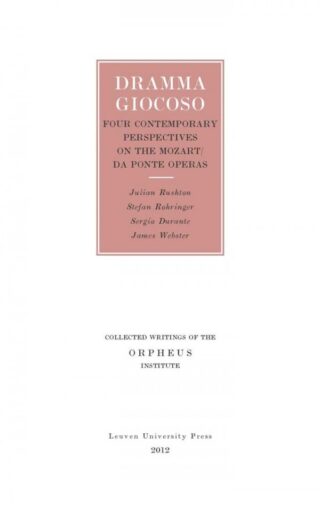
Dramma Giocoso
Four Contemporary Perspectives on the Mozart/Da Ponte Operas
Darla Crispin (Editor),
Series: Geschriften van het Orpheus Instituut/Collected Writings of the Orpheus Institute 10
Category: Artistic Practice, Music
Language: English
ISBN: 9789058678454
Publication date: April 25, 2012
€32.50 (including 6% VAT)
Buy NowNumber of pages: 144
Size: 240 x 150 x 10 mm

Stock item: 66140
Standard delivery time for print books:
For Belgium: 5 to 8 working days
For EU: 2 to 3 weeks
For other countries: 4 to 5 weeks
Series: Geschriften van het Orpheus Instituut/Collected Writings of the Orpheus Institute 10
Category: Artistic Practice, Music
Language: English
ISBN: 9789461660589
Publication date: March 20, 2013
€24.50 (including 6% VAT)
Buy NowNumber of pages: 144
The three Mozart/Da Ponte operas offer an inexhaustible wellspring for critical reflection, possessing a complexity and equivocation common to all great humane works. They have the potential to reflect and refract whatever locus of contemporaneity may be the starting point for enquiry. Thus, even postmodern and postmillennial concerns, far from seeming irrelevant to these operas, are instead given new perspectives by them, whilst the music and the dramatic situations have the multivalency to accept each refreshed pallet of interpretation without loss of their essential character. These operas seem perennially ‘new’. In exploring the evergreen qualities of Don Giovanni and Le Nozze di Figaro, this collection of studies does not shun approaches that have foundations in established theory, but refracts them through such problems as the tension between operatic tradition and psychological realism, the co-existence of multiple yet equal plots, and the antagonism between the tenets of tradition and the need for self-actualization. In exploring such themes, the authors not only illuminate new aspects of Mozart’s operatic compositions, but also probe the nature of musical analysis itself.
This publication is GPRC-labeled (Guaranteed Peer-Reviewed Content).
CONTENTS
PREFACE
– Julian Rushton
‘By their arias shall ye know them’: characterization in aria-based opera
– Stefan Rohringer
Don Ottavio and the history of the tenor voice
– Sergio Durante
Don Giovanni then and now: text and performance
– James Webster
The Act IV Finale of Le nozze di Figaro: Dramatic and Musical Construction
PERSONALIA
COLOPHON
Frequently Asked Questions
What is "Dramma Giocoso" about?
The three Mozart/Da Ponte operas offer an inexhaustible wellspring for critical reflection, possessing a complexity and equivocation common to all great humane works. They have the potential to reflect and refract whatever locus of contemporaneity may be the starting point for enquiry. Thus, even postmodern and postmillennial concerns, far from seeming irrelevant to these operas, are instead given new perspectives by them, whilst the music and the dramatic situations have the multivalency to accept each refreshed pallet of interpretation without loss of their essential character. These operas seem perennially ‘new'. In exploring the evergreen qualities of Don Giovanni and Le Nozze di Figaro, this collection of studies does not shun approaches that have foundations in established theory, but refracts them through such problems as the tension between operatic tradition and psychological realism, the co-existence of multiple yet equal plots, and the antagonism between the tenets of tradition and the need for self-actualization. In exploring such themes, the authors not only illuminate new aspects of Mozart's operatic compositions, but also probe the nature of musical analysis itself.
This publication is GPRC-labeled (Guaranteed Peer-Reviewed Content).
Who wrote "Dramma Giocoso"?
"Dramma Giocoso" was written by Julian Rushton, Stefan Rohringer, Sergio Durante and James Webster.
Julian Rushton is Emeritus Professor of Music at the University of Leeds and Chairman of the Editorial Committee of Musica Britannica.
Stefan Rohringer is Professor of Music Theory at Hochschule für Musik und Theater München.
Sergio Durante is Director of the Department of Art and Music History at the University of Padua.
James Webster is Goldwin Smith Professor of Music at Cornell University. He is the author of Haydn's "Farewell" Symphony and the Idea of Classical Style.
Who edited "Dramma Giocoso"?
"Dramma Giocoso" was edited by Darla Crispin.
Darla Crispin is a pianist and musicologist tracing perspectives from artistic research. Formerly an ORCiM Research Fellow, she is currently Associate Professor of Musicology at the Norwegian Academy of Music (NMH), Oslo.
Is "Dramma Giocoso" part of a series?
Yes, "Dramma Giocoso" is part of the "Geschriften van het Orpheus Instituut/Collected Writings of the Orpheus Institute" series. It's book 10 in the series.
In association with

The publications in the series "Collected Writings of the Orpheus Institute" contain musical testimonies and music-theoretical reflections with a strong emphasis on musical practice.
Editorial Board
Peter Dejans, Luk Vaes
What is the Table of Contents for "Dramma Giocoso"?
CONTENTS
PREFACE
- Julian Rushton
'By their arias shall ye know them': characterization in aria-based opera
- Stefan Rohringer
Don Ottavio and the history of the tenor voice
- Sergio Durante
Don Giovanni then and now: text and performance
- James Webster
The Act IV Finale of Le nozze di Figaro: Dramatic and Musical Construction
PERSONALIA
COLOPHON
Related titles
 Franz Schreker. Der Schmied von Gent
Pieter Bergé (Editor), Steven Vande Moortele (Author), Martijn Vincken (Author),
February 2027
 The Book of Requiems, 1815–1900
John Koslovsky (Editor), Steven Vande Moortele (Editor),
December 2026
 Collective Trauma and Future Fantasies
Raika Khorshidian (Editor), Birgit Mersmann (Editor), Cathrine Bublatzky (Editor), Julia Stenzel (Editor),
November 2026

 Violence and Trauma in Contemporary Performance
Sofie de Smet (Editor), Marieke Breyne (Editor), Pedzisai Maedza (Editor), Christel Stalpaert (Editor),
May 2025
 Music Theory and Analysis Volume 12 Issue 1, 2025 (Journal Subscription)
John Koslovsky (Editor), Markus Neuwirth (Editor), Derek Remeš (Editor),
May 2025