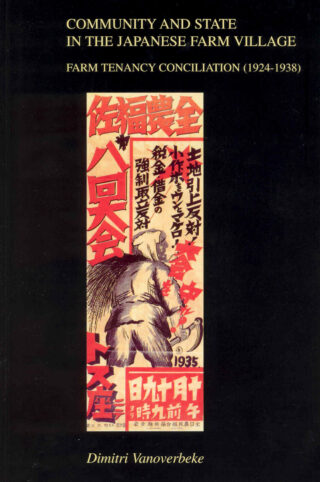
Community and State in the Japanese Farm Village
Farm Tenancy Conciliation (1924-1938)
Dimitri Vanoverbeke (Author),
While many studies have been written on the farm tenancy disputes that undermined the social fabric in Japan between the First and the Second World War, the Japanese government’s major response to these disputes, namely the creation of an in-court conciliation procedure has not received proportionate attention. In fact, this is the first book-length study on the farm tenancy conciliation procedure and analysis of the Japanese government’s wish to maintain tradition at al cost in the farmer community. The farm tenants as well as the landowners were from 1917 struggling for their right for better opportunities and hence, a better life in the context of Japan’s modernization. This book does focus on the ultimate answer by the Japanese government to the disputes between farmer tenants and their landowners, the Farm Tenancy Conciliation Law of 1924. The major focus of this part, however, will be on the role of the Tenancy Officer in the functioning of this law. This tenancy officer has never received in depth attention in- or outside Japan. This book overcomes this neglect and is based mainly upon first-hand reports of the farm tenancy disputes written by the mediators and upon original diaries of tenancy officers. This book provides a new insight in alternative dispute resolution in Japan specifically and in the interaction of law and society in general.
Introduction
Part I – The Growth and Collapse of the Farmer Community, 1600-1917
1. The farmer and the State in an Historiacal Perspective
2. Trouble in the Farm Village: Tradition and Social Change
3. Models of Conflict Resolution in the Farm Village
Part II – State and Farmers: The New Order, 1917-1938
4. The Legal Groundwork for a Farm Tenency Conciliation System
5. Engineering a New Order: The Tennancy Officer
6. The Tennancy Officer as a Mediator between Tradition and Modernity
Appendix: The Farm Tenancy Conciliation Law
Bibliography
Frequently Asked Questions
What is "Community and State in the Japanese Farm Village" about?
While many studies have been written on the farm tenancy disputes that undermined the social fabric in Japan between the First and the Second World War, the Japanese government's major response to these disputes, namely the creation of an in-court conciliation procedure has not received proportionate attention. In fact, this is the first book-length study on the farm tenancy conciliation procedure and analysis of the Japanese government's wish to maintain tradition at al cost in the farmer community. The farm tenants as well as the landowners were from 1917 struggling for their right for better opportunities and hence, a better life in the context of Japan's modernization. This book does focus on the ultimate answer by the Japanese government to the disputes between farmer tenants and their landowners, the Farm Tenancy Conciliation Law of 1924. The major focus of this part, however, will be on the role of the Tenancy Officer in the functioning of this law. This tenancy officer has never received in depth attention in- or outside Japan. This book overcomes this neglect and is based mainly upon first-hand reports of the farm tenancy disputes written by the mediators and upon original diaries of tenancy officers. This book provides a new insight in alternative dispute resolution in Japan specifically and in the interaction of law and society in general.
Who wrote "Community and State in the Japanese Farm Village"?
"Community and State in the Japanese Farm Village" was written by Dimitri Vanoverbeke.
Is "Community and State in the Japanese Farm Village" part of a series?
Yes, "Community and State in the Japanese Farm Village" is part of the "Symbolae Facultatis Litterarum Lovaniensis - Series B" series. It's book 29 in the series.
What is the Table of Contents for "Community and State in the Japanese Farm Village"?
Introduction
Part I - The Growth and Collapse of the Farmer Community, 1600-1917
1. The farmer and the State in an Historiacal Perspective
2. Trouble in the Farm Village: Tradition and Social Change
3. Models of Conflict Resolution in the Farm Village
Part II - State and Farmers: The New Order, 1917-1938
4. The Legal Groundwork for a Farm Tenency Conciliation System
5. Engineering a New Order: The Tennancy Officer
6. The Tennancy Officer as a Mediator between Tradition and Modernity
Appendix: The Farm Tenancy Conciliation Law
Bibliography
Related titles
 Margarete Schütte-Lihotzky and the Architecture of Collective Dissidence, 1918–1989
S.E. Eisterer (Author),
April 2027



 Collective Trauma and Future Fantasies
Raika Khorshidian (Editor), Birgit Mersmann (Editor), Cathrine Bublatzky (Editor), Julia Stenzel (Editor),
November 2026


 Toekomstdromen
Maarten Van Dijck (Editor), Gerrit Verhoeven (Editor), Hans Cools (Editor),
November 2026


 German–Rapanui Entanglements
Cristián Moreno Pakarati (Editor), Diego Muñoz (Editor), Philipp Schorch (Editor),
August 2026
 Trend en toeval – vierde editie
Bruno Blondé (Author), Isabelle Devos (Author), Jord Hanus (Author), Wouter Ryckbosch (Author),
August 2026
 Cinema in Post-War Belgium
Gertjan Willems (Editor), Bjorn Gabriels (Editor), Bénédicte Rochet (Editor),
May 2026

 Performing Magnetism
Eleonora Paklons (Editor), Kristof Smeyers (Editor), Kurt Vanhoutte (Editor), Hannah Welslau (Editor),
May 2026
 Political Exile in the Global Twentieth Century
Wolfram Kaiser (Editor), Piotr H. Kosicki (Editor),
April 2026
 Christian Democracy and the Fall of Communism
Michael Gehler (Editor), Piotr H. Kosicki (Editor), Helmut Wohnout (Editor),
April 2026
 Brusselse plaatsnamen
Iadine Degryse (Editor), Benjamin Wayens (Editor), Chantal Kesteloot (Editor), Dennis De Vriese (Editor), Matthijs Degraeve (Editor),
April 2026

 Cartographies of Catastrophes
Laura Demeter (Editor), Carmen M. Enss (Editor), Piotr Kisiel (Editor), Carol Ludwig (Editor),
February 2026
 Comics and the Global South
Andrea Aramburú (Editor), Dibyadyuti Roy (Editor), Joe Sutliff Sanders (Editor),
February 2026