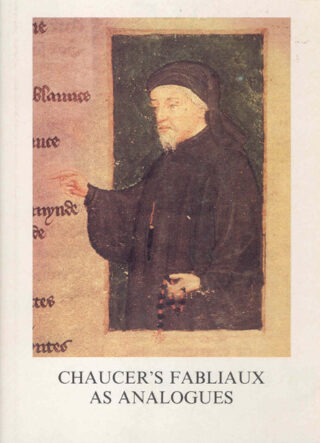
Chaucer’s Fabliaux as Analogues
E. Hertog (Author),
The presence of so many fabliaux in Chaucer’s Canterbury Tales is intriguing in its own right, given the fact that there are no real fabliaux in Middle English befor Chaucer.
But these stories are also interesting as instances of a concept and practice thas has received little critical attention so far, namely ‘analogy’, the writing and, above all, recognition of ‘similar’ stories. How to account for the literary practice that enables us to perceive stories as similar, c.q. analogous? This original study sets out to explore this phenomenon, first tentatively vis-à)vis other terms and practices (Translation, Borrowing, Adaptation, Version) and then, in the major part of the book, in a pragmatic-structuralist analysis of four salient components of narrative – Plot, Character, Thematics, and Genre – each illustrated with examples taken from Chaucer’s fabliaux and their analogues in various European languages.
In each of the four chapters the key-issue is Categorisation and Hertog traces its evolution and usefulness a a concept from Wittgenstein’s family resemblances’ and Zadeh’s ‘fuzzy set theory’ to E. Rosch’s Prototype theory. The conclusion draws attention to two aspects which set Chaucer’s fabliaux very much apart from the other analogues: their contextuality within the polylogue of the Canterbury Tales, and secondly, their explicit intertextuality which invites us to look anew at the assumptions of traditional source-criticism. The study ends with some theoretical reflections on analogy and an attempt at definition.
The book will interest not only Chaucerians and other medievalists but also scholars in literarry theory and interpretation.
Acknowledgements
Abbreviations
Introduction
-
Plot
The perception of Plot
The Summoner’s Tale and the Analogues
The Reeve’s Tale and the Analogues
Conclusion - Character
The Actantial Structure
The Social Model
The Acteurs: Heile, Viola and Alisoun
Conclusion - Thematics
The Isotopic Approach
The Mapping Structure of Metaphor
An Analysis of the Merchant’s Tale
Conclusion - Genre
The relationship to tradition
The Communicative Situation of Genre
Conclusion: the Example of the Shipman’s Tale
Conclusion
Bibliography
Index
Frequently Asked Questions
What is "Chaucer’s Fabliaux as Analogues" about?
The presence of so many fabliaux in Chaucer's Canterbury Tales is intriguing in its own right, given the fact that there are no real fabliaux in Middle English befor Chaucer.
But these stories are also interesting as instances of a concept and practice thas has received little critical attention so far, namely 'analogy', the writing and, above all, recognition of 'similar' stories. How to account for the literary practice that enables us to perceive stories as similar, c.q. analogous? This original study sets out to explore this phenomenon, first tentatively vis-à)vis other terms and practices (Translation, Borrowing, Adaptation, Version) and then, in the major part of the book, in a pragmatic-structuralist analysis of four salient components of narrative - Plot, Character, Thematics, and Genre - each illustrated with examples taken from Chaucer's fabliaux and their analogues in various European languages.
In each of the four chapters the key-issue is Categorisation and Hertog traces its evolution and usefulness a a concept from Wittgenstein's family resemblances' and Zadeh's 'fuzzy set theory' to E. Rosch's Prototype theory. The conclusion draws attention to two aspects which set Chaucer's fabliaux very much apart from the other analogues: their contextuality within the polylogue of the Canterbury Tales, and secondly, their explicit intertextuality which invites us to look anew at the assumptions of traditional source-criticism. The study ends with some theoretical reflections on analogy and an attempt at definition.
The book will interest not only Chaucerians and other medievalists but also scholars in literarry theory and interpretation.
Who wrote "Chaucer’s Fabliaux as Analogues"?
"Chaucer’s Fabliaux as Analogues" was written by E. Hertog.
Is "Chaucer’s Fabliaux as Analogues" part of a series?
Yes, "Chaucer’s Fabliaux as Analogues" is part of the "Mediaevalia Lovaniensia" series. It's book 19 in the series.

The longstanding, peer-reviewed book series Mediaevalia Lovaniensia. Studies in Medieval History, Society, and Culture publishes high-quality scholarship on the history and culture of the Middle Ages (c. 500–1550). Topics of particular interest to the series include, but are not limited to, social behaviour and power relations in medieval society, processes of identity formation, religious and urban culture, medieval thought and literature, and gender history. The series focuses on Europe and the wider Mediterranean world and is particularly rich in interdisciplinary approaches. By means of monographs and edited volumes, the series explores thematic frontiers and embraces innovative methodological approaches in historical and philological scholarship that is based on an in-depth source-based study.
Mediaevalia Lovaniensia accepts monographs as well as thematically coherent volumes in English. Moreover, it offers scholars the possibility to publish critical editions of primary texts with broader relevance to the understanding of medieval culture and society. The series aspires to publish books that have the potential to become reference works in the field of Medieval Studies.
We encourage early career (postdoctoral) researchers to submit a reworked version of their PhD thesis to this series. Leuven University Press provides authors with two publishing scenarios: traditional (non-Open Access) and the option to publish in Open Access (including language editing).
Editorial Board
Jelle Haemers (KU Leuven)
Jeroen Deploige (Ghent University)
Brigitte Meijns (KU Leuven)
Chanelle Delameillieure (KU Leuven - KULAK)
Baudouin Van den Abeele (UCLouvain)
Proposals
Proposals and enquiries can be sent to one of the editorial board members. Please send a short abstract. Upon approval of the proposal, the full manuscript will be submitted to international blind peer review by two (external) experts. The editors strive towards completing the review of proposals within one month and of complete manuscripts within five months after submission. Manuscripts should preferably be (+/-) 80.000 to 120.000 words in length.
Please make use of the submission form to present your manuscript or proposal to our board.
Authors interested in Open Access can consult the available funding options.
Links & Resources
What is the Table of Contents for "Chaucer’s Fabliaux as Analogues"?
Acknowledgements
Abbreviations
Introduction
Plot
The perception of Plot
The Summoner's Tale and the Analogues
The Reeve's Tale and the Analogues
Conclusion- Character
The Actantial Structure
The Social Model
The Acteurs: Heile, Viola and Alisoun
Conclusion - Thematics
The Isotopic Approach
The Mapping Structure of Metaphor
An Analysis of the Merchant's Tale
Conclusion - Genre
The relationship to tradition
The Communicative Situation of Genre
Conclusion: the Example of the Shipman's Tale
Conclusion
Bibliography
Index
Related titles
 Orality and Scribal Culture in the High Middle Ages
Timothy B. Noone (Author), Mark J. Clark (Author),
November 2026
 Toekomstdromen
Maarten Van Dijck (Editor), Gerrit Verhoeven (Editor), Hans Cools (Editor),
November 2026
 The Medieval Aristotle
Nena Bobovnik (Editor), Clelia V. Crialesi (Editor), Lisa Devriese (Editor),
August 2026

 Trend en toeval – vierde editie
Bruno Blondé (Author), Isabelle Devos (Author), Jord Hanus (Author), Wouter Ryckbosch (Author),
August 2026

 Political Exile in the Global Twentieth Century
Wolfram Kaiser (Editor), Piotr H. Kosicki (Editor),
April 2026
 Christian Democracy and the Fall of Communism
Michael Gehler (Editor), Piotr H. Kosicki (Editor), Helmut Wohnout (Editor),
April 2026
 Brusselse plaatsnamen
Iadine Degryse (Editor), Benjamin Wayens (Editor), Chantal Kesteloot (Editor), Dennis De Vriese (Editor), Matthijs Degraeve (Editor),
April 2026
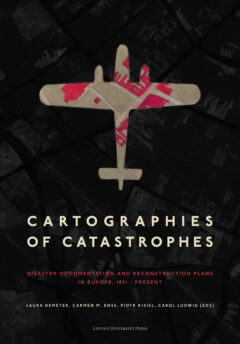 Cartographies of Catastrophes
Laura Demeter (Editor), Carmen M. Enss (Editor), Piotr Kisiel (Editor), Carol Ludwig (Editor),
February 2026

 Thomas Aquinas and Hervaeus Natalis on Concepts and Intentional Objects
Fabrizio Amerini (Author),
February 2026