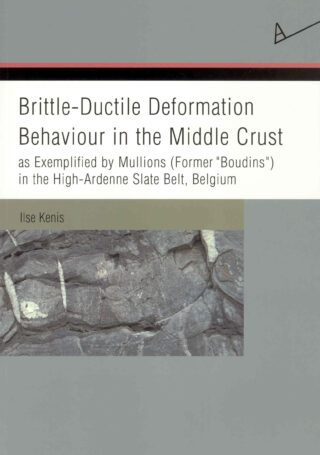
Brittle-Ductile Deformation Behaviour in the Middle Crust, as exemplified by Mullions (Former “Boudins”) in the High-Ardenne Slate Belt Belgium
Ilse Kenis (Author),
Nearly a century ago the terms ‘boudin’ and ‘boudinage’ have been introduced in the Ardenne-Eifel area to describe particular ‘sausage’-like structures. The term ‘boudin’ is now generally acknowledged in the geological terminology to describe structures that are the result of layer-parallel extension, i.e. ‘boudinage’. The structures in the Ardenne-Eifel area, however, turn out not to comply with the latter definition, which lead to a controversy on the true nature of these particular structures, i.e. the ‘boudinage question’. Eventually a renewed interest in the veins allowed to give a conclusive answer to this controversy. The key to the solution has to be found in a multidisciplinary approach, integrating structural, mineralogical, geochemical and microthermometrical analyses. What started of as a pure academic search for the solution to the ‘boudinage question’, ended up with a more general understanding of fundamental deformation processes occurring in the brittle-ductile transition zone in the middle crust, such as ‘hydraulic fracturing’ and ‘layer-parallel shortening. The Ardenne-Eifel area not only turns out to be an exposed fractured reservoir, it also bears the evidences of the viscous rheology of the middle crust.
GENERAL INTRODUCTION
Chapter 1: “Boudins” in the Ardenne-Eifel area. A historical review
1.1. The beginning
1.2. Introduction of the terms “Boudins” and “Boudinage” and discussion on the genesis of structures
1.3. Confusion
1.4. Conclusion
Chapter 2: Geodynamic setting
2.1. Overview
2.2. Stratigraphy of the Lower Devonian
2.3. Stratigraphy of the High-Ardenne slate belt
2.4. Structural architecture of the High-Ardenne slate belt
2.5. Metamorphism
2.6. Structural features
2.7. Synthesis
FROM “BOUDIN” TO MULLION
Chapter 3: Structural analysis
3.1. Studied outcrops in the High-Ardenne slate belt
3.2. Synthesis of meso- and macroscopic geometrical analysis
3.3. Fabric analysis
3.4. Interpretation
3.5. Evolutionary model
3.6. Discussion
3.7. Summary
Chapter 4: Fluid flow and formation of the veins
4.1. Fluid inclusions
4.2. Methodology
4.3. Fluids in the High-Ardenne slate belt
4.4. Mineralizing fluid
4.5. Spatial and chronological evolution of the fluids in the High-Ardenne slate belt
4.6. Determination of the P-T conditions at the time of veining
4.7. Discussion
4.8. Summary
Chapter 5: Kinematic model
5.1. Overview
5.2. Nomenclature
5.3. Kinematic model
MULLIONS AS A PALAEORHEOLOGICAL GAUGE
Chapter 6: Numerical mullion model and parameter sensitivity analysis
6.1. Mullion model
6.2. Parameter sensitivity analysis
6.3. Discussion
6.4. Summary
Chapter 7: Rheology of psammites deforming in the middle crust
7.1. Parameter estimation method
7.2. Case studies
7.3. Discussion
DISCUSSION AND CONCLUSIONS
Chapter 8: Discussion
8.1. Fractured reservoirs
8.2. Rheology of the middle crust
Conclusions
References
Appendix: content of CD-Rom
Acknowledgements
Frequently Asked Questions
What is "Brittle-Ductile Deformation Behaviour in the Middle Crust, as exemplified by Mullions (Former “Boudins”) in the High-Ardenne Slate Belt Belgium" about?
Nearly a century ago the terms 'boudin' and 'boudinage' have been introduced in the Ardenne-Eifel area to describe particular 'sausage'-like structures. The term 'boudin' is now generally acknowledged in the geological terminology to describe structures that are the result of layer-parallel extension, i.e. 'boudinage'. The structures in the Ardenne-Eifel area, however, turn out not to comply with the latter definition, which lead to a controversy on the true nature of these particular structures, i.e. the 'boudinage question'. Eventually a renewed interest in the veins allowed to give a conclusive answer to this controversy. The key to the solution has to be found in a multidisciplinary approach, integrating structural, mineralogical, geochemical and microthermometrical analyses. What started of as a pure academic search for the solution to the 'boudinage question', ended up with a more general understanding of fundamental deformation processes occurring in the brittle-ductile transition zone in the middle crust, such as 'hydraulic fracturing' and 'layer-parallel shortening. The Ardenne-Eifel area not only turns out to be an exposed fractured reservoir, it also bears the evidences of the viscous rheology of the middle crust.
Who wrote "Brittle-Ductile Deformation Behaviour in the Middle Crust, as exemplified by Mullions (Former “Boudins”) in the High-Ardenne Slate Belt Belgium"?
"Brittle-Ductile Deformation Behaviour in the Middle Crust, as exemplified by Mullions (Former “Boudins”) in the High-Ardenne Slate Belt Belgium" was written by Ilse Kenis.
Is "Brittle-Ductile Deformation Behaviour in the Middle Crust, as exemplified by Mullions (Former “Boudins”) in the High-Ardenne Slate Belt Belgium" part of a series?
Yes, "Brittle-Ductile Deformation Behaviour in the Middle Crust, as exemplified by Mullions (Former “Boudins”) in the High-Ardenne Slate Belt Belgium" is part of the "Aardkundige Mededelingen" series. It's book 14 in the series.
What is the Table of Contents for "Brittle-Ductile Deformation Behaviour in the Middle Crust, as exemplified by Mullions (Former “Boudins”) in the High-Ardenne Slate Belt Belgium"?
GENERAL INTRODUCTION
Chapter 1: "Boudins" in the Ardenne-Eifel area. A historical review
1.1. The beginning
1.2. Introduction of the terms "Boudins" and "Boudinage" and discussion on the genesis of structures
1.3. Confusion
1.4. Conclusion
Chapter 2: Geodynamic setting
2.1. Overview
2.2. Stratigraphy of the Lower Devonian
2.3. Stratigraphy of the High-Ardenne slate belt
2.4. Structural architecture of the High-Ardenne slate belt
2.5. Metamorphism
2.6. Structural features
2.7. Synthesis
FROM "BOUDIN" TO MULLION
Chapter 3: Structural analysis
3.1. Studied outcrops in the High-Ardenne slate belt
3.2. Synthesis of meso- and macroscopic geometrical analysis
3.3. Fabric analysis
3.4. Interpretation
3.5. Evolutionary model
3.6. Discussion
3.7. Summary
Chapter 4: Fluid flow and formation of the veins
4.1. Fluid inclusions
4.2. Methodology
4.3. Fluids in the High-Ardenne slate belt
4.4. Mineralizing fluid
4.5. Spatial and chronological evolution of the fluids in the High-Ardenne slate belt
4.6. Determination of the P-T conditions at the time of veining
4.7. Discussion
4.8. Summary
Chapter 5: Kinematic model
5.1. Overview
5.2. Nomenclature
5.3. Kinematic model
MULLIONS AS A PALAEORHEOLOGICAL GAUGE
Chapter 6: Numerical mullion model and parameter sensitivity analysis
6.1. Mullion model
6.2. Parameter sensitivity analysis
6.3. Discussion
6.4. Summary
Chapter 7: Rheology of psammites deforming in the middle crust
7.1. Parameter estimation method
7.2. Case studies
7.3. Discussion
DISCUSSION AND CONCLUSIONS
Chapter 8: Discussion
8.1. Fractured reservoirs
8.2. Rheology of the middle crust
Conclusions
References
Appendix: content of CD-Rom
Acknowledgements
Related titles
 Characterisation of Fermented Grain-based Raw Materials and Foods
Arno G. B. Wouters (Editor), Yamina De Bondt (Editor), Kati Katina (Editor), Christophe M. Courtin (Editor),
February 2026

 Wiskunde voor economen: concepten en technieken uit de wiskundige analyse – tweede editie
Johan Quaegebeur (Author), Walter Van Assche (Author), Naci Tanrıöven (Author), Paulien Vandereyt (Author),
July 2024
 Wiskunde voor economen: concepten en technieken uit de lineaire algebra – Tweede editie
Johan Quaegebeur (Author), Wim Schoutens (Author), Naci Tanrıöven (Author), Paulien Vandereyt (Author),
June 2022
 Minoan Earthquakes
Simon Jusseret (Editor), Manuel Sintubin (Editor), Jan Driessen (Preface by),
April 2017
 Contributions to the Geology of Belgium and Northwest Europe
Patrick Degryse (Editor), Manuel Sintubin (Editor),
September 2002
 Spectroscopy of Transition Metal Ions on Surfaces
Bert Weckhuysen (Editor), Pascal Van Der Voort (Editor), Gabriela Catana (Editor),
May 2000