Aïm Deüelle Lüski and Horizontal Photography
Ariella Azoulay (Author), Aïm Deüelle Lüski (),
Series: Lieven Gevaert Series 16
Category: Art, Media and Visual Culture, Photography
ISBN: 9789058679499
Publication date: January 6, 2014
€34.50 (including 6% VAT)
Buy NowNumber of pages: 261
Size: 240 x 160 x 150 mm

Stock item: 83798
Standard delivery time for print books:
For Belgium: 5 to 8 working days
For EU: 2 to 3 weeks
For other countries: 4 to 5 weeks
Exploring radically new possibilities for contemporary photography by an internationally leading theorist.
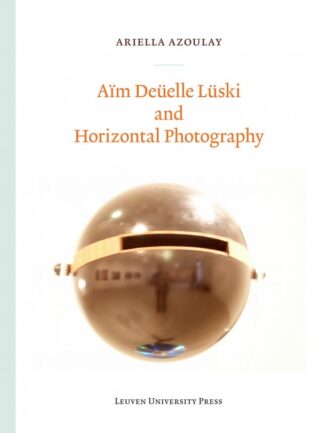
This book is the product of a unique collaboration between Israeli artist and philosopher Aïm Deüelle Lüski and visual culture theorist Ariella Azoulay. In their longstanding working relationship, they research how to theorize the structure of the contemporary scopic regime and open a space for its civil transformation. On this occasion, Azoulay interprets a particular series of cameras built by Deüelle Lüski, along with photographs taken by these cameras. Unlike conventional cameras and their vertical photography, Deüelle Lüski’s cameras seek to generate new sets of relations between the camera and the world. Azoulay’s text unfolds four different ‘short histories’ of problems in photography, each of which deconstructs what otherwise might appear as a coherent photographic regime, yet which is shown to be based solely on principles of sovereignty and possession. Through and with Deüelle Lüski’s project Azoulay seeks to ‘potentialize’ the history of photography, that is, to recover long forgotten, un-materialized possibilities. The book contains 100 images and a conversation between the author and the artist.
This publication is GPRC-labeled (Guaranteed Peer-Reviewed Content).
Part 1. A Short History of Photography in Dark Times
Four Birth Junctions
The Body of the Cameras
Pinhole(s) Cameras
The Photographer and the Inventor
Not at the Click of a Button
The World is Not an Object to be Possessed
Camera as a Means, Camera as a Participating Presence
Local Index
Back-to-Back
The Scene of the Murder
The Place and Time
The Big Bang and Sovereign-Possessive-Instrumental Scopic Regime
Our Time
Part 2. The Cameras
Lemons Camera, 1977-1978
Neighborhood Camera, 1977
Horizontal Camera, 1998
72-Centimeters Clay-Wood Camera, 1992
Refugee Camp Camera (Clay), 1994-1995
Shoulder Camera, 1996
North-East-South-West (NESW) Camera, 1992
Pita Camera, 2004
Musical Notes Cameras: Mahler (1988), Scriabin (2012)
Ball Camera, 2004
Cake Camera, 2010
Cards Camera, Vertical & Horizontal, 2010
Wine Barrel Camera, 2012
Scaled Camera, 1978
Football Camera, 2012
Part 3. A Threshold is a Place
Ariella Azoulay talks with Aïm Deüelle Lüski
Visant à repenser la photographie à neuf, le travail conjoint d'Ariella Azoulay et Aïm Deuelle Lüski amène a reconsidérer l'histoire de la photographie ainsi que ce par quoi on la définit. Il s'agit là d'une expérience déconcertante, mais cette réflexion apparaît nécessaire pour se dégager des conceptions qui entravent un rapport citoyen à la photographie.
Erika Wicky, Ciel Variable n° 98, 2014
Deüelle Lüski's camera project is instructive in its non-technological determinism: it exemplifies the fact that technologies are not teleological, but are malleable. In the case of photography, through its flexibility, it can disrupt attempts -; no matter how forceful -; to fix their ontology, their products and the messages they produce. Subversive projects such as Deüelle Lüski's may be increasing through community connections made easier with new media technologies; we will have to see where the threshold era that Azoulay and Deüelle Lüski claim we are in will take us in terms of civil engagement. Nonetheless, to see the threshold as a horizon instead of an obstructive, vertical plane is already a positive step.
Sonya de Laat, Western University, Visual Studies 2015 - http://dx.doi.org/10.1080/1472586X.2015.1020084
Frequently Asked Questions
What is "Aïm Deüelle Lüski and Horizontal Photography" about?
Exploring radically new possibilities for contemporary photography by an internationally leading theorist.
This book is the product of a unique collaboration between Israeli artist and philosopher Aïm Deüelle Lüski and visual culture theorist Ariella Azoulay. In their longstanding working relationship, they research how to theorize the structure of the contemporary scopic regime and open a space for its civil transformation. On this occasion, Azoulay interprets a particular series of cameras built by Deüelle Lüski, along with photographs taken by these cameras. Unlike conventional cameras and their vertical photography, Deüelle Lüski's cameras seek to generate new sets of relations between the camera and the world. Azoulay's text unfolds four different ‘short histories' of problems in photography, each of which deconstructs what otherwise might appear as a coherent photographic regime, yet which is shown to be based solely on principles of sovereignty and possession. Through and with Deüelle Lüski's project Azoulay seeks to ‘potentialize' the history of photography, that is, to recover long forgotten, un-materialized possibilities. The book contains 100 images and a conversation between the author and the artist.
This publication is GPRC-labeled (Guaranteed Peer-Reviewed Content).
Who wrote "Aïm Deüelle Lüski and Horizontal Photography"?
"Aïm Deüelle Lüski and Horizontal Photography" was written by Ariella Azoulay and Aïm Deüelle Lüski.
Ariella Azoulay is a theorist of photography, curator and documentary filmmaker. She teaches in the departments of Modern Culture and Media (MCM) and Comparative Literature at Brown University.
Is "Aïm Deüelle Lüski and Horizontal Photography" part of a series?
Yes, "Aïm Deüelle Lüski and Horizontal Photography" is part of the "Lieven Gevaert Series" series. It's book 16 in the series.

The series covers four types of publications:
- outstanding monographic studies
- multi-authored volumes on a specific topic
- book length projects with artists
- translations and/or reprints of classic texts.
All books are published in English and are written for an international audience of scholars.
Format
All books in the series are published in 17*23 cm paperback with French flaps, printed in black and white on white maco paper and with a maximum page extent of 300 pages (120.000 words) including images (unless agreed otherwise).
Authors interested in publishing their book in Open Access can check out the funding options here. Open access books are published under a creative commons license.
Series editors
Hilde Van Gelder, KU Leuven
Alexander Streitberger, UCLouvain
Proposals
Proposals and enquiries can be sent to the series editors.
Please make use of the submission form to present the full manuscript to our board.
Authors interested in Open Access can consult the available funding options.
Links & Resources
What is the Table of Contents for "Aïm Deüelle Lüski and Horizontal Photography"?
Part 1. A Short History of Photography in Dark Times
Four Birth Junctions
The Body of the Cameras
Pinhole(s) Cameras
The Photographer and the Inventor
Not at the Click of a Button
The World is Not an Object to be Possessed
Camera as a Means, Camera as a Participating Presence
Local Index
Back-to-Back
The Scene of the Murder
The Place and Time
The Big Bang and Sovereign-Possessive-Instrumental Scopic Regime
Our Time
Part 2. The Cameras
Lemons Camera, 1977-1978
Neighborhood Camera, 1977
Horizontal Camera, 1998
72-Centimeters Clay-Wood Camera, 1992
Refugee Camp Camera (Clay), 1994-1995
Shoulder Camera, 1996
North-East-South-West (NESW) Camera, 1992
Pita Camera, 2004
Musical Notes Cameras: Mahler (1988), Scriabin (2012)
Ball Camera, 2004
Cake Camera, 2010
Cards Camera, Vertical & Horizontal, 2010
Wine Barrel Camera, 2012
Scaled Camera, 1978
Football Camera, 2012
Part 3. A Threshold is a Place
Ariella Azoulay talks with Aïm Deüelle Lüski
Related titles
 Collective Trauma and Future Fantasies
Raika Khorshidian (Editor), Birgit Mersmann (Editor), Cathrine Bublatzky (Editor), Julia Stenzel (Editor),
November 2026


 Feminists Resisting Gendered Violence
Hemangini Gupta (Editor), Fiona Mackay (Editor), Jan Breckenridge (Editor), Louise Chappell (Editor), Rachna Mehra (Editor), Rukmini Sen (Editor), Mailin Suchting (Editor),
October 2026

 A City in Practice
Aude Tournaye (Editor), Filip De Boeck (Editor), Picha Collective (Editor),
September 2026
 Ecologies of Photography in the American West
Monica Bravo (Editor), Carolin Görgen (Editor),
September 2026
 Cinema in Post-War Belgium
Gertjan Willems (Editor), Bjorn Gabriels (Editor), Bénédicte Rochet (Editor),
May 2026
 Performing Magnetism
Eleonora Paklons (Editor), Kristof Smeyers (Editor), Kurt Vanhoutte (Editor), Hannah Welslau (Editor),
May 2026
 Jean Katambayi Mukendi
Johannes Muselaers (Editor), Stéphane Symons (Editor), Anne-Claire Schmitz (Editor), Emma Enderby (Editor),
April 2026
 Nomadic Camera
Burcu Dogramaci (Editor), Winfried Gerling (Editor), Jens Jäger (Editor), Birgit Mersmann (Editor),
March 2026
 Comics and the Global South
Andrea Aramburú (Editor), Dibyadyuti Roy (Editor), Joe Sutliff Sanders (Editor),
February 2026
 Entangled Art Histories
Valérie Mavridorakis (Editor), Alexander Streitberger (Editor), Hilde Van Gelder (Editor), Erik Verhagen (Editor),
October 2025
 The Visionary Art of Franco-Belgian Comics, 1930s to 1960s
Hugo Frey (Editor), Maaheen Ahmed (Editor),
September 2025
 Violence and Trauma in Contemporary Performance
Sofie de Smet (Editor), Marieke Breyne (Editor), Pedzisai Maedza (Editor), Christel Stalpaert (Editor),
May 2025