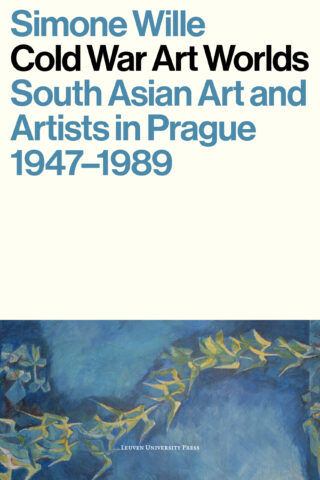

Cold War Art Worlds
South Asian Art and Artists in Prague, 1947-1989
Simone Wille (Author),

Category: Art, Asian Studies, History, History 1800-present
Language: English
ISBN: 9789462704701
Publication date: November 5, 2025
€49.50 (including 6% VAT)
Buy NowNumber of pages: 320
Size: 234 x 156 x 15 mm
Number of illustrations: 121
Illustrations and other content description:
Illustrated, 40 pages in colour

Funded by: KU Leuven Fund for Fair Open Access
FWF - Der Wissenschaftsfonds
Open Book Collective
Stock item: 168590
Standard delivery time for print books:
For Belgium: 5 to 8 working days
For EU: 2 to 3 weeks
For other countries: 4 to 5 weeks
Category: Art, Asian Studies, History, History 1800-present
Language: English
ISBN: 9789461666635
Publication date: November 5, 2025
Download Free EpubNumber of pages: 320
Number of illustrations: 121
Illustrations and other content description:
Illustrated, 40 pages in colour
Funded by: KU Leuven Fund for Fair Open Access
FWF - Der Wissenschaftsfonds
Open Book Collective
Category: Art, Asian Studies, History, History 1800-present
Language: English
ISBN: 9789461666628
Publication date: November 5, 2025
Download Free PDFNumber of pages: 320
Number of illustrations: 121
Illustrations and other content description:
Illustrated, 40 pages in colour
Funded by: KU Leuven Fund for Fair Open Access
FWF - Der Wissenschaftsfonds
Open Book Collective
Prague as a vital Cold War hub for South Asian artists.
During the Cold War, the Central-European capital city Prague, along with other previously less noticed locations in the polarised post-war world, emerged as a key site where an art world of particular importance for artists from South Asia developed. By emphasising cultural mobility as a catalyst for exchange and network building, this book challenges and complicates assumptions about Cold War binaries of East and West and the polarisation between so-called totalitarian regimes and free cultures. Positioning Prague as a nexus where South-Asian modernisms intersected with multiple peoples, histories, and ideologies in the post-World War II era, it offers a narrative of decolonisation that rejected rigid systemic alignment in favour of participation across blocs by prioritising migratory aesthetics over nationalist parochialism. Well-researched and rich in archival materials, this book proposes new ways of writing art histories and makes a significant contribution to both Cold War studies and critical global modernism studies.
Erratum: p. 79 figure 21: © Bildrecht, Wien 2025
Notes on Image Titles and Reproductions
Acknowledgements
Chapter 1. Introduction
1.1 Cold War Art Worlds: South Asian Art and Artists in Prague, 1947–1989
1.2 The Formation of Art Worlds and Artistic Careers through Mobility
1.3 Cold War Art Worlds
1.4 Prague: Co-creating Alternative Art Worlds
1.5 Looking Towards India
1.6 Activating Art History through the Archives
1.7 The Mobility of South Asian Artists and Cold War Art Worlds
Chapter 2. A Pakistani Artist in Prague
2.1 Visualising Transformation at a Crossroads in History
2.2 Shakir Ali: Ideological Affiliations of Artist and Traveller
2.3 Decolonisation and Sites of Production
2.4 Codes of Affiliation
Chapter 3. Exhibiting and Collecting South Asian Art in Prague and Lidice
3.1 Indian Art Exhibitions in Czechoslovakia and an Indian Art Collection in Prague
3.1.1 Mobility across Waters and Divides
3.1.2 Exhibiting India as a Collaborative Effort
3.1.3 Fostering “Indicki-Czech[oslovak] Bhai-Bhai”
3.1.4 Appreciation from the Margins
3.1.5 Mobility across a “Curtain of Lace”
3.1.6 Establishing a Collection of Modern Indian Art in Prague
3.1.7 Curatorial Efforts to Foster Friendship
3.1.8 The 1979 Indian Art Exhibition: Modernist Art at Home in Prague
3.2 A Solidarity Collection in Lidice
3.3 Exhibiting and Collecting South Asian Art in Socialist Central Europe
Chapter 4. Individual Journeys to Prague
4.1 Ram Kumar (1924–2018): Voyaging into Communism
4.1.1 “Displaced Things”: Stranded between Locations
4.1.2 Two-Person Exhibitions
4.2 Maqbool Fida Husain’s Prague Connection: Mobility and Art Worlds
4.2.1 The Perception of the Margin
4.2.2 A Strong Connection with Prague: Intersecting and Co-creating Place
4.2.3 Capturing Prague as a Significant Place
Chapter 5. Chittaprosad’s Immobile Mobility
5.1 A Single Room with a Central Function
5.2 A Single Room as a Stage for a Puppet Theatre
5.3 Exhibiting in Prague
5.4 The Anatomy of a Film about the History and Life of an Artist
5.5 A Symbolic Personal Friendship
Chapter 6. Conclusion
6.1 Indian Art Students in Prague
6.2 Czechoslovak Engagement with India through the Camera Lens
6.2.1 Filmic Documentation about Cultural Exchange
6.2.2 Moderní indickí maliari (1967)
6.3 Final Remarks
Notes
Bibliography
Index
Simone Wille
Simone Wille, Institute of Art History, University of Innsbruck.
'This book brings in archives hitherto unexplored – primarily from central and eastern Europe – and nuances the personal histories and transnational footprints of key artists of postcolonial South Asia.' – Sanjukta Sunderason, University of Amsterdam
'This book examines an important yet under researched nexus of transnational and transcultural exchange, between South Asia and Czechoslovakia. Through painstaking archival research in multiple geographies, the author challenges existing narratives of postwar internationalism to bring to light a story about socialist internationalism that operates on multiple levels, from the diplomatic, to the personal, to the artistic.' – Ming Tiampo, Carleton University
Frequently Asked Questions
What is "Cold War Art Worlds" about?
Prague as a vital Cold War hub for South Asian artists.
During the Cold War, the Central-European capital city Prague, along with other previously less noticed locations in the polarised post-war world, emerged as a key site where an art world of particular importance for artists from South Asia developed. By emphasising cultural mobility as a catalyst for exchange and network building, this book challenges and complicates assumptions about Cold War binaries of East and West and the polarisation between so-called totalitarian regimes and free cultures. Positioning Prague as a nexus where South-Asian modernisms intersected with multiple peoples, histories, and ideologies in the post-World War II era, it offers a narrative of decolonisation that rejected rigid systemic alignment in favour of participation across blocs by prioritising migratory aesthetics over nationalist parochialism. Well-researched and rich in archival materials, this book proposes new ways of writing art histories and makes a significant contribution to both Cold War studies and critical global modernism studies.
Who wrote "Cold War Art Worlds"?
"Cold War Art Worlds" was written by Simone Wille.
Simone Wille, Institute of Art History, University of Innsbruck.
Is "Cold War Art Worlds" available Open Access?
Yes, "Cold War Art Worlds" is published Open Access. It is available under a BY license.
Who funded the publication of "Cold War Art Worlds"?
Publication of "Cold War Art Worlds" was funded by KU Leuven Fund for Fair Open Access
FWF - Der Wissenschaftsfonds
Open Book Collective
.
What is the Table of Contents for "Cold War Art Worlds"?
Erratum: p. 79 figure 21: © Bildrecht, Wien 2025
Notes on Image Titles and Reproductions
Acknowledgements
Chapter 1. Introduction
1.1 Cold War Art Worlds: South Asian Art and Artists in Prague, 1947–1989
1.2 The Formation of Art Worlds and Artistic Careers through Mobility
1.3 Cold War Art Worlds
1.4 Prague: Co-creating Alternative Art Worlds
1.5 Looking Towards India
1.6 Activating Art History through the Archives
1.7 The Mobility of South Asian Artists and Cold War Art Worlds
Chapter 2. A Pakistani Artist in Prague
2.1 Visualising Transformation at a Crossroads in History
2.2 Shakir Ali: Ideological Affiliations of Artist and Traveller
2.3 Decolonisation and Sites of Production
2.4 Codes of Affiliation
Chapter 3. Exhibiting and Collecting South Asian Art in Prague and Lidice
3.1 Indian Art Exhibitions in Czechoslovakia and an Indian Art Collection in Prague
3.1.1 Mobility across Waters and Divides
3.1.2 Exhibiting India as a Collaborative Effort
3.1.3 Fostering “Indicki-Czech[oslovak] Bhai-Bhai”
3.1.4 Appreciation from the Margins
3.1.5 Mobility across a “Curtain of Lace”
3.1.6 Establishing a Collection of Modern Indian Art in Prague
3.1.7 Curatorial Efforts to Foster Friendship
3.1.8 The 1979 Indian Art Exhibition: Modernist Art at Home in Prague
3.2 A Solidarity Collection in Lidice
3.3 Exhibiting and Collecting South Asian Art in Socialist Central Europe
Chapter 4. Individual Journeys to Prague
4.1 Ram Kumar (1924–2018): Voyaging into Communism
4.1.1 “Displaced Things”: Stranded between Locations
4.1.2 Two-Person Exhibitions
4.2 Maqbool Fida Husain’s Prague Connection: Mobility and Art Worlds
4.2.1 The Perception of the Margin
4.2.2 A Strong Connection with Prague: Intersecting and Co-creating Place
4.2.3 Capturing Prague as a Significant Place
Chapter 5. Chittaprosad’s Immobile Mobility
5.1 A Single Room with a Central Function
5.2 A Single Room as a Stage for a Puppet Theatre
5.3 Exhibiting in Prague
5.4 The Anatomy of a Film about the History and Life of an Artist
5.5 A Symbolic Personal Friendship
Chapter 6. Conclusion
6.1 Indian Art Students in Prague
6.2 Czechoslovak Engagement with India through the Camera Lens
6.2.1 Filmic Documentation about Cultural Exchange
6.2.2 Moderní indickí maliari (1967)
6.3 Final Remarks
Notes
Bibliography
Index
What is the DOI for "Cold War Art Worlds"?
The Digital Object Identifier (DOI) for "Cold War Art Worlds" is 10.11116/9789461666635.
Related titles
 Margarete Schütte-Lihotzky and the Architecture of Collective Dissidence, 1918–1989
S.E. Eisterer (Author),
April 2027
 Collective Trauma and Future Fantasies
Raika Khorshidian (Editor), Birgit Mersmann (Editor), Cathrine Bublatzky (Editor), Julia Stenzel (Editor),
November 2026
 Toekomstdromen
Maarten Van Dijck (Editor), Gerrit Verhoeven (Editor), Hans Cools (Editor),
November 2026
 Feminists Resisting Gendered Violence
Hemangini Gupta (Editor), Fiona Mackay (Editor), Jan Breckenridge (Editor), Louise Chappell (Editor), Rachna Mehra (Editor), Rukmini Sen (Editor), Mailin Suchting (Editor),
October 2026
 A City in Practice
Aude Tournaye (Editor), Filip De Boeck (Editor), Picha Collective (Editor),
September 2026
 Ecologies of Photography in the American West
Monica Bravo (Editor), Carolin Görgen (Editor),
September 2026
 German–Rapanui Entanglements
Cristián Moreno Pakarati (Editor), Diego Muñoz (Editor), Philipp Schorch (Editor),
August 2026
 Trend en toeval – vierde editie
Bruno Blondé (Author), Isabelle Devos (Author), Jord Hanus (Author), Wouter Ryckbosch (Author),
August 2026
 Cinema in Post-War Belgium
Gertjan Willems (Editor), Bjorn Gabriels (Editor), Bénédicte Rochet (Editor),
May 2026
 Performing Magnetism
Eleonora Paklons (Editor), Kristof Smeyers (Editor), Kurt Vanhoutte (Editor), Hannah Welslau (Editor),
May 2026
 Christian Democracy and the Fall of Communism
Michael Gehler (Editor), Piotr H. Kosicki (Editor), Helmut Wohnout (Editor),
April 2026
 Political Exile in the Global Twentieth Century
Wolfram Kaiser (Editor), Piotr H. Kosicki (Editor),
April 2026
 Jean Katambayi Mukendi
Johannes Muselaers (Editor), Stéphane Symons (Editor), Anne-Claire Schmitz (Editor), Emma Enderby (Editor),
April 2026