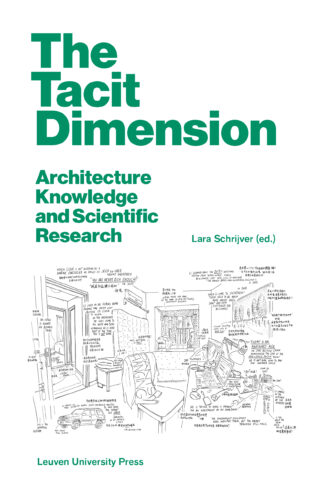

The Tacit Dimension
Architecture Knowledge and Scientific Research
Lara Schrijver (Editor),

Category: Architecture and Urban Planning
Language: English
ISBN: 9789462702714
Publication date: May 10, 2021
€17.00 (including 6% VAT)
Buy NowNumber of pages: 130
Size: 216 x 140 x 7 mm

Funded by: KU Leuven
Stock item: 141876
Standard delivery time for print books:
For Belgium: 5 to 8 working days
For EU: 2 to 3 weeks
For other countries: 4 to 5 weeks
Category: Architecture and Urban Planning
Language: English
ISBN: 9789461663818
Publication date: May 19, 2021
Download Free EpubNumber of pages: 130
Funded by: KU Leuven
Category: Architecture and Urban Planning
Language: English
ISBN: 9789461663801
Publication date: May 3, 2021
Download Free PDFNumber of pages: 130
Funded by: KU Leuven
Understanding the multitude of knowledges that constitute architectural thinking, designing and making
In architecture, tacit knowledge plays a substantial role in both the design process and its reception. The essays in this book explore the tacit dimension of architecture in its aesthetic, material, cultural, design-based, and reflexive understanding of what we build. Tacit knowledge, described in 1966 by Michael Polanyi as what we ‘can know but cannot tell’, often denotes knowledge that escapes quantifiable dimensions of research. Much of architecture’s knowledge resides beneath the surface, in nonverbal instruments such as drawings and models that articulate the spatial imagination of the design process.
Awareness of the tacit dimension helps to understand the many facets of the spaces we inhabit, from the ideas of the architect to the more hidden assumptions of our cultures. Beginning in the studio, where students are guided into becoming architects, the book follows a path through the tacit knowledge present in materials, conceptual structures, and the design process, revealing how the tacit dimension leads to craftsmanship and the situated knowledge of architecture-in-the-world.
Contributors: Tom Avermaete (ETH Zürich), Margitta
Buchert (Leibniz-Universität Hannover), Christoph Grafe (Bergische Universität
Wuppertal), Mari Lending (The Oslo School of Architecture and Design), Angelika
Schnell (Academy of Fine Arts Vienna), Eireen Schreurs (Delft University of
Technology), Lara Schrijver (University of Antwerp)
Ebook available in Open Access.
This publication is GPRC-labeled (Guaranteed Peer-Reviewed Content).
Introduction: Tacit Knowledge, Architecture and its Underpinnings
Lara Schrijver
Performative Design Research: En-acting Knowledge in Teaching
Angelika Schnell
Teaching Architecture Full Scale
Mari Lending
Transformative Dialogues: On Material Knowing in Architecture
Eireen Schreurs
A Black Box? Architecture and its Epistemes
Tom Avermaete
Design Knowledges on the Move
Margitta Buchert
A Silent Master: Artistry and Craft in the Work of Peter Celsing
Christoph Grafe
Material Knowledge and Cultural Values
Lara Schrijver
“In my twenty years of peer-reviewing book manuscripts for potential publication, this one has been the most fascinating for me. In fact, I did not put it down. Thank you for inviting me to peer-review it.” Igea Troiani, University of Plymouth
Frequently Asked Questions
What is "The Tacit Dimension" about?
Understanding the multitude of knowledges that constitute architectural thinking, designing and making
In architecture, tacit knowledge plays a substantial role in both the design process and its reception. The essays in this book explore the tacit dimension of architecture in its aesthetic, material, cultural, design-based, and reflexive understanding of what we build. Tacit knowledge, described in 1966 by Michael Polanyi as what we ‘can know but cannot tell’, often denotes knowledge that escapes quantifiable dimensions of research. Much of architecture’s knowledge resides beneath the surface, in nonverbal instruments such as drawings and models that articulate the spatial imagination of the design process.
Awareness of the tacit dimension helps to understand the many facets of the spaces we inhabit, from the ideas of the architect to the more hidden assumptions of our cultures. Beginning in the studio, where students are guided into becoming architects, the book follows a path through the tacit knowledge present in materials, conceptual structures, and the design process, revealing how the tacit dimension leads to craftsmanship and the situated knowledge of architecture-in-the-world.
Contributors: Tom Avermaete (ETH Zürich), Margitta
Buchert (Leibniz-Universität Hannover), Christoph Grafe (Bergische Universität
Wuppertal), Mari Lending (The Oslo School of Architecture and Design), Angelika
Schnell (Academy of Fine Arts Vienna), Eireen Schreurs (Delft University of
Technology), Lara Schrijver (University of Antwerp)
Ebook available in Open Access.
This publication is GPRC-labeled (Guaranteed Peer-Reviewed Content).
Who edited "The Tacit Dimension"?
"The Tacit Dimension" was edited by Lara Schrijver.
Lara Schrijver is professor of architecture theory at the University of Antwerp, Faculty of Design Sciences.
Is "The Tacit Dimension" available Open Access?
Yes, "The Tacit Dimension" is published Open Access. It is available under a BY-NC-ND license.
Who funded the publication of "The Tacit Dimension"?
Publication of "The Tacit Dimension" was funded by KU Leuven
.
What is the Table of Contents for "The Tacit Dimension"?
Introduction: Tacit Knowledge, Architecture and its Underpinnings
Lara Schrijver
Performative Design Research: En-acting Knowledge in Teaching
Angelika Schnell
Teaching Architecture Full Scale
Mari Lending
Transformative Dialogues: On Material Knowing in Architecture
Eireen Schreurs
A Black Box? Architecture and its Epistemes
Tom Avermaete
Design Knowledges on the Move
Margitta Buchert
A Silent Master: Artistry and Craft in the Work of Peter Celsing
Christoph Grafe
Material Knowledge and Cultural Values
Lara Schrijver
What is the DOI for "The Tacit Dimension"?
The Digital Object Identifier (DOI) for "The Tacit Dimension" is 10.11116/9789461663801.
Related titles
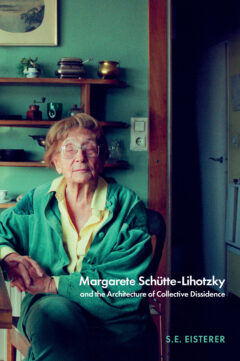 Margarete Schütte-Lihotzky and the Architecture of Collective Dissidence, 1918–1989
S.E. Eisterer (Author),
April 2027
 Infrastructuring Arrival
Karel Arnaut (Editor), Luce Beeckmans (Editor), Bruno Meeus (Editor),
November 2026

 Cartographies of Catastrophes
Laura Demeter (Editor), Carmen M. Enss (Editor), Piotr Kisiel (Editor), Carol Ludwig (Editor),
February 2026
 Architecture & Feminist Critical Theory
Hilde Heynen (Author), Lucía C. Pérez-Moreno (Editor),
November 2025

 Integration Otherwise Inspiration Kit
Luce Beeckmans (Author), Dounia Salamé (Author), Martina Bovo (Author), Mary Hogan (Author),
June 2025
 Bronnengids Interieurontwerp België, 1945-2000
Benoît Vandevoort (Editor), Sam Vanhee (Editor), Fredie Floré (Editor), Els De Vos (Editor), Tine Poot (Editor),
April 2025
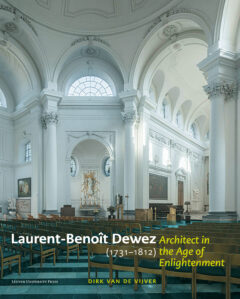 Laurent-Benoît Dewez (1731–1812), Architect in the Age of Enlightenment
Dirk Van de Vijver (Author),
February 2025
 Between Conventional and Experimental
Regine Hess (Editor), Inbal Ben-Asher Gitler (Editor), Tzafrir Fainholtz (Editor), Yael Allweil (Editor),
December 2024
 Architectures of Resistance
Angeliki Sioli (Editor), Nishat Awan (Editor), Kristopher Palagi (Editor),
August 2024