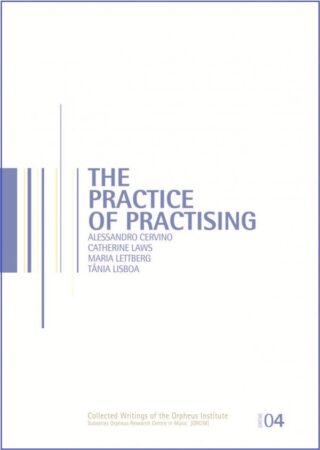
The process of practising is intrinsic to musical creativity. Practising may primarily be thought of as technical, but it is often also musically meaningful, including elements of interpretation, improvisation, and/or composition. The practice room can be a space in which to explore a field of creative possibilities; a place to experiment and to refine ideas. To date, the literature on practice has been primarily pedagogical and psychological. Little attention is paid to the significance of practice, and especially to the role of embodied experience – of understanding gained through doing – in the forming of musical ideas. The Practice of Practising is primarily concerned with considering practising as a practice in itself: a collection of processes that determines musical creativity and significance. The volume comprises four diverse case studies, in relation to music by J. S. Bach, Elliott Carter, Alfred Schnittke, and Morton Feldman, presenting both solo and ensemble perspectives.
Contents
Preface by Catherine Laws and Tânia Lisboa
I. A self-study of learning the Prelude from Bach’s Suite No. 6 for cello solo: Comparing words and actions
– Tânia Lisboa, Roger Chaffin, Topher Logan
Prologue
Effective practice
The investigation
Stages and cycles in learning the prelude
Relating practice and reports
Comparing practice and comments
Stage 1: exploration
Stages 2 and 3: smoothing out and listening
Stage 4: re-working technique
Stage 5: preparation for performance
Connecting theory and practice
Coda
References
Acknowledgements
II. Performer’s harmony: towards a performance of Elliott Carter’s Piano Sonata
– Alessandro Cervino
Preliminary remarks
Getting started
The process
The practice of practising: a tool for knowing
Afterword
References
III. Morton Feldman’s Late Piano Music: Experimentalism in Practice
– Catherine Laws
Memory and subjectivity in Feldman’s late music
The problem of interpretation
Palais de Mari and the contingencies of performance
Practice as an experimental process
References
IV. Alfred Schnittke’s Piano Trio: Learning and Performing
– Maria Lettberg
Introduction
Preparation for rehearsals and recording
Achieving affinity
Conclusions
References
Personalia
Frequently Asked Questions
What is "The Practice of the Practising" about?
The process of practising is intrinsic to musical creativity. Practising may primarily be thought of as technical, but it is often also musically meaningful, including elements of interpretation, improvisation, and/or composition. The practice room can be a space in which to explore a field of creative possibilities; a place to experiment and to refine ideas. To date, the literature on practice has been primarily pedagogical and psychological. Little attention is paid to the significance of practice, and especially to the role of embodied experience - of understanding gained through doing - in the forming of musical ideas. The Practice of Practising is primarily concerned with considering practising as a practice in itself: a collection of processes that determines musical creativity and significance. The volume comprises four diverse case studies, in relation to music by J. S. Bach, Elliott Carter, Alfred Schnittke, and Morton Feldman, presenting both solo and ensemble perspectives.
Who wrote "The Practice of the Practising"?
"The Practice of the Practising" was written by Alessandro Cervino, Maria Lettberg and Tânia Lisboa.
Alessandro Cervino is Junior Researcher at the Orpheus Research Centre in Music (ORCiM), Assistant Professor and Researcher at the Lemmensinstituut of Leuven, and Affiliated Researcher at Katholieke Universiteit Leuven.
Maria Lettberg is Junior Researcher at the Orpheus Research Centre in Music (ORCiM).
Tânia Lisboa is Senior Researcher at the Orpheus Research Centre in Music (ORCiM) and a Research Fellow at the Royal College of Music.
Who edited "The Practice of the Practising"?
"The Practice of the Practising" was edited by Catherine Laws.
Catherine Laws is a pianist, reader in Music at the University of York, and senior artistic research fellow at the Orpheus Institute.
Is "The Practice of the Practising" part of a series?
Yes, "The Practice of the Practising" is part of the "Orpheus Research Centre in Music" series. It's book 4 in the series.

Editorial Board Officer
William Brooks
Editorial Board
William Brooks, Kathleen Coessens, Paulo de Assis, Darla Crispin, Catherine Laws, Heike Vermeire (copy editing)
What is the Table of Contents for "The Practice of the Practising"?
Contents
Preface by Catherine Laws and Tânia Lisboa
I. A self-study of learning the Prelude from Bach's Suite No. 6 for cello solo: Comparing words and actions
- Tânia Lisboa, Roger Chaffin, Topher Logan
Prologue
Effective practice
The investigation
Stages and cycles in learning the prelude
Relating practice and reports
Comparing practice and comments
Stage 1: exploration
Stages 2 and 3: smoothing out and listening
Stage 4: re-working technique
Stage 5: preparation for performance
Connecting theory and practice
Coda
References
Acknowledgements
II. Performer's harmony: towards a performance of Elliott Carter's Piano Sonata
- Alessandro Cervino
Preliminary remarks
Getting started
The process
The practice of practising: a tool for knowing
Afterword
References
III. Morton Feldman's Late Piano Music: Experimentalism in Practice
- Catherine Laws
Memory and subjectivity in Feldman's late music
The problem of interpretation
Palais de Mari and the contingencies of performance
Practice as an experimental process
References
IV. Alfred Schnittke's Piano Trio: Learning and Performing
- Maria Lettberg
Introduction
Preparation for rehearsals and recording
Achieving affinity
Conclusions
References
Personalia
What is the DOI for "The Practice of the Practising"?
The Digital Object Identifier (DOI) for "The Practice of the Practising" is 10.11116/9789461661234.
Related titles
 The Book of Requiems, 1815–1900
John Koslovsky (Editor), Steven Vande Moortele (Editor),
December 2026
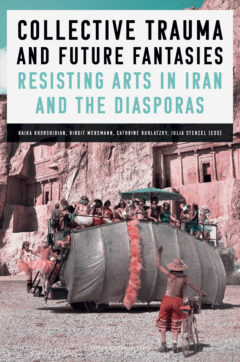 Collective Trauma and Future Fantasies
Raika Khorshidian (Editor), Birgit Mersmann (Editor), Cathrine Bublatzky (Editor), Julia Stenzel (Editor),
November 2026

 Violence and Trauma in Contemporary Performance
Sofie de Smet (Editor), Marieke Breyne (Editor), Pedzisai Maedza (Editor), Christel Stalpaert (Editor),
May 2025
 Music Theory and Analysis Volume 12 Issue 1, 2025 (Journal Subscription)
John Koslovsky (Editor), Markus Neuwirth (Editor), Derek Remeš (Editor),
May 2025