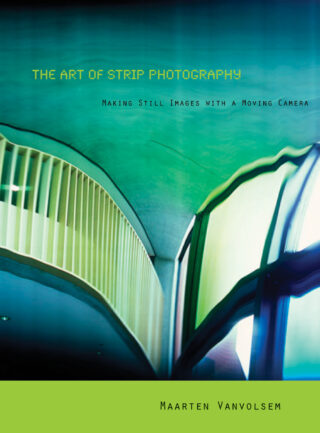
The Art of Strip Photography
Making still Images with a Moving Camera
Maarten Vanvolsem (Author),
Series: Lieven Gevaert Series 11
Category: Art, Media and Visual Culture, Photography
Language: English
ISBN: 9789058678409
Publication date: May 4, 2011
€34.50 (including 6% VAT)
Buy NowNumber of pages: 212
Size: 230 x 170 x 15 mm

Stock item: 62561
Standard delivery time for print books:
For Belgium: 5 to 8 working days
For EU: 2 to 3 weeks
For other countries: 4 to 5 weeks
Photographic images can, apart from their capacity to show, convey an experience, a quality that has seldom been recognized. In this book the artist and photographer Maarten Vanvolsem explains how the strip technique can tell a different story of time and space in photographic images, a story that leads to new expressions and experiences of time and movement. The strip technique itself seems to be neglected in the debate on time and photography, although it has a long history. Its use is widespread and, especially in recent years, more and more artists rediscover the technique. Based on an historical overview, a knowledge and understanding of the technique, and experiments with the building of cameras, this book will propose a new use of this forgotten art: a use in which the temporal terms ‘speed’, ‘rhythm’, and ‘pace’ are of more value than terms so often associated with photography such as ‘freeze’, ‘split second’, or ‘capture’. Within the book one can find more than thirty artists using the strip technique for their artistic practice. A lot of the artwork produced goes beyond traditional photography and the standards set by the photo industry. The research also reveals the extent to which artists use the technique to rediscover the time-based possibilities of the photographic image.
This publication is GPRC-labeled (Guaranteed Peer-Reviewed Content).
Introduction
1. Strip Photography and its Historical Context: A Camera Mechanism (Invention and Re-invention)
1.1 Panorama Photography
1.2 Photogrammetry
1.3 Peripheral Photography
1.4 The Photo Finish
1.5 Other Fields of Use
2. The Strip Technique
2.1 Shutter Technique
2.2 Film Movement
2.3 Exposure
3. Photographers Working with the Strip Technique
3.1 Photo Finish on Halfway Course
3.2 Boosting the Knowledge of the Strip Technique
3.3 The Panorama Image as a Time Span
3.4 Creative Use of the Strip Exposure
3.5 A Moving Camera
3.6 Stereo Strip Photography
3.7 Great Britain as Breeding Ground
3.8 Video Technology and Strip Images
4. Experiencing Time in a Still Image
4.1 Forgotten Possibilities of Photography and its Technique
The Dominance of the Snapshot
Perspective and the Renaissance Doctrine (Perspective and Unity of Space and Time)
Theory and Technology
Strip Images Complicate the Picture
De Duve’s Space-time Construction
4.2 Reading a Non-still Image
“Reading” the Image
The Image: A Score of Time
Perspective
Rhythm
Sharpness
Music Score
5. Moving the Camera Towards Another Expression
5.1 Shift in Artists’ Use of the Strip Technique
Non-scientific Use of the Strip Technique
Aesthetic Use of the Strip Technique
Meta-photographic Use of the Technique
5.2 Moving the Camera: Solving the Paradox in Dance Photography
The Paradox in Dance Photography
Silent Move
5.3 The Intrinsic Time of a Work of Art
Color Images
List of Images
Notes
Bibliography
Striptechniek, fotografie, performance
Dirk Reynders bespreekt The Art of Strip Photography van Maarten Vanvolsem.
FAKtor, januari 2012
Frequently Asked Questions
What is "The Art of Strip Photography" about?
Photographic images can, apart from their capacity to show, convey an experience, a quality that has seldom been recognized. In this book the artist and photographer Maarten Vanvolsem explains how the strip technique can tell a different story of time and space in photographic images, a story that leads to new expressions and experiences of time and movement. The strip technique itself seems to be neglected in the debate on time and photography, although it has a long history. Its use is widespread and, especially in recent years, more and more artists rediscover the technique. Based on an historical overview, a knowledge and understanding of the technique, and experiments with the building of cameras, this book will propose a new use of this forgotten art: a use in which the temporal terms ‘speed', ‘rhythm', and ‘pace' are of more value than terms so often associated with photography such as ‘freeze', ‘split second', or ‘capture'. Within the book one can find more than thirty artists using the strip technique for their artistic practice. A lot of the artwork produced goes beyond traditional photography and the standards set by the photo industry. The research also reveals the extent to which artists use the technique to rediscover the time-based possibilities of the photographic image.
This publication is GPRC-labeled (Guaranteed Peer-Reviewed Content).
Who wrote "The Art of Strip Photography"?
"The Art of Strip Photography" was written by Maarten Vanvolsem.
Maarten Vanvolsem is Lecturer and MA course leader for photography at Sint-Lukas Brussels, University College of Art and Design and Research Fellow of 'The Lieven Gevaert Research Centre for Photography, Art and Visual Culture' at KU Leuven.
Is "The Art of Strip Photography" part of a series?
Yes, "The Art of Strip Photography" is part of the "Lieven Gevaert Series" series. It's book 11 in the series.

The series covers four types of publications:
- outstanding monographic studies
- multi-authored volumes on a specific topic
- book length projects with artists
- translations and/or reprints of classic texts.
All books are published in English and are written for an international audience of scholars.
Format
All books in the series are published in 17*23 cm paperback with French flaps, printed in black and white on white maco paper and with a maximum page extent of 300 pages (120.000 words) including images (unless agreed otherwise).
Authors interested in publishing their book in Open Access can check out the funding options here. Open access books are published under a creative commons license.
Series editors
Hilde Van Gelder, KU Leuven
Alexander Streitberger, UCLouvain
Proposals
Proposals and enquiries can be sent to the series editors.
Please make use of the submission form to present the full manuscript to our board.
Authors interested in Open Access can consult the available funding options.
Links & Resources
What is the Table of Contents for "The Art of Strip Photography"?
Introduction
1. Strip Photography and its Historical Context: A Camera Mechanism (Invention and Re-invention)
1.1 Panorama Photography
1.2 Photogrammetry
1.3 Peripheral Photography
1.4 The Photo Finish
1.5 Other Fields of Use
2. The Strip Technique
2.1 Shutter Technique
2.2 Film Movement
2.3 Exposure
3. Photographers Working with the Strip Technique
3.1 Photo Finish on Halfway Course
3.2 Boosting the Knowledge of the Strip Technique
3.3 The Panorama Image as a Time Span
3.4 Creative Use of the Strip Exposure
3.5 A Moving Camera
3.6 Stereo Strip Photography
3.7 Great Britain as Breeding Ground
3.8 Video Technology and Strip Images
4. Experiencing Time in a Still Image
4.1 Forgotten Possibilities of Photography and its Technique
The Dominance of the Snapshot
Perspective and the Renaissance Doctrine (Perspective and Unity of Space and Time)
Theory and Technology
Strip Images Complicate the Picture
De Duve's Space-time Construction
4.2 Reading a Non-still Image
"Reading" the Image
The Image: A Score of Time
Perspective
Rhythm
Sharpness
Music Score
5. Moving the Camera Towards Another Expression
5.1 Shift in Artists' Use of the Strip Technique
Non-scientific Use of the Strip Technique
Aesthetic Use of the Strip Technique
Meta-photographic Use of the Technique
5.2 Moving the Camera: Solving the Paradox in Dance Photography
The Paradox in Dance Photography
Silent Move
5.3 The Intrinsic Time of a Work of Art
Color Images
List of Images
Notes
Bibliography
Related titles

 Collective Trauma and Future Fantasies
Raika Khorshidian (Editor), Birgit Mersmann (Editor), Cathrine Bublatzky (Editor), Julia Stenzel (Editor),
November 2026


 Feminists Resisting Gendered Violence
Hemangini Gupta (Editor), Fiona Mackay (Editor), Jan Breckenridge (Editor), Louise Chappell (Editor), Rachna Mehra (Editor), Rukmini Sen (Editor), Mailin Suchting (Editor),
October 2026

 A City in Practice
Aude Tournaye (Editor), Filip De Boeck (Editor), Picha Collective (Editor),
September 2026
 Ecologies of Photography in the American West
Monica Bravo (Editor), Carolin Görgen (Editor),
September 2026
 Cinema in Post-War Belgium
Gertjan Willems (Editor), Bjorn Gabriels (Editor), Bénédicte Rochet (Editor),
May 2026
 Performing Magnetism
Eleonora Paklons (Editor), Kristof Smeyers (Editor), Kurt Vanhoutte (Editor), Hannah Welslau (Editor),
May 2026
 Jean Katambayi Mukendi
Johannes Muselaers (Editor), Stéphane Symons (Editor), Anne-Claire Schmitz (Editor), Emma Enderby (Editor),
April 2026
 Nomadic Camera
Burcu Dogramaci (Editor), Winfried Gerling (Editor), Jens Jäger (Editor), Birgit Mersmann (Editor),
March 2026
 Comics and the Global South
Andrea Aramburú (Editor), Dibyadyuti Roy (Editor), Joe Sutliff Sanders (Editor),
February 2026


 Entangled Art Histories
Valérie Mavridorakis (Editor), Alexander Streitberger (Editor), Hilde Van Gelder (Editor), Erik Verhagen (Editor),
October 2025
 The Visionary Art of Franco-Belgian Comics, 1930s to 1960s
Hugo Frey (Editor), Maaheen Ahmed (Editor),
September 2025

 Violence and Trauma in Contemporary Performance
Sofie de Smet (Editor), Marieke Breyne (Editor), Pedzisai Maedza (Editor), Christel Stalpaert (Editor),
May 2025